Rubus odoratus
| Rubus odoratus | |
|---|---|
 | |
| Purple-flowering raspberry cultivated in Denmark | |
Scientific classification  | |
| Kingdom: | Plantae |
| Clade: | Embryophytes |
| Clade: | Tracheophytes |
| Clade: | Angiosperms |
| Clade: | Eudicots |
| Clade: | Rosids |
| Order: | Rosales |
| Family: | Rosaceae |
| Genus: | Rubus |
| Subgenus: | Rubus subg. Anoplobatus |
| Species: | R. odoratus |
| Binomial name | |
| Rubus odoratus | |
| Synonyms[1] | |
|
Synonymy
| |
Rubus odoratus, the purple-flowered raspberry,[2][3] flowering raspberry,[3] or Virginia raspberry, is a species of Rubus native to eastern North America. It is sometimes referred to as thimbleberry,[4][5][6] a name more commonly associated with the North American R. parviflorus.
Description
[edit]Rubus odoratus is a shrub growing to 3 metres (10 ft) tall,[2] with perennial, not biennial, stems (unlike many other species in the genus). Also, unlike most related species, this plant does not have thorns.[7] The leaves are palmately lobed with five (rarely three or seven) lobes, up to 25 centimetres (10 in) across, superficially resembling maple leaves.[7]
The flowers are 3–5 cm (1–2 in) in diameter,[2] with five magenta or occasionally white petals; they are produced from early summer to early fall.[7] Maturing in late summer to early autumn, the red edible fruit resembles a large, flat raspberry[7][8] with 30–60 drupelets,[9] and feels rather fuzzy.
 Leaves
 Flower buds
 Flowers
 Fruits
 Seeds
Seeds


Distribution and habitat
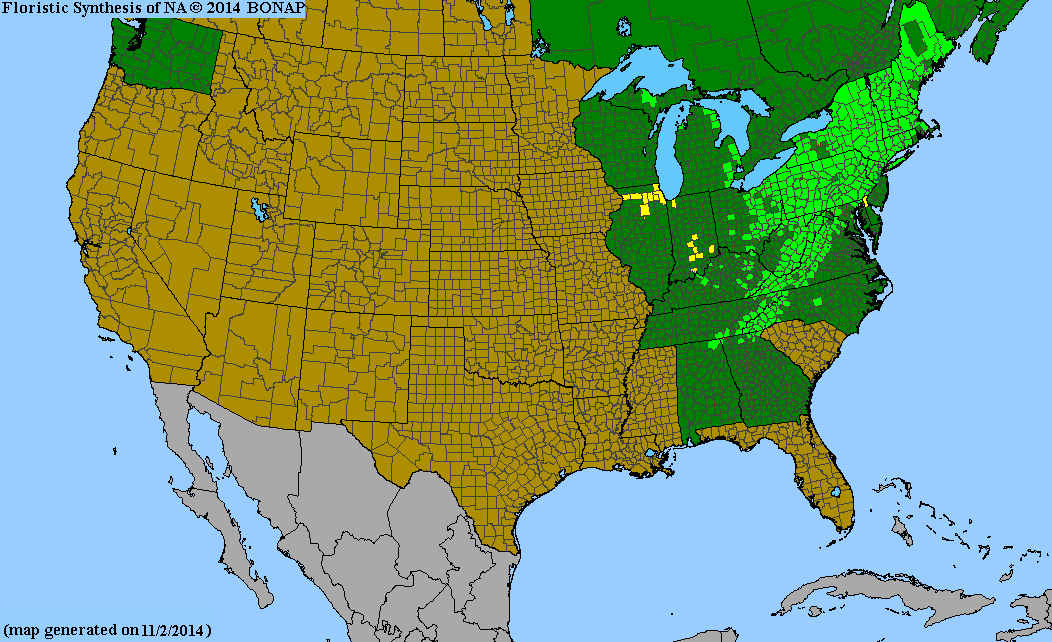
[edit]The species is native to eastern North America, from Nova Scotia west to Ontario and Wisconsin, and south along the Appalachian Mountains as far as Georgia and Alabama.[3][10] It is locally naturalized in parts of Washington state,[11] Vermont, and also in Europe, notably southeastern England.[2]
It prefers partial shade,[8] moisture,[9] and rich, slightly acidic soil.
Uses
[edit]Rubus odoratus is grown as an ornamental plant[2] for its conspicuous flowers and long flowering period.
References
[edit]- ↑ The Plant List, Rubus odoratus L.
- 1 2 3 4 5 Stace, Clive. van der Meijden, Ruud; de Kort, Ingrid (eds.). "Flora of NW Europe > Species: Rubus odoratus (Raspberry, purple-flowered)". Etibioinformatics.nl. Archived from the original on 2013-11-11. Retrieved 2026-06-15.
- 1 2 3 "Rubus odoratus". Germplasm Resources Information Network. Agricultural Research Service, United States Department of Agriculture. Retrieved 12 January 2018.
- ↑ "Rubus odoratus — flowering raspberry". Native Plant Trust.
- ↑ "Rubus odoratus | flowering raspberry". RHS.
- ↑ "Rubus odoratus". Plant Database. University of Texas.
- 1 2 3 4 "Rubus odoratus". Wildflowers of the Southeastern United States. 2001-07-20. Archived from the original on 2007-09-27.
- 1 2 3 Blanchan, Neltje; Dickinson, Asa Don (1917). Wild Flowers Worth Knowing. Project Gutenberg Literary Archive Foundation.
- 1 2 3 "Rubus odoratus in Flora of North America". eFloras.org. Retrieved 2026-06-15.
- ↑ "Biota of North America Program 2014 county distribution map".
- ↑ "Rubus odoratus". USDA Plants Profile.
External links
[edit] Media related to Rubus odoratus at Wikimedia Commons
- "Rubus odoratus". Plants for a Future.