


Portal:United Kingdom

_Wikivoyage_Banner.JPG)
The United Kingdom Portal
.svg) |
 |

| |
The United Kingdom of Great Britain and Northern Ireland, commonly known as the United Kingdom (UK) or Britain, is a country in northwestern Europe, off the coast of the continental mainland. It comprises England, Scotland, Wales and Northern Ireland, with a population of over 69 million in 2024. The UK includes the island of Great Britain, the north-eastern part of the island of Ireland, and most of the smaller islands within the British Isles, covering 94,354 square miles (244,376 km2). It shares a land border with the Republic of Ireland and is surrounded by the Atlantic Ocean, the North Sea, the English Channel, the Celtic Sea and the Irish Sea, while maintaining sovereignty over the Crown Dependencies and the British Overseas Territories. The capital and largest city of England and the UK is London; Edinburgh, Cardiff and Belfast are the national capitals of Scotland, Wales and Northern Ireland, respectively.
The British Isles have been continuously inhabited since the Neolithic. In AD 43 the Roman conquest of Britain began. The Roman departure between 383 and 410 was followed by Anglo-Saxon settlement beginning around 450. In 1066 the Normans conquered England. Over the 17th century the role of the British monarchy was reduced, particularly as a result of the English Civil War. In 1707 the Kingdom of England and the Kingdom of Scotland united under the Treaty of Union to create the Kingdom of Great Britain. The Acts of Union 1800 incorporated the Kingdom of Ireland to create the United Kingdom of Great Britain and Ireland in 1801. Most of Ireland seceded from the UK in 1922 as the Irish Free State, and the Royal and Parliamentary Titles Act 1927 created the present United Kingdom.
The UK became the first industrialised country and was the world's foremost power for the majority of the 19th and early 20th centuries, particularly during the Pax Britannica between 1815 and 1914. The British Empire was the leading economic power for most of the 19th century, a position supported by its agricultural prosperity, its role as a dominant trading nation, a massive industrial capacity, significant technological achievements, and the rise of 19th-century London as the world's principal financial centre. At its height in the 1920s, the empire encompassed around a quarter of the world's landmass and population, and was the largest in history. However, its involvement in the First World War and in the Second World War damaged Britain's economic power, and a global wave of decolonisation led to the independence of most British colonies. (Full article...)
Featured article

The Hellingly Hospital Railway was a light railway owned and operated by East Sussex County Council, used to deliver coal and passengers to Hellingly Hospital, a psychiatric hospital near Hailsham, via a spur from the London, Brighton and South Coast Railway’s Cuckoo Line at Hellingly railway station. The railway was constructed in 1899 and opened to passengers on 20 July 1903, following its electrification in 1902. After the railway grouping of 1923, passenger numbers declined so significantly that the hospital authorities no longer considered passenger usage of the line to be economical, and the service was withdrawn. The railway closed to freight in 1959, following the hospital's decision to convert its coal boilers to oil, which rendered the railway unnecessary. The route took a mostly direct path from a junction immediately south of Hellingly Station to Hellingly Hospital, past sidings known as Farm Siding and Park House Siding respectively, used as stopping places to load and unload produce and supplies from outbuildings of the hospital. Much of the railway has since been converted to footpath, and many of the buildings formerly served by the line are now abandoned. (Full article...)
Featured biography

Robert Falcon Scott (1868–1912) was a Royal Navy officer and explorer who led two expeditions to the Antarctic regions: the Discovery Expedition, 1901–04, and the ill-fated Terra Nova Expedition, 1910–13. During this second venture, Scott led a party of five which reached the South Pole on 17 January 1912, only to find that they had been preceded by Roald Amundsen's Norwegian expedition. On their return journey, Scott and his four comrades all perished from a combination of exhaustion, starvation and extreme cold. Following the news of his death, Scott became an iconic British hero, a status maintained for more than 50 years and reflected by the many permanent memorials erected across the nation. In the closing decades of the 20th century, however, in a more sceptical age, the legend was reassessed as attention focused on the causes of the disaster and the extent of Scott's personal culpability. From a previously unassailable position, Scott became a figure of controversy, with questions raised about his competence and character. Commentators in the 21st century have on the whole regarded Scott more positively, emphasising his personal bravery and stoicism while acknowledging his errors, but ascribing his expedition's fate primarily to misfortune. (Full article...)
General images -
-
 The wizard Merlin features as a character in many works of fiction, including the BBC series Merlin. (from Culture of the United Kingdom)
 -
 Trooping the Colour is an annual ceremony, most notably associated with the British Army, and involves a grand parade featuring hundreds of soldiers, horses, and musicians. (from Culture of the United Kingdom)
 -
 Featherweight champion "Prince" Naseem Hamed was a major name in boxing and 1990s British pop culture. (from Culture of the United Kingdom)
 -
 Queen Victoria's Christmas tree at Windsor Castle, published in the Illustrated London News, 1848 (from Culture of the United Kingdom)
 -
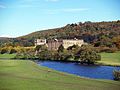 One of the UK's many stately homes, Chatsworth House in Derbyshire, surrounded by an English garden. The house is one of the settings of Jane Austen's novel Pride and Prejudice. (from Culture of the United Kingdom)
 -
 Ice dancers Torvill and Dean in 2011. Their historic gold medal-winning performance at the 1984 Winter Olympics was watched by a British television audience of more than 24 million people. (from Culture of the United Kingdom)
 -
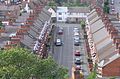 Terraced houses are typical in inner cities and places of high population density. (from Culture of the United Kingdom)
 -
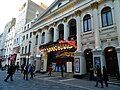 Music hall evolved into variety shows. First performed in 1912, the Royal Variety Performance was first held at the London Palladium (pictured) in 1941. Performed in front of members of the Royal Family, it is held annually in December and broadcast on television. (from Culture of the United Kingdom)
 -
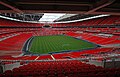 Wembley Stadium, London, home of the England football team and FA Cup finals. Wembley also hosts concerts: Adele's 28 June 2017 concert was attended by 98,000 fans, a stadium record for a music event in the UK. (from Culture of the United Kingdom)
 -
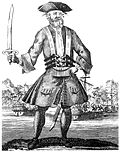 Engraving of the English pirate Blackbeard from the 1724 book A General History of the Pyrates. The book is the prime source for many famous pirates of the Golden Age. (from Culture of the United Kingdom)
 -
 Stonehenge, Wiltshire at sunset (from Culture of the United Kingdom)
 -
 The first colour photograph in 1861. Produced by the three-colour method suggested by James Clerk Maxwell in 1855, it is the foundation of all colour photographic processes. (from Culture of the United Kingdom)
 -
 Statue of Minnie the Minx, a character from The Beano, in Dundee, Scotland. Launched in 1938, The Beano is known for its anarchic humour, with Dennis the Menace appearing on the cover. (from Culture of the United Kingdom)
 -
 King Alfred the Great statue in Winchester, Hampshire. The 9th-century English king encouraged education in his kingdom, and proposed that primary education be taught in English, with those wishing to advance to holy orders to continue their studies in Latin. (from Culture of the United Kingdom)
 -

-
 Charles Darwin established that all species of life have descended over time from common ancestors. (from Culture of the United Kingdom)
 -
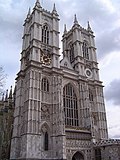 Westminster Abbey is an example of English Gothic architecture. Since 1066, when William the Conqueror was crowned, the coronations of British monarchs have been held here. (from Culture of the United Kingdom)
 -
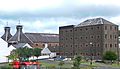 Old Bushmills Distillery, County Antrim, Northern Ireland. Founded in 1608, it is the oldest licensed whiskey distillery in the world. (from Culture of the United Kingdom)
 -
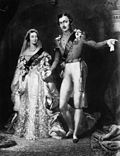 Queen Victoria in her white wedding dress with Prince Albert on their return from the marriage service at St James's Palace, London, 10 February 1840 (from Culture of the United Kingdom)
 -
 The full breakfast is among the best known British dishes, consisting of fried egg, sausage, bacon, mushrooms, baked beans, toast, fried tomatoes, and sometimes white or black pudding. (from Culture of the United Kingdom)
 -
 R. White's soft drinks sold in London. Selling carbonated lemonade in 1845, by 1887 they sold strawberry soda, raspberry soda and cherryade. (from Culture of the United Kingdom)
 -
 Peter O'Toole as T. E. Lawrence in David Lean's 1962 epic Lawrence of Arabia (from Culture of the United Kingdom)
 -
 The Beatles are the most commercially successful and critically acclaimed band in popular music, with estimated sales of over one billion.
 -
 The British Heart Foundation is the biggest funder of cardiovascular research in the UK. (from Culture of the United Kingdom)
 -
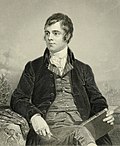 Robert Burns is regarded as the national poet of Scotland.
 -
 McVitie's chocolate digestive is routinely ranked the UK's favourite snack, and No. 1 biscuit to dunk in tea. (from Culture of the United Kingdom)
 -
 Josiah Wedgwood was a leading entrepreneur in the Industrial Revolution. (from Culture of the United Kingdom)
 -
 Scouts, Brownies, and Cubs with the local community in Tiverton, Devon on Remembrance Sunday (from Culture of the United Kingdom)
 -

-
 Yard, foot and inch measurements at the Royal Observatory, London. The British public commonly measure distance in miles and yards, height in feet and inches, weight in stone and pounds, speed in miles per hour. (from Culture of the United Kingdom)
 -
 English novelist Jane Austen was held by literary critic Harold Bloom to be one of the greatest Western writers of all time. (from Culture of the United Kingdom)
 -
 The Notting Hill Carnival is Britain's biggest street festival. Led by members of the British African-Caribbean community, the annual carnival takes place in August and lasts three days. (from Culture of the United Kingdom)
 -
 Physicist Stephen Hawking set forth a theory of cosmology explained by a union of the general theory of relativity and quantum mechanics. His 1988 book A Brief History of Time appeared on The Sunday Times best-seller list for a record-breaking 237 weeks. (from Culture of the United Kingdom)
 -
 Welsh native Roald Dahl is frequently ranked the best children's author in British polls.
 -
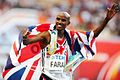 Mo Farah is the most successful British track athlete in modern Olympic Games history, winning the 5000 m and 10,000 m events at two Olympic Games. (from Culture of the United Kingdom)
 -
 The Proms are held annually at the Royal Albert Hall during the summer. Regular performers at the Albert Hall include Eric Clapton who has played at the venue over 200 times. (from Culture of the United Kingdom)
 -
 A Christmas dinner plate in Scotland, featuring roast turkey, roast potatoes, mashed potatoes and brussels sprouts (from Culture of the United Kingdom)
 -
 Tea, biscuits, jam and cakes. Tea is the most popular beverage in the UK. (from Culture of the United Kingdom)
 -
 Titanic Belfast museum on the former shipyard in Belfast where the RMS Titanic was built (from Culture of the United Kingdom)
 -

-
 Sunday league football (a form of amateur football). Amateur matches throughout the UK often take place in public parks. (from Culture of the United Kingdom)
 -
 The Oxford Union debate chamber. Called the "world's most prestigious debating society", the Oxford Union has hosted leaders and celebrities. (from Culture of the United Kingdom)
 -
 Two of the current Ravens of the Tower of London. The ravens' presence is traditionally believed to protect the Crown and the tower; a superstition holds that "if the Tower of London ravens are lost or fly away, the Crown will fall and Britain with it". (from Culture of the United Kingdom)
 -
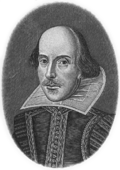 William Shakespeare has had a significant impact on British theatre and drama. (from Culture of the United Kingdom)
 -
 Cricketer W. G. Grace, with his long beard and MCC cap, was the most famous British sportsman in the Victorian era. (from Culture of the United Kingdom)
 -
 Bodiam Castle is a 14th-century moated castle in East Sussex. Today there are thousands of castles throughout the UK. (from Culture of the United Kingdom)
 -
 Union Flag being flown on The Mall, London looking towards Buckingham Palace (from Culture of the United Kingdom)
 -
 The red telephone box and Royal Mail red post box appear throughout the UK. (from Culture of the United Kingdom)
 -
 Highland dancing in traditional Gaelic dress with its tartan pattern (from Culture of the United Kingdom)
 -
 Smeaton's Eddystone Lighthouse, 9 miles out to sea. John Smeaton pioneered hydraulic lime in concrete which led to the development of Portland cement in England and thus modern concrete. (from Culture of the United Kingdom)


_zoom.jpg)


_Moscow_2013.jpg)


.jpg)

.jpg)


Subportals


WikiProjects
Things you can do
- Visit the British Wikipedians' notice board.
- The noticeboard is the central forum for information and discussion on editing related to the United Kingdom.
- Comment at the British deletion sorting page.
- This page lists deletion discussions on topics relating to the United Kingdom.
Featured pictures
-
 Photograph: ColinSt Matthew's Church in Paisley, Scotland, is an Art Nouveau church built between 1905 and 1907. The architect, WD McLennan, designed the building and many interior furnishings, including the organ case, font and pulpit. This view of the interior is from the rear gallery and features the stained glass window by Robert Anning Bell.
 -
 Photograph: Lt. J. W. BrookeWorld War I was a global war originating in Europe that lasted from 28 July 1914 to 11 November 1918. More than 70 million military personnel participated, making it one of the largest wars in history. An estimated nine million combatants and seven million civilians died as a direct result of the war with losses exacerbated by technological developments and the tactical stalemate caused by trench warfare (pictured). The war is also considered a contributory factor in a number of genocides and the 1918 influenza epidemic, which caused between 50 and 100 million deaths worldwide. Unresolved rivalries at the end of the conflict contributed to the outbreak of World War II about twenty years later.
 -
 Photo: Stefan KrauseLoch Torridon is a sea loch on the west coast of Scotland in the Northwest Highlands. The 15 mile- (25 km-) long body of water is home to several islets and a prominent prawn and shellfish fishery.
 -
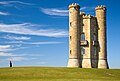 Broadway Tower is a folly located near the village of Broadway, Worcestershire, England, at one of the highest points of the Cotswolds. Its base is 1,024 feet (312 m) above sea level, the tower itself standing 55 feet (17 m) tall. On a clear day, thirteen counties of England can be seen from its top.
 -
 Photograph: Christoph BraunA 'K6' model red telephone box outside of St Paul's Cathedral in London. These kiosks for a public telephone were designed by Sir Giles Gilbert Scott and painted "currant red" for easy visibility. Although such telephone boxes ceased production when the KX series was introduced in 1985, they remain a common sight in Britain and some of its colonies, and are considered a British cultural icon.
 -
 Photo credit: DiliffA stitched image of the Radcliffe Camera in Oxford, England, as seen from the tower of the Church of St Mary the Virgin. The building, often abbreviated as 'Rad Cam', was built by James Gibbs in 1737–1749 to house the Radcliffe Science Library. After the Radcliffe Science Library moved into another building, the Radcliffe Camera became a reading room of the Bodleian Library.
 -
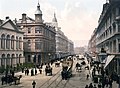 Image: Detroit Publishing Co.; Restoration: Lise BroerA photochrom print of Royal Avenue in Belfast, Northern Ireland, from the 1890s. In the 19th century, Belfast became Ireland's pre-eminent industrial city, and saw an influx of immigration, made up of mostly Catholics into a predominantly Protestant city. Sectarian tensions remained high throughout the years, with no major incidents having taken place since 1998's Belfast Agreement.
 -
Photo credit: Lt. J. W. BrookeA Cheshire Regiment sentry in a trench near La Boisselle during the Battle of the Somme. The battle is best remembered for its first day, 1 July 1916, on which the British Army suffered 57,470 casualties, including 19,240 dead. With more than one million casualties over five months, it was one of the bloodiest battles in human history. The Allied forces attempted to break through the German lines along a 25-mile (40 km) front north and south of the River Somme.
-
 Image credit: Alfred BryanGilbert and Sullivan created fourteen comic operas, including H.M.S. Pinafore, The Pirates of Penzance, and The Mikado, many of which are still frequently performed today. However, events around their 1889 collaboration, The Gondoliers, led to an argument and a lawsuit dividing the two. In 1891, after many failed attempts at reconciliation by the pair and their producer, Richard D'Oyly Carte, Gilbert and Sullivan's music publisher, Tom Chappell, stepped in to mediate between two of his most profitable artists, and within two weeks he had succeeded. This cartoon in The Entr'acte expresses the magazine's pleasure at the reuniting of D'Oyly Carte (left), Gilbert (centre), and Sullivan (right).
 -
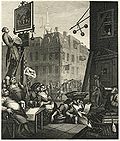 Image credit: William HogarthBeer Street and Gin Lane are a pair of 1751 engravings by William Hogarth in support of the then-proposed Gin Act 1751. This Act of Parliament made the distillation of gin illegal in England. Beer Street shows a happy city drinking the "good" beverage of English beer, whereas Gin Lane claims to show what would happen if people started drinking gin, a harder liquor. People are shown as healthy, happy and hardworking in Beer Street, while in Gin Lane they are scrawny, lazy and acting carelessly, including a drunk mother accidentally sending her baby tumbling to its doom.
 -
 Painting: John Michael Wright or studioCharles II of England (1630–1685) was king of England, Scotland and Ireland. He was king of Scotland from 1649 from his father's execution until being deposed by Oliver Cromwell in 1651, and king of England, Scotland and Ireland from the restoration of the monarchy in 1660 until his death. Internationally, Charles became involved in the Second and Third Anglo-Dutch Wars. Domestically, Charles attempted to introduce religious freedom for Catholics and Protestant dissenters with his 1672 Royal Declaration of Indulgence, but the English Parliament forced him to withdraw it.
 -
 Photo credit: NASALondon by night.
London is the capital of the United Kingdom and of England. The city of Londinium was founded by the Romans on the north bank of the River Thames in around 50 AD. By the 18th century London was the biggest city in the world. It was the most populous city in the world from 1825 until 1925, when it was overtaken by New York City. -
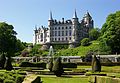 Photo: Jack SpellingbaconA view of Dunrobin Castle, Sutherland, Highland, Scotland, from the castle's gardens. A castle was first built on the site in 1401, but most of the current building was designed in 1845 by Sir Charles Barry. Barry, also responsible for the Palace of Westminster, turned the castle into a Scots Baronial-style home.
 -
![Image 14 George IV Artist: Sir Thomas Lawrence An oil on canvas portrait of George IV of the United Kingdom as the Prince Regent, by Sir Thomas Lawrence. In 1814, Lord Stewart, who had been appointed ambassador in Vienna and was a previous client of Thomas Lawrence, wanted to commission a portrait by him of the Prince Regent. He arranged that Lawrence should be presented to the Prince Regent at a levée. Soon after, the Prince visited Lawrence at his studio in Russell Square. Lawrence wrote to his brother that: To crown this honour, [he] engag'd to sit to me at one today and after a successful sitting of two hours, has just left me and comes again tomorrow and the next day. More featured pictures](https://upload.wikimedia.org/wikipedia/commons/thumb/9/9f/George_IV_bust1.jpg/120px-George_IV_bust1.jpg) Artist: Sir Thomas LawrenceAn oil on canvas portrait of George IV of the United Kingdom as the Prince Regent, by Sir Thomas Lawrence. In 1814, Lord Stewart, who had been appointed ambassador in Vienna and was a previous client of Thomas Lawrence, wanted to commission a portrait by him of the Prince Regent. He arranged that Lawrence should be presented to the Prince Regent at a levée. Soon after, the Prince visited Lawrence at his studio in Russell Square. Lawrence wrote to his brother that: To crown this honour, [he] engag'd to sit to me at one today and after a successful sitting of two hours, has just left me and comes again tomorrow and the next day.
Artist: Sir Thomas LawrenceAn oil on canvas portrait of George IV of the United Kingdom as the Prince Regent, by Sir Thomas Lawrence. In 1814, Lord Stewart, who had been appointed ambassador in Vienna and was a previous client of Thomas Lawrence, wanted to commission a portrait by him of the Prince Regent. He arranged that Lawrence should be presented to the Prince Regent at a levée. Soon after, the Prince visited Lawrence at his studio in Russell Square. Lawrence wrote to his brother that: To crown this honour, [he] engag'd to sit to me at one today and after a successful sitting of two hours, has just left me and comes again tomorrow and the next day. -
 Photo credit: Chalmers ButterfieldShaftesbury Avenue from Piccadilly Circus, in the West End of London, c. 1949. The Circus, a famous traffic intersection and public space in the City of Westminster was built in 1819 to connect Regent Street with the major shopping street of Piccadilly. Its status as a major traffic intersection has made it a busy meeting point and a tourist attraction in its own right.


.jpg)
![Image 14 George IV Artist: Sir Thomas Lawrence An oil on canvas portrait of George IV of the United Kingdom as the Prince Regent, by Sir Thomas Lawrence. In 1814, Lord Stewart, who had been appointed ambassador in Vienna and was a previous client of Thomas Lawrence, wanted to commission a portrait by him of the Prince Regent. He arranged that Lawrence should be presented to the Prince Regent at a levée. Soon after, the Prince visited Lawrence at his studio in Russell Square. Lawrence wrote to his brother that: To crown this honour, [he] engag'd to sit to me at one today and after a successful sitting of two hours, has just left me and comes again tomorrow and the next day. More featured pictures](/restyle/wiki/File:George_IV_bust1.jpg)

Did you know -

- ... that before Fred Thomas became an MP, he was the Royal Marines' light heavyweight boxing champion?
- ... that Scottish politician Tam Dalyell opposed devolution, warning it would become a "motorway without exit to a separate state"?
- ... that Graham Fraser pioneered cochlear implantation in the United Kingdom?
- ... that Southern Water was fined £90 million for deliberately dumping sewage into the sea?
- ... that Thelma Adams protested milk quotas in the United Kingdom by sitting in a bathtub of milk, while dressed as Cleopatra?
- ... that by losing her constituency of South West Norfolk in 2024, Liz Truss became the first former UK prime minister since 1935 to lose their seat?
In the news

- 21 July 2026 – Middle Eastern crisis
- A tanker is attacked by Iran in the coast of Oman near the Strait of Hormuz in the wake of the U.S. military conducting strikes for a 10th consecutive night yesterday, forcing crew to abandon ship. The United Kingdom Maritime Trade Operations also confirms the attack. (Military.com)
- 20 July 2026 – 2026 Labour Party leadership crisis
- Sir Keir Starmer resigns as Prime Minister of the United Kingdom, and is succeeded by Andy Burnham. (CNN) (The Guardian) (The Telegraph)
- 17 July 2026 – 2026 Labour Party leadership election
- Andy Burnham is elected as the new leader of the British Labour Party. He will formally succeed Keir Starmer as prime minister on Monday. (BBC News) (CNN) (The Guardian)
- 15 July 2026 – United Kingdom–European Union relations
- Effect of Brexit on Gibraltar
- The United Kingdom and the European Union remove the land-border fence between Gibraltar and Spain under a post-Brexit treaty, allowing free movement while introducing joint British-Spanish checks at Gibraltar's airport and port. (AP)
- 13 July 2026 – Iran–United Kingdom relations
- The United Kingdom announces that it will designate Iran's Islamic Revolutionary Guards Corps as a terrorist organization, and will ban support for the militia group. (The Guardian) (NBC News)
Categories

Other UK-connected Wikipedias
Wikimedia
The following Wikimedia Foundation sister projects provide more on this subject:
-
 Commons
Free media repository -
 Wikidata
Free knowledge base -
 Wikiquote
Collection of quotations -
 Wikisource
Free-content library -
 Wikiversity
Free learning tools -
 Wikivoyage
Free travel guide -
 Wiktionary
Dictionary and thesaurus


