


Pieri's formula
In mathematics, Pieri's formula, named after Mario Pieri, describes the product of a Schubert cycle by a special Schubert cycle in the Schubert calculus, or the product of a Schur polynomial by a complete symmetric function.
In terms of Schur functions sλ indexed by partitions λ, it states that
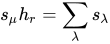
where hr is a complete homogeneous symmetric polynomial and the sum is over all partitions λ obtained from μ by adding r elements, no two in the same column. By applying the ω involution on the ring of symmetric functions, one obtains the dual Pieri rule for multiplying an elementary symmetric polynomial with a Schur polynomial:
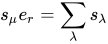
The sum is now taken over all partitions λ obtained from μ by adding r elements, no two in the same row.
Pieri's formula implies Giambelli's formula. The Littlewood–Richardson rule is a generalization of Pieri's formula
giving the product of any two Schur functions. Monk's formula is an analogue of Pieri's formula for flag manifolds.
References
[edit]- Macdonald, I. G. (1995), Symmetric functions and Hall polynomials, Oxford Mathematical Monographs (2nd ed.), The Clarendon Press Oxford University Press, ISBN 978-0-19-853489-1, MR 1354144
{{citation}}: CS1 maint: deprecated archival service (link) - Sottile, Frank (2001) [1994], "Schubert calculus", Encyclopedia of Mathematics, EMS Press