


Portal:Wine

The Wine Portal


Wine is an alcoholic beverage made from fermentation of grape juice. The natural chemical balance of grapes is such that they can ferment without the addition of sugars, acids, enzymes, or other nutrients. Although fruits other than grapes can also be fermented, the resultant wines are normally named after the fruit from which they are produced (for example, apple wine) and are known as fruit wine (or country wine). Others, such as barley wine and rice wine (e.g. sake), are made from starch-based materials and resemble beer more than wine; ginger wine is fortified with brandy. In these cases, the use of the term "wine" is a reference to the higher alcohol content, rather than the production process. The commercial use of the word "wine" (and its equivalent in other languages) is protected by law in many jurisdictions. Wine is produced by fermenting crushed grapes using various types of yeast which consume the sugars found in the grapes and convert them into alcohol. Various varieties of grapes and strains of yeasts are used depending on the types of wine produced.
Wine stems from an extended and rich history dating back about 8,000 years and is thought to have originated in present-day Georgia or Iran. Wine is thought to have appeared in Europe about 6,500 years ago in present-day Bulgaria and Greece and was very common in ancient Greece and Rome; the Greek god Dionysos, and his Roman counterpart Liber represented wine. Wine continues to play a role in religious ceremonies, such as Kiddush in Judaism and the Eucharist in Christianity. (Full article...)
Selected articles -
-
![Image 1 Tuscan Chianti in a traditional fiasco Italian wine (Italian: vino italiano) is produced in every region of Italy. Italy is the country with the widest variety of indigenous grapevine in the world, with an area of 702,000 hectares (1.73 million acres) under vineyard cultivation, as well as the world's largest wine producer and the largest exporter as of 2024[update]. Contributing 49.8 million hl of wine in 2022, Italy accounted for over 19.3% of global production, ahead of France (17.7%) and Spain (13.8%); the following year, production decreased by 11.5 million hl, and Italy was surpassed by France. Italian wine is also popular domestically among Italians, who consume a yearly average of 46.8 litres per capita, ranking third in world wine consumption. The origins of vine-growing and winemaking in Italy has been illuminated by recent research, stretching back even before the Phoenician, Etruscans and Greek settlers, who produced wine in Italy before the Romans planted their own vineyards. The Romans greatly increased Italy's viticultural area using efficient viticultural and winemaking methods. (Full article...)](https://upload.wikimedia.org/wikipedia/en/d/d2/Blank.png)

Tuscan Chianti in a traditional fiasco
Italian wine (Italian: vino italiano) is produced in every region of Italy. Italy is the country with the widest variety of indigenous grapevine in the world, with an area of 702,000 hectares (1.73 million acres) under vineyard cultivation, as well as the world's largest wine producer and the largest exporter as of 2024[update]. Contributing 49.8 million hl of wine in 2022, Italy accounted for over 19.3% of global production, ahead of France (17.7%) and Spain (13.8%); the following year, production decreased by 11.5 million hl, and Italy was surpassed by France. Italian wine is also popular domestically among Italians, who consume a yearly average of 46.8 litres per capita, ranking third in world wine consumption.
The origins of vine-growing and winemaking in Italy has been illuminated by recent research, stretching back even before the Phoenician, Etruscans and Greek settlers, who produced wine in Italy before the Romans planted their own vineyards. The Romans greatly increased Italy's viticultural area using efficient viticultural and winemaking methods. (Full article...) -
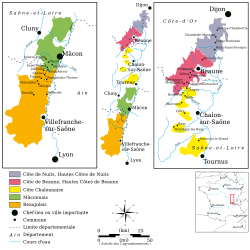
Burgundy wine (French: Bourgogne or vin de Bourgogne) is a wine made in the Burgundy region of east-central France, in the valleys and slopes west of the Saône, a tributary of the Rhône. The most famous wines produced here, and those commonly referred to as "Burgundies", are dry red wines made from pinot noir grapes and white wines made from chardonnay grapes.
Red and white wines are also made from other grape varieties, such as gamay and aligoté, respectively. Small amounts of rosé and sparkling wines are also produced in the region. Chardonnay-dominated Chablis and gamay-dominated Beaujolais are recognised as part of the Burgundy wine region, but wines from those subregions are usually referred to by their own names rather than as "Burgundy wines". (Full article...) -
Cabernet Franc is one of the major black grape varieties worldwide. It is principally grown for blending with Cabernet Sauvignon and Merlot in the Bordeaux style, but can also be vinified alone, as in the Loire's Chinon. In addition to being used in blends and produced as a varietal in Canada, Lake Erie AVA in Pennsylvania, and across the United States and Argentina, it is sometimes made into ice wine in those regions.
Cabernet Franc is lighter than Cabernet Sauvignon, making a bright pale red wine that contributes finesse and lends a peppery perfume to blends with more robust grapes. Depending on the growing region and style of wine, additional aromas can include tobacco, raspberry, bell pepper, cassis, and violets. (Full article...) -
Jean-Louis Vignes (April 9, 1780 - January 17, 1862), also known as Don Luis del Aliso, was a French-born Californian vintner and ranchero. He was one of the first commercial wine makers in California and one of the first men to import and plant European Vitis vinifera grapes in the state. A skilled cooper by trade and an adventurer and entrepreneur by choice, he arrived in the Sandwich Islands on July 6, 1827. After losing his business in Honolulu due to Queen Ka'ahumanu's edict banning alcohol production, he sailed to California and landed at Pueblo de Los Angeles in 1831. In 1850, Vignes was the largest wine producer in California. (Full article...)
-
Riesling (/ˈriːslɪŋ, ˈriːzlɪŋ/ REE-sling, REEZ-ling, German: [ˈʁiːslɪŋ] ⓘ) is a white grape variety that is believed to have originated from the Rhine Valley region of western Germany, before later being traced to the Alsace region by 1470 and Austria by 1700. Riesling is an aromatic grape variety displaying flowery, almost perfumed, aromas as well as high acidity. It is used to make dry, semi-sweet, sweet, and sparkling white wines. Riesling wines are usually varietally pure and are seldom oaked. As of 2004[update], Riesling was estimated to be the world's 20th most grown variety at 48,700 hectares (120,000 acres) (with an increasing trend), but in terms of importance for quality wines, it is usually included in the "top three" white wine varieties together with Chardonnay and Sauvignon blanc. Riesling is a variety that is highly "terroir-expressive", meaning that the character of Riesling wines is greatly influenced by the wine's place of origin.
In cooler regions, such as the Mosel in Germany, Riesling wines often display apple and tree fruit notes with pronounced acidity that is sometimes balanced by residual sugar. As a late-ripening variety, Riesling can develop citrus and peach notes in warmer areas such as the Palatinate, Alsace, and parts of[which?] Austria. In Australia, Riesling is often noted for a characteristic lime note that tends to emerge in examples from the Clare Valley and Eden Valley in South Australia. (Full article...) -

A cartoon from Punch from 1890: The phylloxera, a true gourmet, finds out the best vineyards and attaches itself to the best wines.
The Great French Wine Blight was a severe blight of the mid-19th century that destroyed many of the vineyards in France and laid waste to the wine industry. It was caused by an insect that originated in North America and was carried across the Atlantic in the late 1850s. The actual genus of the insect is still debated, although it is largely considered to have been a species of Daktulosphaira vitifoliae, commonly known as grape phylloxera. While France is considered to have been worst affected, the blight also did a great deal of damage to vineyards in other European countries.
How Phylloxera was introduced to Europe remains debated: American vines had been taken to Europe many times before, for reasons including experimentation and trials in grafting, without consideration of the possibility of the introduction of pestilence. While the Phylloxera was thought to have arrived around 1858, it was first recorded in France in 1863, in the former province of Languedoc. It is argued by some that the introduction of such pests as phylloxera was only a problem after the invention of steamships, which allowed a faster journey across the ocean, and consequently allowed pests such as the Phylloxera to survive the trip. (Full article...) -
Cabernet Sauvignon (French: [kabɛʁnɛ soviɲɔ̃]) is one of the world's most widely recognized red wine grape varieties. It is grown in nearly every major wine producing country among a diverse spectrum of climates from Australia and British Columbia, Canada to Lebanon's Beqaa Valley.
This grape variety appeared in France in the 17th century as a result of natural crossbreeding. Its popularity is often attributed to its ease of cultivation—the grapes have thick skins and the vines are hardy and naturally low yielding, budding late to avoid frost and resistant to viticulture hazards. (Full article...) -

Map of the Bordeaux regions with most of its appellations shown. The rivers Garonne and Dordogne, and the Gironde estuary are important in defining the various parts of the region.
Bordeaux wine (Occitan: vin de Bordèu; French: vin de Bordeaux) is produced in the Bordeaux region of southwest France, around the city of Bordeaux, on the Garonne River. To the north of the city, the Dordogne River joins the Garonne forming the broad estuary called the Gironde; the Gironde department, with a total vineyard area of 110,800 hectares, is the second largest wine-growing area in France behind the Languedoc-Rousillon.
Average vintages produce over 700 million bottles of wine, ranging from large quantities of daily table wine to some of the world's most expensive and prestigious wines. The vast majority of wine produced in Bordeaux is red (sometimes called "claret" in Britain), with sweet white wines (most notably Sauternes), dry whites, and (in much smaller quantities) rosé and sparkling wines (Crémant de Bordeaux) collectively making up the remainder. Bordeaux wine is made by more than 5,660 producers or châteaux. There are 65 appellations of Bordeaux wine. (Full article...) -

Jesus depicted transforming water into wine. Maerten de Vos, The Marriage at Cana, c. 1597, Cathedral of our Lady, Antwerp, Belgium.
Mention of alcoholic beverages appears in the Hebrew Bible, after Noah planted a vineyard and became inebriated. In the New Testament, Jesus miraculously made copious amounts of wine at the wedding at Cana (John 2). Wine is the most common alcoholic beverage mentioned in biblical literature, where it is a source of symbolism, and was an important part of daily life in biblical times. Additionally, the inhabitants of ancient Israel drank beer and wines made from fruits other than grapes, and references to these appear in scripture. However, the alcohol content of ancient alcoholic beverages was significantly lower than modern alcoholic beverages. The low alcohol content was due to the limitations of fermentation and the nonexistence of distillation methods in the ancient world. Rabbinic teachers wrote acceptance criteria on consumability of ancient alcoholic beverages after significant dilution with water, and prohibited undiluted wine.
In the early 19th century the temperance movement began. Evangelical Christians became prominent in this movement, and while previously almost all Christians had a much more relaxed attitude to alcohol, today many evangelical Christians abstain from alcohol. Bible verses would be interpreted in a way that encouraged abstinence, for example 1 Corinthians 10:21, which states, "You cannot drink the cup of the Lord and the cup of demons too..." (Full article...) -
Nebbiolo (/ˌnɛbiˈoʊloʊ/, Italian: [nebˈbjɔːlo]; Piedmontese: nebieul [neˈbjøl]) is an Italian red wine grape variety predominantly associated with its native Piedmont region, where it makes the Denominazione di Origine Controllata e Garantita (DOCG) wines of Barolo, Barbaresco, Gattinara, Ghemme, and Roero, together with numerous DOC wines. Nebbiolo is thought to derive its name from the Italian nebbia or Piedmontese nebia, meaning 'fog'. During harvest, which generally takes place late in October, a deep, intense fog sets into the Langhe region where many Nebbiolo vineyards are located. Alternative explanations refer to the fog-like glaucous veil that forms over the berries as they reach maturity, or that perhaps the name is derived instead from the Italian word nobile, meaning 'noble'. Nebbiolo produces lightly-colored red wines which can be highly tannic in youth with scents of tar and roses. As they age, the wines take on a characteristic brick-orange hue at the rim of the glass and mature to reveal other aromas and flavours such as violets, tar, wild herbs, cherries, raspberries, truffles, tobacco, and prunes. Nebbiolo wines can require years of ageing to balance the tannins with other characteristics. (Full article...) -
Sangiovese is a red Italian wine grape variety that derives its name from the Latin sanguis Jovis, "blood of Jupiter".
Sangiovese Grosso, used for traditionally powerful and slow maturing red wines, is primarily grown in the central regions of Italy, particularly in Tuscany, where it is the dominant grape variety. Here, Sangiovese thrives in various subregions, including Chianti, Montalcino, and Montepulciano,
whose diverse terroirs winemakers put to good use to craft wines that reflect the land's unique nuances. (Full article...) -

Map of Anjou wine region.
Anjou wine is produced in the Loire Valley wine region of France near the city of Angers. The wines of region are often grouped together with the wines of nearby Saumur as "Anjou-Saumur". Along with the wines produced further east in Touraine, Anjou-Saumur make what is collectively known as the "Middle Loire" (as opposed to the "Upper Loire" which includes the wine regions of Sancerre and Pouilly-Fumé). Within the Anjou wine region are several Appellation d'origine contrôlées (AOCs) responsible for a broad spectrum of wines including still red, white and rosé produced with varying levels of sweetness. Extending across the Deux-Sèvres, Maine-et-Loire and Vienne départements, the generic Anjou AOC appellation and its various sub-appellations encompasses vineyards across more than 151 communes.
Wine expert Tom Stevenson describes the wines of the area as being a "microcosm of the Loire Valley", featuring wines made from every grape variety and in almost every style produced in the entire Loire wine region. Among the wines of Anjou, Savennières is noted for its dry Chenin blanc wines and the Coteaux du Layon for its sweet dessert wines that includes the botrytized wines of Bonnezeaux and Quarts de Chaume. Various rosé wines are produced in the region under different AOC designation include Rosé d'Anjou, the most basic level made predominantly from Grolleau, and Cabernet d'Anjou which is usually made from Cabernet Franc or Cabernet Sauvignon. For most of its history, dry red wines have represented a small percentage of Anjou winemaking but in recent years the numbers have been steadily increasing—aided, in part, by the 1987 establishment of the Anjou-Villages AOC designation for red wines which can be made from only Cabernet Sauvignon and Cabernet Franc. The Gamay grape of the Beaujolais wine region has had a long history in the Anjou with its own Anjou-Gamay AOC. Grapes from around the region can go into basic Anjou blanc and Anjou Rouge AOC wines. (Full article...) -

Skin-contact wine before clarification and stabilization
Orange wine, also known as skin-contact white wine, skin-fermented white wine, or amber wine, is a type of wine made from white wine grapes where the grape skins are not removed but stay in contact with the juice for days or even months, as is more typical with red wines. This contrasts with conventional white wine production, which involves crushing the grapes and quickly moving the juice off the skins into the fermentation vessel. The skins contain color pigment, phenols and tannins that would normally be considered undesirable for white wines, while for red wines skin contact and maceration is a vital part of the winemaking process that gives red wine its color, flavor, and texture. Orange wines tend to be natural (a.k.a. minimal intervention) wines. The International Organisation of Vine and Wine describes orange/amber wine as "White wine with maceration" and prescribes the minimum duration of the maceration phase to be 1 month. (Full article...) -
Washington wine is a wine produced from grape varieties grown in the U.S. state of Washington. Washington ranks third in the United States in the production of wine, behind California and New York. By 2017, the state had over 55 thousand acres (220 square kilometres) of vineyards, a harvest of 229 thousand short tons (208 thousand tonnes) of grapes, and exports going to over 40 countries around the world from the 940+ wineries located in the state. While there are some viticultural activities in the cooler, wetter western half of the state, the majority (99.9%) of wine grape production takes place in the shrub-steppe eastern half. The rain shadow of the Cascade Range leaves the Columbia River Basin with around 8 inches (20 cm) of annual rain fall, making irrigation and water rights of paramount interest to the Washington wine industry. Viticulture in the state is also influenced by long sunlight hours (on average, two more hours a day than in California during the growing season) and consistent temperatures.
The early history of the Washington wine industry can be traced to the introduction of Cinsault grapes by Italian immigrants to the Walla Walla region. Grapes are not indigenous to the Columbia Valley viticultural area, but both Vinifera and Labruscavines are grown. The oldest planted Vinifera vines still in existence were planted by German immigrants in the Tampico vicinity, west of Union Gap, in 1871. Others were planted in the Kennewick area in 1895, and in the Walla Walla area by 1899. Planting of premium Vinifera grapes began in the Columbia Valley in the mid-1960s. By 1981 there were over 6,610 acres (2,675 ha) of Vinifera grapes including 2,700 acres (1,093 ha) of cultivated vineyards. In the 1950s and 1960s, the precursors of the state's biggest wineries (Chateau Ste. Michelle and Columbia Winery) were founded. Throughout the rest of the 20th century, the wine world discovered a new aspect of Washington wines with each passing decade – starting with Rieslings and Chardonnays in the 1970s, the Merlot craze of the 1980s and the emergence of Cabernet Sauvignon and Syrah in the 1990s. Washington has twenty federally defined American Viticultural Area (AVA)s with all but one located in Eastern Washington. The largest is the Columbia Valley AVA, which extends into a small portion of northern Oregon and encompasses most of the states's AVAs. They are Lewis-Clark Valley AVA, the Ancient Lakes AVA, Walla Walla Valley AVA, which encompasses Oregon's The Rocks District of Milton-Freewater AVA, Horse Heaven Hills AVA, the Wahluke Slope AVA, Lake Chelan AVA, Naches Heights AVA, and the Yakima Valley AVA, which in turn also encompasses the Rattlesnake Hills AVA, Snipes Mountain AVA, the Red Mountain AVA, Goose Gap AVA and the Candy Mountain AVA. The Columbia Gorge AVA is west of the Columbia Valley AVA. As of 2023, Washington's only AVA located west of the Cascades is the Puget Sound AVA and a petition has been submitted to Alcohol and Tobacco Tax and Trade Bureau (TTB) proposing a new American Viticultural Area named "Mount St. Helens" covering parts of Clark County, Cowlitz County, Skamania County and Lewis County. (Full article...) -
Tempranillo (also known as Ull de Llebre, Cencibel, Tinto Fino and Tinta del País in Spain, Aragonez or Tinta Roriz in Portugal, and several other synonyms elsewhere) is a black grape variety widely grown to make full-bodied red wines in its native Spain. Its name is the diminutive of the Spanish temprano ("early"), a reference to the fact that it ripens several weeks earlier than most Spanish red grapes. Tempranillo has been grown on the Iberian Peninsula since the time of Phoenician settlements. It is the main grape used in Rioja, and is often referred to as Spain's noble grape. The grape has been planted throughout the globe's wine regions.
In 2015, Tempranillo was the fourth most widely planted wine grape variety worldwide with 232,561 hectares (574,670 acres) under vine, of which 87% was in Spain where it is the most planted red grape variety. (Full article...)
![Image 1 Tuscan Chianti in a traditional fiasco Italian wine (Italian: vino italiano) is produced in every region of Italy. Italy is the country with the widest variety of indigenous grapevine in the world, with an area of 702,000 hectares (1.73 million acres) under vineyard cultivation, as well as the world's largest wine producer and the largest exporter as of 2024[update]. Contributing 49.8 million hl of wine in 2022, Italy accounted for over 19.3% of global production, ahead of France (17.7%) and Spain (13.8%); the following year, production decreased by 11.5 million hl, and Italy was surpassed by France. Italian wine is also popular domestically among Italians, who consume a yearly average of 46.8 litres per capita, ranking third in world wine consumption. The origins of vine-growing and winemaking in Italy has been illuminated by recent research, stretching back even before the Phoenician, Etruscans and Greek settlers, who produced wine in Italy before the Romans planted their own vineyards. The Romans greatly increased Italy's viticultural area using efficient viticultural and winemaking methods. (Full article...)](/restyle/wiki/File:Blank.png)


Did you know (auto-generated) -

- ... that Eminem promoted "Houdini" with a video in which David Blaine eats a wine glass?
- ... that Silver Iocovozzi, a Food & Wine Best New Chef, first dreamed of becoming an architect?
- ... that illustrator Abigail Larson once designed a wine-bottle label for the Edgar Allan Poe Museum?
- ... that a men's soccer team hired Jenna Winebrenner to analyze game film and practice with the squad?
- ... that the magazine Acoustic Guitar said that Dan Erlewine "might be the most famous guitar repairperson on earth"?
- ... that Herzog Wine Cellars produces approximately 250,000 cases of kosher wine annually?
- ... that both scholars and activists believe that diet culture is often intertwined with racism and other forms of prejudice?
- ... that a £142 wine fridge was smuggled into Downing Street on 11 December 2020, during the height of the COVID-19 lockdown in the United Kingdom?
Selected quote
| “ | A world without wine is a world without culture. | ” |
| — Shawn Grover [[1]] |
Related portals


Selected winery

Groot Constantia was established in 1684 by the VOC Governor of the Cape of Good Hope Simon van der Stel, and was used to produce wine as well as other fruit and vegetables and cattle farming. Following Van der Stel's death in 1712 the estate was broken up and sold in three parts.
In 1778 the portion of the estate surrounding Van der Stel's Cape Dutch-style manor house was sold to the Cloete family, who planted extensive vineyards and extended and improved the mansion by commissioning the architect Thibault. The house remained in the possession of the Cloete family until 1885, during which period the estate became famous for its production of Constantia dessert wine.
In 1885 Groot Constantia was purchased by the government of the Cape of Good Hope and was used as an experimental wine and agricultural estate. Following a disastrous fire in 1925 the house was extensively restored. In 1969 the manor house became part of the South African Cultural History Museum, and in 1993 the estate passed into the ownership of the Groot Constantia Trust. The exhibition in the house is managed by Museums of Cape Town, and is particularly focused on rural slavery and the life of slaves during the early Cape colonial period. (Full article...)
General images -
-
 Night harvest by hand of wine grapes in Napa, California (from Winemaking)
 -
 A cap of grape skins forms on the surface of fermenting red wine (from Winemaking)
 -
 Vineyards in Italy (from Winemaking)
 -
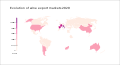 The world wine export 2020 shows the annual wine export production of various countries. (from Winemaking)
 -
 Monastic cellarer tasting wine as depicted in Li Livres dou Santé, a late 13th century French manuscript. (from History of wine)
 -
 Dionysus in a vineyard, depicted on an amphora from the late 6th century BC. (from History of wine)
 -
 Testing wine for sulphur dioxide level (from Winemaking)
 -
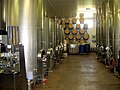 Stainless steel fermentation vessels and new oak barrels at the Three Choirs Vineyard, Gloucestershire, England (from Winemaking)
 -
 Harvested Cabernet Sauvignon grapes (from Winemaking)
 -
 Georgian Kvevri, a jar dated to the 6th millennium BC found at the Shulaveri site (Georgian National Museum). (from History of wine)
 -
 A Napa Valley vineyard on the side of a road (from Viticulture)
 -
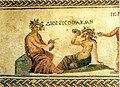 Hellenistic mosaics discovered close to the city of Paphos depicting Dionysos, god of wine (from History of wine)
 -
 Shipping wine in Roman Gaul: amphoras (top) were the traditional Mediterranean vessels, but the Gauls introduced the use of barrels. (from History of wine)
 -
 Entrance to the Areni-1 cave in southern Armenia near the town of Areni where a winery dated to c. 4100 BC was found in 2007. (from History of wine)
 -
 Antique wooden wine press in front of World Heritage vineyards (from Winemaking)
 -
 Central component of a mechanical destemming. Paddles above the small circular slots rotate to remove the larger chunks of stems. Grapes are pulled off the stems and fall through the holes. Some small amount of stem particles are usually desired to be kept with the grapes for tannin structure. (from Winemaking)
 -
 Wine grapes on Long Island (from Viticulture)
 -
 Wine grapes from the Guadalupe Valley in Ensenada, Baja California, Mexico (from Winemaking)
 -
 A mechanical destemming machine in use at Chateau Montelena winery in Napa Valley (from Winemaking)
 -
 The corkscrew-shaped feed auger sits on top of a mechanical crusher-destemmer. Grape clusters are fed into the machine, where they are first crushed, then destemmed. Stems exit at the end, while juice, skins, seeds, and some debris exit the bottom. (from Winemaking)
 -
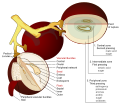 Anatomy of a grape, showing the components extracted from each pressing (from Winemaking)
 -
-
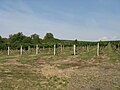
 Vineyard rows illustrating grape cultivation practices (from Viticulture)
 -

-

-
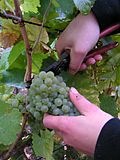 Manual grape gathering (from Viticulture)
 -
 A wine labelling machine with adhesive labels in France (from Winemaking)
 -
 Satyr working at a wine press of wicker-work mats (1st century AD relief). (from History of wine)
 -
 Crushed grapes leaving the crusher (from Winemaking)
 -
 In ancient times, berries were crushed by foot in a barrel or pit (from Winemaking)


.png)


Selected picture

Topics
Wines and winemaking | |||||||||||||||||||
|---|---|---|---|---|---|---|---|---|---|---|---|---|---|---|---|---|---|---|---|
| |||||||||||||||||||
List articles

Categories

Related WikiProjects
| Parent project: WikiProject Food and Drink | |
| Child projects: | Task forces: (All inactive) |
|
|
| Related projects: | |

Things you can do
 |
Here are some tasks you can do for WikiProject Wine:
|
Associated Wikimedia
The following Wikimedia Foundation sister projects provide more on this subject:
-
 Commons
Free media repository -
 Wikidata
Free knowledge base -
 Wikiquote
Collection of quotations -
 Wikisource
Free-content library -
 Wikispecies
Directory of species -
 Wikiversity
Free learning tools -
 Wikivoyage
Free travel guide -
 Wiktionary
Dictionary and thesaurus


