


Davenport constant
 | This article needs more citations. (May 2013) |
In mathematics, the Davenport constant is an invariant of a group studied in additive combinatorics, quantifying the size of nonunique factorizations. Given a finite abelian group , is defined as the smallest number such that every sequence of elements of that length contains a non-empty subsequence adding up to 0. In symbols, this is[1]



Example
[edit]- The Davenport constant for the cyclic group is . To see this, note that the sequence of a fixed generator, repeated times, contains no subsequence with sum 0. Thus . On the other hand, if is an arbitrary sequence, then two of the sums in the sequence are equal. The difference of these two sums also gives a subsequence with sum 0.[2]


Properties
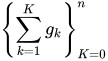
[edit]- Consider a finite abelian group , where the are invariant factors. Then The lower bound is proved by noting that the sequence consisting of copies of , copies of , etc., contains no subsequence with sum 0.[3]
- for p-groups or when is 1 or 2.
- for certain groups including all groups of the form and .
- There are infinitely many examples with at least 4 where does not equal ; it is not known whether there are any with .[3]
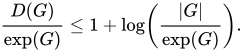
- Let be the exponent of . Then[4]





Applications
[edit]The original motivation for studying Davenport's constant was the problem of non-unique factorization in number fields. Let be the ring of integers in a number field, its class group. Then every element , which factors into at least non-trivial ideals, is properly divisible by an element of . This observation implies that Davenport's constant determines by how much the lengths of different factorization of some element in can differ.[5][citation needed]


The upper bound mentioned above plays an important role in Ahlford, Granville and Pomerance's proof of the existence of infinitely many Carmichael numbers.[4]
Variants
[edit]Olson's constant uses the same definition, but requires the elements of to be distinct.[6]


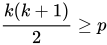
- Balandraud proved that equals the smallest such that .
- For we have On the other hand, if with , then Olson's constant equals the Davenport constant.[7]




References
[edit]- ↑ Geroldinger, Alfred (2009). "Additive group theory and non-unique factorizations". In Geroldinger, Alfred; Ruzsa, Imre Z. (eds.). Combinatorial number theory and additive group theory. Advanced Courses in Mathematics CRM Barcelona. Elsholtz, C.; Freiman, G.; Hamidoune, Y. O.; Hegyvári, N.; Károlyi, G.; Nathanson, M.; Sólymosi, J.; Stanchescu, Y. With a foreword by Javier Cilleruelo, Marc Noy and Oriol Serra (Coordinators of the DocCourse). Basel: Birkhäuser. pp. 1–86. doi:10.1007/978-3-7643-8962-8. ISBN 978-3-7643-8961-1. Zbl 1221.20045.
- ↑ Geroldinger 2009, p. 24.
- 1 2 Bhowmik, Gautami; Schlage-Puchta, Jan-Christoph (2007). "Davenport's constant for groups of the form " (PDF). In Granville, Andrew; Nathanson, Melvyn B.; Solymosi, József (eds.). Additive combinatorics. CRM Proceedings and Lecture Notes. Vol. 43. Providence, RI: American Mathematical Society. pp. 307–326. ISBN 978-0-8218-4351-2. Zbl 1173.11012.
- 1 2 W. R. Alford; Andrew Granville; Carl Pomerance (1994). "There are Infinitely Many Carmichael Numbers" (PDF). Annals of Mathematics. 139 (3): 703–722. doi:10.2307/2118576. JSTOR 2118576.
- ↑ Olson, John E. (1969-01-01). "A combinatorial problem on finite Abelian groups, I". Journal of Number Theory. 1 (1): 8–10. Bibcode:1969JNT.....1....8O. doi:10.1016/0022-314X(69)90021-3. ISSN 0022-314X.
- ↑ Nguyen, Hoi H.; Vu, Van H. (2012-01-01). "A characterization of incomplete sequences in vector spaces". Journal of Combinatorial Theory, Series A. 119 (1): 33–41. arXiv:1112.0754. doi:10.1016/j.jcta.2011.06.012. ISSN 0097-3165.
- ↑ Ordaz, Oscar; Philipp, Andreas; Santos, Irene; Schmidt, Wolfgang A. (2011). "On the Olson and the Strong Davenport constants" (PDF). Journal de Théorie des Nombres de Bordeaux. 23 (3): 715–750. doi:10.5802/jtnb.784. S2CID 36303975 – via NUMDAM.

- Nathanson, Melvyn B. (1996). Additive Number Theory: Inverse Problems and the Geometry of Sumsets. Graduate Texts in Mathematics. Vol. 165. Springer-Verlag. ISBN 978-0-387-94655-9. Zbl 0859.11003.
External links
[edit]- "Davenport constant", Encyclopedia of Mathematics, EMS Press, 2001 [1994]
- Hutzler, Nick. "Davenport Constant". MathWorld.