


900 (number)
| ||||
|---|---|---|---|---|
| Cardinal | nine hundred | |||
| Ordinal | 900th (nine hundredth) | |||
| Factorization | 22 × 32 × 52 | |||
| Divisors | 1, 2, 3, 4, 5, 6, 9, 10, 12, 15, 18, 20, 25, 30, 36, 45, 50, 60, 75, 90, 100, 150, 180, 225, 300, 450, 900 | |||
| Greek numeral | Ϡ´ | |||
| Roman numeral | CM, cm | |||
| Binary | 11100001002 | |||
| Ternary | 10201003 | |||
| Senary | 41006 | |||
| Octal | 16048 | |||
| Duodecimal | 63012 | |||
| Hexadecimal | 38416 | |||
| Armenian | Ջ | |||
| Hebrew | תת"ק / ץ | |||
| Babylonian cuneiform | 𒌋𒐙 | |||
| Egyptian hieroglyph | 𓍪 | |||
900 (nine hundred) is the natural number following 899 and preceding 901.
In mathematics
[edit]It is the square of 30 and the sum of Euler's totient function for the first 54 positive integers. In base 10, it is a Harshad number. It is also the first number to be the square of a sphenic number.
In other fields
[edit]900 is also:
- In Greek number symbols, the sign Sampi ("ϡ", literally "like a pi")
- A skateboarding trick in which the skateboarder spins two and a half times (360 degrees times 2.5 is 900)
- A 900 series refers to three consecutive perfect games in bowling[1]
- Yoda's age in Star Wars[2]
900s
[edit]901
[edit]901 = 17 × 53. It is a centered triangular number and a happy number.
902
[edit]902 = 2 × 11 × 41. It is a sphenic number, a nontotient, and a Harshad number.
903
[edit]903 = 3 × 7 × 43. It is a sphenic number, a little Schroeder number, a Schröder–Hipparchus number, a zero of Mertens function, and the 42nd triangular number.[3]
904
[edit]904 = 23 × 113. It is a refactorable number, a lazy caterer number, and a zero of Mertens function. There are 904 1's in all partitions of 26 into odd parts.[4]
905
[edit]905 = 5 × 181. It is the smallest composite de Polignac number[5] and the sum of seven consecutive primes (109 + 113 + 127 + 131 + 137 + 139 + 149).
"The 905" is a common nickname for the suburban portions of the Greater Toronto Area in Canada, a region whose telephones used area code 905 before overlay plans added two more area codes.
906
[edit]906 = 2 × 3 × 151. It is a strobogrammatic number, a sphenic number, and a zero of Mertens function.
907
[edit]907 is a prime number.
908
[edit]908 = 22 × 227. It is a nontotient. There are 908 primitive sorting networks on 6 elements.[6] There are 908 rhombic tilings of a 12-gon.[6]
909
[edit]909 = 32 × 101. There are 909 non-isomorphic aperiodic multiset partitions of weight 7.[7]
910s
[edit]910
[edit]910 = 2 × 5 × 7 × 13. It is a Harshad number, a happy number, a zreo of Mertens function, and a balanced number.[8] There are 910 polynomial symmetric functions of matrix of order 7 under separate row and column permutations.[9]
911
[edit]911 is a prime number, a Sophie Germain prime, an Eisenstein prime with no imaginary part and real part of the form , and the sum of three consecutive primes (293 + 307 + 311). Since 913 is a semiprime, 911 is a Chen prime.

911 a centered decagonal number.[10]
There are 911 inverse semigroups of order 7 (sequence A001428 in the OEIS)
911 is obtained by concatenating its product of digits and sum of digits.
911 is a short form of referring to the terrorist attack in the United States in 2001.
912
[edit]912 = 24 × 3 × 19. It is a Harshad number, the sum of four consecutive primes (223 + 227 + 229 + 233), and the sum of ten consecutive primes (71 + 73 + 79 + 83 + 89 + 97 + 101 + 103 + 107 + 109).
913
[edit]913 = 11 × 83. It is a Smith number[11] and a zero of Mertens function.
914
[edit]914 = 2 × 457. It is a nontotient. There are 914 compositions of 11 that are neither weakly increasing nor weakly decreasing.[12]
915
[edit]915 = 3 × 5 × 61. It is a sphenic number, a Smith number,[11] a Harshad number, and a zero of Mertens function.
916
[edit]916 = 22 × 229. It is a strobogrammatic number, a zero of Mertens function, a nontotient, and a member of the Mian–Chowla sequence.[13]
917
[edit]917 = 7 × 131. It is the sum of five consecutive primes (173 + 179 + 181 + 191 + 193).
918
[edit]918 = 2 × 33 × 17. It is a Harshad number.
919
[edit]919 is a prime number, a cuban prime,[14] a prime index prime, a Chen prime, a palindromic prime, acentered hexagonal number,[15] and a zero of Mertens function.
920s
[edit]920
[edit]920 = 23 × 5 × 23. It is a zero of Mertens function. There are a total of 920 nodes in all rooted trees with 8 nodes.[16]
921
[edit]921 = 3 × 307. There are 921 enriched r-trees of size 7.[17]
922
[edit]922 = 2 × 461. It is a nontotient and a Smith number.[11]
923
[edit]923 = 13 × 71. There are 923 combinations of 6 things from 1 to 6 at a time.[18]
924
[edit]924 = 22 × 3 × 7 × 11. It is the sum of a twin prime (461 + 463), central binomial coefficient .[19]

925
[edit]925 = 52 × 37. It is a pentagonal number[20] and a centered square number.[21]
925 is the millesimal fineness number for Sterling silver.
926
[edit]926 = 2 × 463. It is a nontotient and the sum of six consecutive primes (139 + 149 + 151 + 157 + 163 + 167).
927
[edit]927 = 32 × 103. It is a tribonacci number.[22]
928
[edit]928 = 25 × 29. It is a happy number, the sum of four consecutive primes (227 + 229 + 233 + 239), and the sum of eight consecutive primes (101 + 103 + 107 + 109 + 113 + 127 + 131 + 137).
929
[edit]929 is a prime number, a Proth prime,[23] a palindromic prime, an Eisenstein prime with no imaginary part, and the sum of nine consecutive primes (83 + 89 + 97 + 101 + 103 + 107 + 109 + 113 + 127).
There are 929 chapters in Tanakh, giving the name to 929: Tanakh B'yachad.[24]
The PDF417 barcode format uses a GF(929) error-correction code.[25]
930s
[edit]930
[edit]930 = 2 × 3 × 5 × 31. It is a pronic number.[26]
931
[edit]931 = 72 × 19. It is the sum of three consecutive primes (307 + 311 + 313). It is a repdigit in two different bases 11130 and 77711. There are 931 regular simple graphs spanning 7 vertices.[27]
932
[edit]932 = 22 × 233. There are 932 regular simple graphs on 7 labeled nodes.[28]
933
[edit]933 = 3 × 311.
934
[edit]934 = 2 × 467. It is a nontotient.
935
[edit]935 = 5 × 11 × 17. It is a sphenic number, a Lucas–Carmichael number,[29] and a Harshad number.
936
[edit]936 = 23 × 32 × 13. It is a pentagonal pyramidal number[30] and a Harshad number.
937
[edit]937 is a prime number, a Chen prime, a star number,[31] and a happy number.
938
[edit]938 = 2 × 7 × 67. It is a sphenic number and a nontotient. There are 938 lines through at least 2 points of an 8 × 8 grid of points.[32]
939
[edit]939 = 3 × 313. There are 939 V-toothpicks after 31 rounds of the honeycomb sequence.[33]
940s
[edit]940
[edit]940 = 22 × 5 × 47. It is the totient sum for the first 55 integers.
941
[edit]941 is a prime number, a Chen prime, and an Eisenstein prime with no imaginary part. It is the sum of three consecutive primes (311 + 313 + 317) and the sum of five consecutive primes (179 + 181 + 191 + 193 + 197).
942
[edit]942 = 2 × 3 × 157. It is a sphenic number, a convolved Fibonacci number,[34] a nontotient, and the sum of four consecutive primes (229 + 233 + 239 + 241).
943
[edit]943 = 23 × 41.
944
[edit]944 = 24 × 59. It is a nontotient and a Lehmer-Comtet number.[35]
945
[edit]945 = 33 × 5 × 7. It is a Leyland number,[36] the smallest odd abundant number,[37] the smallest odd primitive abundant number,[38] and the smallest odd primitive semiperfect number.[39] 945 is the double factorial of 9: 945 = 9!!.[40]
946
[edit]946 = 2 × 11 × 43. It is a sphenic number, a hexagonal number,[41] a happy number, and the 43rd triangular number.[3]
947
[edit]947 is a prime number, a balanced prime,[42] a Chen prime, a lazy caterer number, an Eisenstein prime with no imaginary part, and the sum of seven consecutive primes (113 + 127 + 131 + 137 + 139 + 149 + 151).
948
[edit]948 = 22 × 3 × 79. It is a nontotient. It forms a Ruth–Aaron pair with 949 under the second definition. There are 948 combinatory separations of normal multisets of weight 6.[43]
949
[edit]949 = 13 × 73. It forms a Ruth–Aaron pair with 948 under the second definition.
950s
[edit]950
[edit]950 = 2 × 52 × 19. It is a nontotient and a generalized pentagonal number.[44]
951
[edit]951 = 3 × 317. It is a centered pentagonal number.[45]
952
[edit]952 = 23 × 7 × 17. There are 952 reduced words of length 3 in the Weyl group D_17.[46] There are 952 regions in regular tetradecagon with all diagonals drawn.[47]
953
[edit]953 is a prime number, a Sophie Germain prime,[48] a Chen prime, an Eisenstein prime with no imaginary part, and a centered heptagonal number.[49]
954
[edit]954 = 2 × 32 × 53. It is a nontotient, a Harshad number, and the sum of ten consecutive primes (73 + 79 + 83 + 89 + 97 + 101 + 103 + 107 + 109 + 113). It is sixth derivative of x^(x^x) evaluated at x=1.[50]
955
[edit]955 = 5 × 191. There are 955 transitive rooted trees with 17 nodes.
956
[edit]956 = 22 × 239. There are 956 compositions of 13 into powers of 2.[51]
957
[edit]957 = 3 × 11 × 29 = antisigma(45).[52] It is a sphenic number.
958
[edit]958 = 2 × 479. It is a nontotient and a Smith number.[11]
It is the millesimal fineness number for Britannia silver
959
[edit]959 = 7 × 137. It is a composite de Polignac number.[53]
960s
[edit]960
[edit]960 = 26 × 3 × 5. It is aHarshad number and the sum of six consecutive primes (149 + 151 + 157 + 163 + 167 + 173).
There are 960 possible starting positions for the chess variant Chess960.
961
[edit]961 = 312. It is the largest 3-digit perfect square and a centered octagonal number.[54] It is the sum of three consecutive primes (313 + 317 + 331) and the sum of five consecutive primes (181 + 191 + 193 + 197 + 199).
962
[edit]962 = 2 × 13 × 37. It is a sphenic number and a nontotient.
963
[edit]963 = 32 × 107. It is the sum of the first 24 primes.
964
[edit]964 = 22 × 241. It is a happy number, a nontotient, the totient sum of the first 56 integers, and the sum of four consecutive primes (233 + 239 + 241 + 251).
965
[edit]965 = 5 × 193.
966
[edit]966 = 2 × 3 × 7 × 23 = . It is a Harshad number and the sum of eight consecutive primes (103 + 107 + 109 + 113 + 127 + 131 + 137 + 139).

967
[edit]967 is a prime number and a prime index prime.
968
[edit]968 = 23 × 112. It is a nontotient and an Achilles number.
969
[edit]969 = 3 × 17 × 19. It is a sphenic number, a nonagonal number,[55] and a tetrahedral number.[56]
- age of Methuselah according to Old Testament, anti-Muslim movement in Myanmar
970s
[edit]970
[edit]970 = 2 × 5 × 97. It is a sphenic number and a heptagonal number.
971
[edit]971 is a prime number, an emirp, a Chen prime, and an Eisenstein prime with no imaginary part.
972
[edit]972 = 22 × 35. It is a Harshad number[57] and an Achilles number.[58]
- 972 has Anti-Factors = 5, 8, 24, 29, 67, 72, 216, 389, 648
- The Sum of Anti-Factors of 972 = number * (n/2) where n is an Odd number. So, it is a Hemi-Anti-Perfect Number. Other such Numbers include 2692, etc.
Sum of Anti-Factors = 5 + 8 + 24 + 29 + 67 + 72 + 216 + 389 + 648 = 1458 = 972 * 3/2
973
[edit]973 = 7 × 139. It is a happy number.
974
[edit]974 = 2 × 487. It is a nontotient.
974! - 1 is prime.[59]
975
[edit]975 = 3 × 52 × 13.
976
[edit]976 = 24 × 61. It is a decagonal number.[60]
977
[edit]977 is a prime number, a balanced prime,[42] a Chen prime, an Eisenstein prime with no imaginary part, a Stern prime,[61] and the sum of nine consecutive primes (89 + 97 + 101 + 103 + 107 + 109 + 113 + 127 + 131). It is a strictly non-palindromic number.[62]
978
[edit]978 = 2 × 3 × 163. It is a sphenic number and a nontotient.
There are 978 secondary structures of RNA molecules with 11 nucleotides.[63]
979
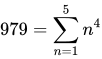
[edit]979 = 11 × 89. It is the sum of the five smallest fourth powers: .
980s
[edit]980
[edit]980 = 22 × 5 × 72. There are 980 ways to tile a hexagon of edge 3 with calissons of side 1.[64]
981
[edit]981 = 32 × 109.
982
[edit]982 = 2 × 491.
983
[edit]983 is a prime number, a safe prime,[65] a Chen prime, and an Eisenstein prime with no imaginary part. It is a Wedderburn–Etherington number[66] and a strictly non-palindromic number.[62]
984
[edit]984 = 23 × 3 × 41.
985
[edit]985 = 5 × 197. It is a Markov number,[67] a Pell number,[68] a Smith number,[11] and the sum of three consecutive primes (317 + 331 + 337).
986
[edit]986 = 2 × 17 × 29. It is a sphenic number, a strobogrammatic number, and a nontotient. There are 986 unimodal compositions of 14 where the maximal part appears once.[69]
987
[edit]987 = 3 × 7 × 47. It is a deficient number, a sphenic number, and the 16th number of the Fibonacci sequence.[70] There are 987 partitions of 52 into prime parts.
988
[edit]988 = 22 × 13 × 19. It is a nontotient, a cake number, and the sum of four consecutive primes (239 + 241 + 251 + 257).
989
[edit]989 = 23 × 43. It is an extra strong Lucas pseudoprime.[71]
990s
[edit]990
[edit]990 = 2 × 32 × 5 × 11. It is a Harshad number, the 44th triangular number,[3] and the sum of six consecutive primes (151 + 157 + 163 + 167 + 173 + 179).
The highest possible VantageScore credit score is 990.
991
[edit]991 is a prime number, a Chen prime, a lucky prime, and a prime index prime. It is the sum of five consecutive primes (191 + 193 + 197 + 199 + 211) and the sum of seven consecutive primes (127 + 131 + 137 + 139 + 149 + 151 + 157).
992
[edit]992 = 25 × 31. It is a pronic number[26] and a nontotient. There are 992 eleven-dimensional exotic spheres.[72]
993
[edit]993 = 3 × 331.
994
[edit]994 = 2 × 7 × 71. It is a sphenic number and a nontotient. There are 994 binary words of length 13 with all distinct runs.[73]
995
[edit]995 = 5 × 199.
996
[edit]996 = 22 × 3 × 83.
997
[edit]997 is the largest three-digit prime number, a lucky prime, and a strictly non-palindromic number.[62]
998
[edit]998 = 2 × 499. It is a nontotient. There are 998 7-node graphs with two connected components.[74]
999
[edit]999 = 33 × 37. It is a Kaprekar number[75] and a Harshad number.
In many video games, 999 is the maximum score that can be displayed.
References
[edit]
- ↑ "Bowler throws 36 consecutive strikes for incredible 900 series". For The Win. 2016-01-13. Retrieved 2021-03-31.
- ↑ Sawan, Amer (2024-06-14). "How Old is Yoda in The Phantom Menace?". CBR. Retrieved 2025-04-19.
- 1 2 3 "Sloane's A000217: Triangular numbers". The On-Line Encyclopedia of Integer Sequences. OEIS Foundation. Retrieved 2016-06-11.
- ↑ Sloane, N. J. A. (ed.). "Sequence A036469 (Partial sums of A000009 (partitions into distinct parts))". The On-Line Encyclopedia of Integer Sequences. OEIS Foundation.
- ↑ "Sloane's A098237: Composite de Polignac numbers". The On-Line Encyclopedia of Integer Sequences. OEIS Foundation. Retrieved 2022-05-10.
- 1 2 Sloane, N. J. A. (ed.). "Sequence A006245 (Number of primitive sorting networks on n elements; also number of rhombic tilings of a 2n-gon)". The On-Line Encyclopedia of Integer Sequences. OEIS Foundation. Retrieved 2022-05-24.
- ↑ Sloane, N. J. A. (ed.). "Sequence A303546 (Number of non-isomorphic aperiodic multiset partitions of weight n)". The On-Line Encyclopedia of Integer Sequences. OEIS Foundation. Retrieved 2022-05-24.
- ↑ Sloane, N. J. A. (ed.). "Sequence A020492 (Balanced numbers: numbers k such that phi(k) (A000010) divides sigma(k) (A000203))". The On-Line Encyclopedia of Integer Sequences. OEIS Foundation.
- ↑ Sloane, N. J. A. (ed.). "Sequence A007716 (Number of polynomial symmetric functions of matrix of order n under separate row and column permutations)". The On-Line Encyclopedia of Integer Sequences. OEIS Foundation.
- ↑ Sloane, N. J. A. (ed.). "Sequence A062786 (Centered 10-gonal numbers)". The On-Line Encyclopedia of Integer Sequences. OEIS Foundation. Retrieved 2016-06-02.
- 1 2 3 4 5 "Sloane's A006753 : Smith numbers". The On-Line Encyclopedia of Integer Sequences. OEIS Foundation. Retrieved 2016-06-11.
- ↑ Sloane, N. J. A. (ed.). "Sequence A332834 (Number of compositions of n that are neither weakly increasing nor weakly decreasing)". The On-Line Encyclopedia of Integer Sequences. OEIS Foundation. Retrieved 2022-05-23.
- ↑ "Sloane's A005282 : Mian-Chowla sequence". The On-Line Encyclopedia of Integer Sequences. OEIS Foundation. Retrieved 2016-06-11.
- ↑ "Sloane's A002407 : Cuban primes". The On-Line Encyclopedia of Integer Sequences. OEIS Foundation. Retrieved 2016-06-11.
- ↑ "Sloane's A003215 : Hex (or centered hexagonal) numbers". The On-Line Encyclopedia of Integer Sequences. OEIS Foundation. Retrieved 2016-06-11.
- ↑ Sloane, N. J. A. (ed.). "Sequence A055544 (Total number of nodes in all rooted trees with n nodes)". The On-Line Encyclopedia of Integer Sequences. OEIS Foundation. Retrieved 2022-05-23.
- ↑ Sloane, N. J. A. (ed.). "Sequence A301462 (Number of enriched r-trees of size n)". The On-Line Encyclopedia of Integer Sequences. OEIS Foundation. Retrieved 2022-05-23.
- ↑ Sloane, N. J. A. (ed.). "Sequence A030662 (Number of combinations of n things from 1 to n at a time, with repeats allowed)". The On-Line Encyclopedia of Integer Sequences. OEIS Foundation. Retrieved 2022-05-23.
- ↑ "Sloane's A000984 : Central binomial coefficients". The On-Line Encyclopedia of Integer Sequences. OEIS Foundation. Retrieved 2016-06-11.
- ↑ "Sloane's A000326 : Pentagonal numbers". The On-Line Encyclopedia of Integer Sequences. OEIS Foundation. Retrieved 2016-06-11.
- ↑ "Sloane's A001844 : Centered square numbers". The On-Line Encyclopedia of Integer Sequences. OEIS Foundation. Retrieved 2016-06-11.
- ↑ "Sloane's A000073 : Tribonacci numbers". The On-Line Encyclopedia of Integer Sequences. OEIS Foundation. Retrieved 2016-06-11.
- ↑ "Sloane's A080076 : Proth primes". The On-Line Encyclopedia of Integer Sequences. OEIS Foundation. Retrieved 2016-06-11.
- ↑ "Crack open your Bible: 929 day study project begins in Jerusalem". The Jerusalem Post. December 18, 2014. Retrieved January 1, 2015.
- ↑ ISO/IEC (2006), Information technology – Automatic identification and data capture techniques – PDF417 bar code symbology specification (PDF) (second ed.), ISO/IEC 15438:2006(E), archived from the original (PDF) on 2011-04-09, retrieved 2011-09-16
- 1 2 "Sloane's A002378 : Oblong (or promic, pronic, or heteromecic) numbers". The On-Line Encyclopedia of Integer Sequences. OEIS Foundation. Retrieved 2016-06-11.
- ↑ Sloane, N. J. A. (ed.). "Sequence A319612 (Number of regular simple graphs spanning n vertices)". The On-Line Encyclopedia of Integer Sequences. OEIS Foundation. Retrieved 2022-05-23.
- ↑ Sloane, N. J. A. (ed.). "Sequence A295193 (Number of regular simple graphs on n labeled nodes)". The On-Line Encyclopedia of Integer Sequences. OEIS Foundation. Retrieved 2022-05-22.
- ↑ "Sloane's A006972 : Lucas-Carmichael numbers". The On-Line Encyclopedia of Integer Sequences. OEIS Foundation. Retrieved 2016-06-11.
- ↑ "Sloane's A002411 : Pentagonal pyramidal numbers". The On-Line Encyclopedia of Integer Sequences. OEIS Foundation. Retrieved 2016-06-11.
- ↑ "Sloane's A003154 : Centered 12-gonal numbers. Also star numbers". The On-Line Encyclopedia of Integer Sequences. OEIS Foundation. Retrieved 2016-06-11.
- ↑ Sloane, N. J. A. (ed.). "Sequence A018808 (Number of lines through at least 2 points of an n X n grid of points)". The On-Line Encyclopedia of Integer Sequences. OEIS Foundation. Retrieved 2022-05-22.
- ↑ Sloane, N. J. A. (ed.). "Sequence A161206 (V-toothpick (or honeycomb) sequence)". The On-Line Encyclopedia of Integer Sequences. OEIS Foundation.
- ↑ Sloane, N. J. A. (ed.). "Sequence A001628 (Convolved Fibonacci numbers)". The On-Line Encyclopedia of Integer Sequences. OEIS Foundation.
- ↑ Sloane, N. J. A. (ed.). "Sequence A005727 (n-th derivative of x^x at x=1. Also called Lehmer-Comtet numbers)". The On-Line Encyclopedia of Integer Sequences. OEIS Foundation.
- ↑ "Sloane's A076980 : Leyland numbers". The On-Line Encyclopedia of Integer Sequences. OEIS Foundation. Retrieved 2016-06-11.
- ↑ Higgins, Peter (2008). Number Story: From Counting to Cryptography. New York: Copernicus. p. 13. ISBN 978-1-84800-000-1.
- ↑ "Sloane's A006038 : Odd primitive abundant numbers". The On-Line Encyclopedia of Integer Sequences. OEIS Foundation. Retrieved 2016-06-11.
- ↑ "Sloane's A006036 : Primitive pseudoperfect numbers". The On-Line Encyclopedia of Integer Sequences. OEIS Foundation. Retrieved 2016-06-11.
- ↑ "Sloane's A006882 : Double factorials". The On-Line Encyclopedia of Integer Sequences. OEIS Foundation. Retrieved 2016-06-11.
- ↑ "Sloane's A000384 : Hexagonal numbers". The On-Line Encyclopedia of Integer Sequences. OEIS Foundation. Retrieved 2016-06-11.
- 1 2 "Sloane's A006562 : Balanced primes". The On-Line Encyclopedia of Integer Sequences. OEIS Foundation. Retrieved 2016-06-11.
- ↑ Sloane, N. J. A. (ed.). "Sequence A269134 (Number of combinatory separations of normal multisets of weight n)". The On-Line Encyclopedia of Integer Sequences. OEIS Foundation. Retrieved 2022-05-13.
- ↑ Sloane, N. J. A. (ed.). "Sequence A001318 (Generalized pentagonal numbers)". The On-Line Encyclopedia of Integer Sequences. OEIS Foundation. Retrieved 2016-06-11.
- ↑ "Sloane's A005891 : Centered pentagonal numbers". The On-Line Encyclopedia of Integer Sequences. OEIS Foundation. Retrieved 2016-06-11.
- ↑ Sloane, N. J. A. (ed.). "Sequence A162328 (Number of reduced words of length n in the Weyl group D_17)". The On-Line Encyclopedia of Integer Sequences. OEIS Foundation. Retrieved 2022-05-12.
- ↑ Sloane, N. J. A. (ed.). "Sequence A007678 (Number of regions in regular n-gon with all diagonals drawn.)". The On-Line Encyclopedia of Integer Sequences. OEIS Foundation. Retrieved 2022-05-13.
- ↑ "Sloane's A005384 : Sophie Germain primes". The On-Line Encyclopedia of Integer Sequences. OEIS Foundation. Retrieved 2016-06-11.
- ↑ "Sloane's A069099 : Centered heptagonal numbers". The On-Line Encyclopedia of Integer Sequences. OEIS Foundation. Retrieved 2016-06-11.
- ↑ Sloane, N. J. A. (ed.). "Sequence A179230 (n-th derivative of x^(x^x) at x=1)". The On-Line Encyclopedia of Integer Sequences. OEIS Foundation.
- ↑ (sequence A023359 in the OEIS)
- ↑ Sloane, N. J. A. (ed.). "Sequence A024816 (Antisigma(n): Sum of the numbers less than n that do not divide n)". The On-Line Encyclopedia of Integer Sequences. OEIS Foundation. Retrieved 2016-05-11.
- ↑ "Sloane's A098237: Composite de Polignac numbers". The On-Line Encyclopedia of Integer Sequences. OEIS Foundation. Retrieved 2022-05-10.
- ↑ "Sloane's A016754 : Odd squares: a(n) = (2n+1)^2. Also centered octagonal numbers". The On-Line Encyclopedia of Integer Sequences. OEIS Foundation. Retrieved 2016-06-11.
- ↑ "Sloane's A001106 : 9-gonal (or enneagonal or nonagonal) numbers". The On-Line Encyclopedia of Integer Sequences. OEIS Foundation. Retrieved 2016-06-11.
- ↑ "Sloane's A000292 : Tetrahedral numbers". The On-Line Encyclopedia of Integer Sequences. OEIS Foundation. Retrieved 2016-06-11.
- ↑ Sloane, N. J. A. (ed.). "Sequence A005349 (Niven (or Harshad, or harshad) numbers: numbers that are divisible by the sum of their digits)". The On-Line Encyclopedia of Integer Sequences. OEIS Foundation.
- ↑ Sloane, N. J. A. (ed.). "Sequence A052486 (Achilles numbers - powerful but imperfect: if n = Product(p_i^e_i) then all e_i > 1 (i.e., powerful), but the highest common factor of the e_i is 1, i.e., not a perfect power.)". The On-Line Encyclopedia of Integer Sequences. OEIS Foundation.
- ↑ "A002982: Numbers n such that n! - 1 is prime". The On-Line Encyclopedia of Integer Sequences. OEIS Foundation. Retrieved 2022-05-10.
- ↑ "Sloane's A001107 : 10-gonal (or decagonal) numbers". The On-Line Encyclopedia of Integer Sequences. OEIS Foundation. Retrieved 2016-06-11.
- ↑ "Sloane's A042978 : Stern primes". The On-Line Encyclopedia of Integer Sequences. OEIS Foundation. Retrieved 2016-06-11.
- 1 2 3 "Sloane's A016038 : Strictly non-palindromic numbers". The On-Line Encyclopedia of Integer Sequences. OEIS Foundation. Retrieved 2016-06-11.
- ↑ Sloane, N. J. A. (ed.). "Sequence A004148 (Generalized Catalan numbers)". The On-Line Encyclopedia of Integer Sequences. OEIS Foundation.
- ↑ "A008793". The On-Line Encyclopedia of Integer Sequences. OEIS Foundation. Retrieved 2022-05-10.
- ↑ "Sloane's A005385 : Safe primes". The On-Line Encyclopedia of Integer Sequences. OEIS Foundation. Retrieved 2016-06-11.
- ↑ "Sloane's A001190 : Wedderburn-Etherington numbers". The On-Line Encyclopedia of Integer Sequences. OEIS Foundation. Retrieved 2016-06-11.
- ↑ "Sloane's A002559 : Markoff (or Markov) numbers". The On-Line Encyclopedia of Integer Sequences. OEIS Foundation. Retrieved 2016-06-11.
- ↑ "Sloane's A000129 : Pell numbers". The On-Line Encyclopedia of Integer Sequences. OEIS Foundation. Retrieved 2016-06-11.
- ↑ Sloane, N. J. A. (ed.). "Sequence A006330 (Number of corners, or planar partitions of n with only one row and one column)". The On-Line Encyclopedia of Integer Sequences. OEIS Foundation.
- ↑ "Sloane's A000045 : Fibonacci numbers". The On-Line Encyclopedia of Integer Sequences. OEIS Foundation. Retrieved 2016-06-11.
- ↑ "Sloane's A0217719 : Extra strong Lucas pseudoprimes". The On-Line Encyclopedia of Integer Sequences. OEIS Foundation. Retrieved 2016-06-11.
- ↑ "week164". Math.ucr.edu. 2001-01-13. Retrieved 2014-05-12.
- ↑ "A351016". The On-Line Encyclopedia of Integer Sequences. OEIS Foundation. Retrieved 2022-05-10.
- ↑ "A275165". The On-Line Encyclopedia of Integer Sequences. OEIS Foundation. Retrieved 2022-05-10.
- ↑ "Sloane's A006886 : Kaprekar numbers". The On-Line Encyclopedia of Integer Sequences. OEIS Foundation. Retrieved 2016-06-02.
| |||||||||
| |||||||||
| |||||||||
| |||||||||
