


Normal basis
In mathematics, specifically the algebraic theory of fields, a normal basis is a special kind of basis for Galois extensions of finite degree, characterised as forming a single orbit for the Galois group. The normal basis theorem states that any finite Galois extension of fields has a normal basis. In algebraic number theory, the study of the more refined question of the existence of a normal integral basis is part of Galois module theory.
Normal basis theorem
[edit]Let be a Galois extension with Galois group . The classical normal basis theorem states that there is an element such that forms a basis of , considered as a vector space over . That is, any element can be written uniquely as for some coefficients .


A normal basis contrasts with a primitive element basis of the form , where is an element whose minimal polynomial has degree .

![{\displaystyle n=[K:F]}](https://wikimedia.org/api/rest_v1/media/math/render/svg/b4e03baa87063bfd9df9f2702dea72a0a646724a)
Group representation point of view
[edit]A field extension K / F with Galois group G can be naturally viewed as a representation of the group G over the field F in which each automorphism is represented by itself; thus K is also a left module for the group algebra F[G]. Every homomorphism of left F[G]-modules is of form for some . Since is a linear basis of F[G] over F, we see that is bijective iff generates a normal basis of K over F.
![{\displaystyle \phi :F[G]\rightarrow K}](https://wikimedia.org/api/rest_v1/media/math/render/svg/29ec7b9bdd492fd69fa6d7ac8f257e8e0a21b867)


The normal basis theorem therefore amounts to the statement saying that if K / F is finite Galois extension, then as a left -module: K is isomorphic to the regular representation. Also, a given generates a normal basis iff, when considering K as a G-representation, does not lie in any proper subrepresentation.
![{\displaystyle K\cong F[G]}](https://wikimedia.org/api/rest_v1/media/math/render/svg/cc1c792ae7f9a551591702ba830fbda92e4a07fc)
![{\displaystyle F[G]}](https://wikimedia.org/api/rest_v1/media/math/render/svg/d8bf843b53d11e972a0627ad44d2a94a2c19298f)
Case of finite fields
[edit]For finite fields this can be stated as follows:[1] Let denote the field of q elements, where q = pm is a prime power, and let denote its extension field of degree n ≥ 1. Here the Galois group is with a cyclic group generated by the q-power Frobenius automorphism with Then there exists an element β ∈ K such that is a basis of K over F.







Proof for finite fields
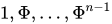
[edit]In case the Galois group is cyclic as above, generated by with the normal basis theorem follows from two basic facts. The first is the linear independence of characters: a multiplicative character is a mapping from a group to a field satisfying and ; then any distinct characters are linearly independent in the -vector space of mappings . We apply this to the Galois group automorphisms thought of as mappings from the multiplicative group . Now as an F-vector space, so we may consider as an element of ; since its powers are linearly independent over in and a fortiori over in , its minimal polynomial must have degree at least n, i.e. it must be .












The second basic fact is the classification of modules over a PID such as . Every such module of finite dimension over F can be represented as , where are monic polynomials and is a multiple of , so that the highest is the monic polynomial of smallest degree annihilating the module. For our cyclic Galois group of order n, we have an -algebra isomorphism taking the generator to the variable : this makes every -module into an -module. Consider as an -module under : the minimal monic polynomial annihilating is the minimal polynomial of , namely . Since we can only have , and as -modules (but this is not an isomorphism of rings). Thus we have an isomorphism of -modules
![{\displaystyle F[X]}](https://wikimedia.org/api/rest_v1/media/math/render/svg/26dc049157db08b423b1c6916eba0c81b1bdc18b)

![{\textstyle M\cong \bigoplus _{i=1}^{k}{\frac {F[X]}{(f_{i}(X))}}}](https://wikimedia.org/api/rest_v1/media/math/render/svg/a3ae4053763b8e15d04ee27a7d0fcb742505595d)


![{\textstyle F[G]\cong {\frac {F[X]}{(X^{n}-1)}}}](https://wikimedia.org/api/rest_v1/media/math/render/svg/7a8ae1f09d5f76c05d5349009e5c43de59333137)





![{\textstyle K\cong {\frac {F[X]}{(X^{n}{-}\,1)}}}](https://wikimedia.org/api/rest_v1/media/math/render/svg/1b0efa9bfb336a865cab98ad220e0448c5e4af78)
,
![{\textstyle K\cong {\frac {F[X]}{(X^{n}{-}\,1)}}\cong F[G]}](https://wikimedia.org/api/rest_v1/media/math/render/svg/a8e82959989806f5155e29e6740f871b97125abb)
under which the basis corresponds to the basis of on the right side, and to a normal basis of on the left.



Note that this proof would also apply in characteristic zero for a cyclic Kummer extension.
Example
[edit]Consider the field over , with Frobenius automorphism . The proof above clarifies the choice of normal bases in terms of the structure of K as a representation of G (or -module). The irreducible factorization means we have a direct sum of F[G]-modules (by the Chinese remainder theorem): The first component is just , while the second is isomorphic as an -module to under the action (Thus as -modules, but not as rings.)



![{\displaystyle X^{n}-1\ =\ X^{3}-1\ =\ (X{-}1)(X^{2}{+}X{+}1)\ \in \ F[X]}](https://wikimedia.org/api/rest_v1/media/math/render/svg/dfce5ffb95d82c40855b1795cabcc39ccd407d63)
![{\displaystyle K\ \cong \ {\frac {F[X]}{(X^{3}{-}\,1)}}\ \cong \ {\frac {F[X]}{(X{+}1)}}\oplus {\frac {F[X]}{(X^{2}{+}X{+}1)}}.}](https://wikimedia.org/api/rest_v1/media/math/render/svg/607508c17c6af9570c384a0269482db42df1867f)

![{\displaystyle \mathbb {F} _{2^{2}}\cong \mathbb {F} _{2}[X]/(X^{2}{+}X{+}1)}](https://wikimedia.org/api/rest_v1/media/math/render/svg/a2f766025556fe0abad75f81ce9c1d14d9eb33a2)


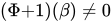
The elements which can be used for a normal basis are precisely those outside either of the submodules, so that and . In terms of the -orbits of , which correspond to the irreducible factors in: the elements of the submodule are the roots of ; and the nonzero elements of the submodule are the roots of ; while the normal basis, which in this case is unique, is given by the roots of the remaining factor .

![{\displaystyle t^{8}-t\ =\ t(t{+}1)\left(t^{3}+t+1\right)\left(t^{3}+t^{2}+1\right)\ \in \ F[t],}](https://wikimedia.org/api/rest_v1/media/math/render/svg/d4ab2afb01857d1cb112c2cec7f36402a6311dc4)


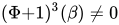
By contrast, for the extension field in which n = 4 is divisible by p = 2, we have the -module isomorphism Here the operator is not diagonalizable, the module has nested submodules given by generalized eigenspaces of , and the normal basis elements β are those outside the largest proper generalized eigenspace, the elements with .

![{\displaystyle L\ \cong \ \mathbb {F} _{2}[X]/(X^{4}{-}1)\ =\ \mathbb {F} _{2}[X]/(X{+}1)^{4}.}](https://wikimedia.org/api/rest_v1/media/math/render/svg/4cf98a4e5be183650b61a5d7e301335303dffb65)


Application to cryptography
[edit]The normal basis is frequently used in cryptographic applications based on the discrete logarithm problem, such as elliptic curve cryptography, since arithmetic using a normal basis is typically more computationally efficient than using other bases.
For example, in the field above, we may represent elements as bit-strings: where the coefficients are bits Now we can square elements by doing a left circular shift, , since squaring β4 gives β8 = β. This makes the normal basis especially attractive for cryptosystems that utilize frequent squaring.



Primitive normal basis
[edit]A primitive normal basis of an extension of finite fields is a normal basis that is generated by a primitive element of , that is a generator of the multiplicative group . (Note that this is a stronger definition of primitive element than mentioned above: one requires powers of the element to produce every non-zero element of , not merely a basis.) Lenstra and Schoof (1987) proved that every extension of finite fields possesses a primitive normal basis, the case when is a prime field having been settled by Harold Davenport.


Proof for the case of infinite fields
[edit]Suppose is a finite Galois extension of the infinite field F. Let , with . By the primitive element theorem there exists such that and for ; and write . The minimal polynomial f of over K is:a degree n monic polynomial which is irreducible in . Since f is separable (having simple roots) we may define the Lagrange interpolation polynomials satisfying and for :Next, define an matrix of polynomials byand let . To see this a non-zero polynomial, observe that , where k is determined by , and iff ; thus is the permutation matrix corresponding to the permutation of G which sends each to , and . Since is a non-zero polynomial, it has only a finite number of roots; and since we assumed F is infinite, we can find with . Define We claim that is a normal basis; i.e. that are linearly independent over F. Suppose for some ; applying any gives , so that . Since , we conclude that , which completes the proof.


![{\displaystyle K=F[\alpha ]}](https://wikimedia.org/api/rest_v1/media/math/render/svg/7f4c1b8eee4c90f687044d6b4371d85ab95d08a7)


![{\displaystyle K[X]}](https://wikimedia.org/api/rest_v1/media/math/render/svg/5bb4d802ca5718a14dc961af8692f35cdfad169b)










It is tempting to take because , but we need to conclude that is a matrix entry of .


Free elements
[edit]If K / F is a Galois extension and x in K generates a normal basis over F, then x is free in K / F. If x has the property that for every subgroup H of the Galois group G, with fixed field KH, x is free for K / KH, then x is said to be completely free in K / F. Every Galois extension has a completely free element.[2]
See also
[edit]References
[edit]- ↑ Nader H. Bshouty; Gadiel Seroussi (1989), Generalizations of the normal basis theorem of finite fields (PDF), p. 1; SIAM J. Discrete Math. 3 (1990), no. 3, 330–337.
- ↑ Dirk Hachenberger, Completely free elements, in Cohen & Niederreiter (1996) pp. 97–107 Zbl 0864.11066
- Cohen, S.; Niederreiter, H., eds. (1996). Finite Fields and Applications. Proceedings of the 3rd international conference, Glasgow, UK, July 11–14, 1995. London Mathematical Society Lecture Note Series. Vol. 233. Cambridge University Press. ISBN 978-0-521-56736-7. Zbl 0851.00052.
- Lenstra, H.W. Jr; Schoof, R.J. (1987). "Primitive normal bases for finite fields". Mathematics of Computation. 48 (177): 217–231. doi:10.2307/2007886. hdl:1887/3824. JSTOR 2007886. Zbl 0615.12023.
- Menezes, Alfred J., ed. (1993). Applications of finite fields. The Kluwer International Series in Engineering and Computer Science. Vol. 199. Boston: Kluwer Academic Publishers. ISBN 978-0792392828. Zbl 0779.11059.
