


Minkowski's second theorem
In mathematics, Minkowski's second theorem is a result in the geometry of numbers about the values taken by a norm on a lattice and the volume of its fundamental cell. It is named so because it is a strengthening of Minkowski's theorem.
Setting
[edit]Let K be a closed convex centrally symmetric body of positive finite volume in n-dimensional Euclidean space . The gauge[1] or distance[2][3] Minkowski functional g attached to K is defined by


Conversely, given a norm g on we define K to be

Let Γ be a lattice in . The successive minima of K or g on Γ are defined by setting the k-th successive minimum λk to be the infimum of the numbers λ such that λK contains k linearly-independent vectors of Γ. We have 0 < λ1 ≤ λ2 ≤ ... ≤ λn < ∞.
Statement
[edit]
Proof
[edit]A basis of linearly independent lattice vectors b1, b2, ..., bn can be defined by g(bj) = λj (warning : it may be not a basis of the lattice, but only a basis of the ambient space).
The lower bound is proved by considering the convex polytope 2n with vertices at ±bj/ λj, which has an interior enclosed by K and a volume which is 2n / (n! λ1λ2...λn) times an integer multiple of a primitive cell of the lattice (as seen by scaling the polytope by λj along each basis vector to obtain 2n n-simplices with lattice point vectors), the integer being the index of the -span of the family as a subgroup of the lattice.


To prove the upper bound, consider functions fj(x) sending points x in to the centroid of the subset of points in that can be written as for some real numbers . Then the coordinate transform has a Jacobian determinant . If and are in the interior of and (with ) then with , where the inclusion in (specifically the interior of ) is due to convexity and symmetry. But lattice points in the interior of are, by definition of , always expressible as a linear combination of , so any two distinct points of cannot be separated by a lattice vector.

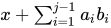







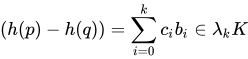




The entire space is tiled by translated copies of a primitve cell . The intersections with have a total volume in sum that is less than the volume of a single primite cell and therefore To see this, consider two intersections and with and their translated versions and that are both contained in the primitive cell located at the origin. If they would intersect at some point , then the two original points and would be separated by a lattice vector, which can be seen by considering the difference . This cannot be the case and therefore, translating every of the intersections into the primitive cell located at the origin does not lead to any intersections, which shows the claim.


References
[edit]- Cassels, J. W. S. (1957). An introduction to Diophantine approximation. Cambridge Tracts in Mathematics and Mathematical Physics. Vol. 45. Cambridge University Press. Zbl 0077.04801.
- Cassels, J. W. S. (1997). An Introduction to the Geometry of Numbers. Classics in Mathematics (Reprint of 1971 ed.). Springer-Verlag. ISBN 978-3-540-61788-4.
- Nathanson, Melvyn B. (1996). Additive Number Theory: Inverse Problems and the Geometry of Sumsets. Graduate Texts in Mathematics. Vol. 165. Springer-Verlag. pp. 180–185. ISBN 0-387-94655-1. Zbl 0859.11003.
- Schmidt, Wolfgang M. (1996). Diophantine approximations and Diophantine equations. Lecture Notes in Mathematics. Vol. 1467 (2nd ed.). Springer-Verlag. p. 6. ISBN 3-540-54058-X. Zbl 0754.11020.
- Siegel, Carl Ludwig (1989). Komaravolu S. Chandrasekharan (ed.). Lectures on the Geometry of Numbers. Springer-Verlag. ISBN 3-540-50629-2. Zbl 0691.10021.