


Mean dependence
In probability theory, a random variable is said to be mean independent of random variable if and only if its conditional mean equals its (unconditional) mean for all such that the probability density/mass of at , , is not zero. Otherwise, is said to be mean dependent on .


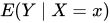


Stochastic independence implies mean independence, but the converse is not true.;[1][2] moreover, mean independence implies uncorrelatedness while the converse is not true. Unlike stochastic independence and uncorrelatedness, mean independence is not symmetric: it is possible for to be mean-independent of even though is mean-dependent on .
The concept of mean independence is often used in econometrics[2] to have a middle ground between the strong assumption of independent random variables () and the weak assumption of uncorrelated random variables


Further reading
[edit]- Cameron, A. Colin; Trivedi, Pravin K. (2009). Microeconometrics: Methods and Applications (8th ed.). New York: Cambridge University Press. ISBN 9780521848053.
- Wooldridge, Jeffrey M. (2010). Econometric Analysis of Cross Section and Panel Data (2nd ed.). London: The MIT Press. ISBN 9780262232586.
References
[edit]- ↑ Cameron & Trivedi (2009, p. 23)
- 1 2 Wooldridge (2010, pp. 54, 907)
 | This probability-related article is a stub. You can help Wikipedia by adding missing information. |