


Glaeser's continuity theorem
In mathematical analysis, Glaeser's continuity theorem is a characterization of the continuity of the derivative of the square roots of functions of class . It was introduced in 1963 by Georges Glaeser,[1] and was later simplified by Jean Dieudonné.[2]

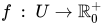
The theorem states: Let be a function of class in an open set U contained in , then is of class in U if and only if its partial derivatives of first and second order vanish in the zeros of f.


References
[edit]- ↑ Glaeser, Georges (1963). "Racine carrée d'une fonction différentiable". Annales de l'Institut Fourier. 13 (2): 203–210. doi:10.5802/aif.146.
- ↑ Dieudonné, Jean (1970). "Sur un théorème de Glaeser". Journal d'Analyse Mathématique. 23: 85–88. doi:10.1007/BF02795491. Zbl 0208.07503.