


gc (engineering)
In engineering and physics, gc is a unit conversion factor used to convert mass to force or vice versa.[1] It is defined as

In unit systems where force is a derived unit, like in SI units, gc is equal to 1. In unit systems where force is a primary unit, like in imperial and US customary measurement systems, gc may or may not equal 1 depending on the units used, and value other than 1 may be required to obtain correct results.[2] For example, in the kinetic energy (KE) formula, if gc = 1 is used, then KE is expressed in foot-poundals; but if gc = 32.174 is used, then KE is expressed in foot-pounds.
Motivations
[edit]According to Newton's second law, the force F is proportional to the product of mass m and acceleration a:

or

If F = 1 lbf, m = 1 lb, and a = 32.174 ft/s2, then
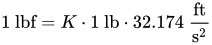
Leading to

gc is defined as the reciprocal of the constant K
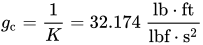
or equivalently, as
Specific systems of units
[edit]| International System | English System 1 | English System 2 |
|---|---|---|
| gc = 1 (kg·m)/(N·s2) | gc = 32.174 (lb·ft)/(lbf·s2) | gc = 1 (slug·ft)/(lbf·s2) |
References
[edit]- ↑ Janna, William (2015). Introduction to Fluid Mechanics (5th ed.). CRC Press. p. 5. ISBN 9781482211610.
- ↑ Cengel, Yunus; Boles, Michael (2014). Thermodynamics: An Engineering Approach (9th ed.). McGraw-Hill Education. p. 6. ISBN 9781259822674.