Cloudflare fetched the original article and streamed it through HTMLRewriter to apply an entirely new visual system without rebuilding the source page.
In mathematics, Fuchs's theorem, named after Lazarus Fuchs, states that a second-order differential equation of the form
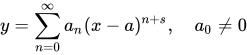
has a solution expressible by a generalised Frobenius series when , and are analytic at or is a regular singular point. That is, any solution to this second-order differential equation can be written as
for some positive real s, or
for some positive real r, where y0 is a solution of the first kind.
Its radius of convergence is at least as large as the minimum of the radii of convergence of , and .
Asmar, Nakhlé H. (2005), Partial differential equations with Fourier series and boundary value problems, Upper Saddle River, NJ: Pearson Prentice Hall, ISBN0-13-148096-0.