


Ahlswede–Daykin inequality
The Ahlswede–Daykin inequality (Ahlswede & Daykin 1978), also known as the four functions theorem (or inequality), is a correlation-type inequality for four functions on a finite distributive lattice. It is a fundamental tool in statistical mechanics and probabilistic combinatorics (especially random graphs and the probabilistic method).
The inequality states that if are nonnegative functions on a finite distributive lattice such that


for all x, y in the lattice, then

for all subsets X, Y of the lattice, where
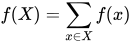
and


The Ahlswede–Daykin inequality can be used to provide a short proof of both the Holley inequality and the FKG inequality. It also implies the XYZ inequality.
For a proof, see the original article (Ahlswede & Daykin 1978) or (Alon & Spencer 2000).
Generalizations
[edit]The "four functions theorem" was independently generalized to 2k functions in (Aharoni & Keich 1996) and (Rinott & Saks 1991).
History
[edit]The story of the discovery of the Ahlswede–Daykin inequality was described in the Introduction to the A. Ahlswede et al. book:
"The history of the idea of the AD-inequality is very interesting. As Daykin came to a visit to Bielefeld, Ahlswede was just wallpapering. He stood on the ladder, and Daykin wanted to tell him from a newly proven inequality. The declaration was complicated, and Ahlswede said that probably a more general (and easier) theorem should hold. He made directly—on the ladder—a proposal which already was the AD-inequality."[1]
References
[edit]- ↑ Ahlswede, Alexander; Ahlswede, Rudolf; Althöfer, Ingo; Deppe, Christian; Tamm, Ulrich (30 June 2017). Combinatorial Methods and Models: Rudolf Ahlswede's Lectures on Information Theory 4. Springer. ISBN 978-3-319-53139-7.
Sources
[edit]- Ahlswede, Rudolf; Daykin, David E. (1978), "An inequality for the weights of two families of sets, their unions and intersections", Probability Theory and Related Fields, 43 (3): 183–185, doi:10.1007/BF00536201, ISSN 0178-8051, MR 0491189, S2CID 120659862
- Alon, N.; Spencer, J. H. (2000), The probabilistic method. Second edition. With an appendix on the life and work of Paul Erdős., Wiley-Interscience, New York, ISBN 978-0-471-37046-8, MR 1885388
- Fishburn, P.C. (2001) [1994], "Ahlswede–Daykin inequality", Encyclopedia of Mathematics, EMS Press
- Aharoni, Ron; Keich, Uri (1996), "A Generalization of the Ahlswede Daykin Inequality", Discrete Mathematics, 152 (1–3): 1–12, doi:10.1016/0012-365X(94)00294-S
- Rinott, Yosef; Saks, Michael (1991), "Correlation inequalities and a conjecture for permanents", Combinatorica, 13 (3): 269–277, doi:10.1007/BF01202353, S2CID 206791629