


Duality (electrical circuits)
(Redirected from Dual (electronics))
In electrical engineering, electrical terms are associated into pairs called duals. A dual of a relationship is formed by interchanging voltage and current in an expression. The dual expression thus produced is of the same form, and the reason that the dual is always a valid statement can be traced to the duality of electricity and magnetism.
Here is a partial list of electrical dualities:
- voltage – current
- parallel – series (circuits)
- resistance – conductance
- voltage division – current division
- impedance – admittance
- capacitance – inductance
- reactance – susceptance
- short circuit – open circuit
- Kirchhoff's current law (KCL) – Kirchhoff's voltage law (KVL)
- Thévenin's theorem – Norton's theorem
History
[edit]The use of duality in circuit theory is due to Alexander Russell who published his ideas in 1904.[1][2]
Examples
[edit]Constitutive relations
[edit]- Resistor and conductor (Ohm's law)
- Capacitor and inductor – differential form
- Capacitor and inductor – integral form



Voltage division — current division
[edit]

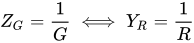
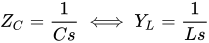
Impedance and admittance
[edit]- Resistor and conductor
- Capacitor and inductor


See also
[edit]References
[edit]- Turner, Rufus P, Transistors Theory and Practice, Gernsback Library, Inc, New York, 1954, Chapter 6.