


Dimensionless physical constant
In physics, a dimensionless physical constant is a physical constant that is dimensionless, i.e. a pure number having no units attached and having a numerical value that is independent of whatever system of units may be used.[1] It is one type of dimensionless quantity.[2]: 1
The concept should not be confused with dimensionless numbers, that are not universally constant, and remain constant only for a particular phenomenon. In aerodynamics for example, if one considers one particular airfoil, the Reynolds number value of the laminar–turbulent transition is one relevant dimensionless number of the problem. However, it is strictly related to the particular problem: for example, it is related to the airfoil being considered and also to the type of fluid in which it moves.
Terminology
[edit source]It has been argued the term fundamental physical constant should be restricted to the dimensionless universal physical constants that currently cannot be derived from any other source;[3][4][5][6] this stricter definition is followed here.
However, the term fundamental physical constant has also been used occasionally to refer to certain universal dimensioned physical constants, such as the speed of light c, vacuum permittivity ε0, Planck constant h, and the Newtonian constant of gravitation G, that appear in the most basic theories of physics.[7][8][9][10] NIST[7] and CODATA[11] sometimes used the term in this less strict manner.
Characteristics
[edit source]There is no exhaustive list of such constants but it does make sense to ask about the minimal number of fundamental constants necessary to determine a given physical theory. Thus, the Standard Model requires 25 physical constants. About half of them are the masses of fundamental particles, which become "dimensionless" when expressed relative to any reference mass (such as the Planck mass or electron mass) or, alternatively, as coupling strength with the Higgs field along with the gravitational constant.[12]
Fundamental physical constants cannot be derived and have to be measured. Developments in physics may lead to either a reduction or an extension of their number: discovery of new particles, or new relationships between physical phenomena, would introduce new constants, while the development of a more fundamental theory might allow the derivation of several constants from a more fundamental constant.
A long-sought goal of theoretical physics is to find first principles (theory of everything) from which all of the fundamental dimensionless constants can be calculated and compared to the measured values.
The large number of fundamental constants required in the Standard Model has been regarded as unsatisfactory since the theory's formulation in the 1970s. The desire for a theory that would allow the calculation of particle masses is a core motivation for the search for "Physics beyond the Standard Model".
History
[edit source]In the 1920s and 1930s, Arthur Eddington embarked upon extensive mathematical investigation into the relations between the fundamental quantities in basic physical theories, later used as part of his effort to construct an overarching theory unifying quantum mechanics and cosmological physics. For example, he speculated on the potential consequences of the ratio of the electron radius to its mass. Most notably, in a 1929 paper he set out an argument based on the Pauli exclusion principle and the Dirac equation that fixed the value of the reciprocal of the fine-structure constant as 𝛼−1 = 16 + 1/2 × 16 × (16–1) = 136. When its value was discovered to be closer to 137, he changed his argument to match that value. His ideas were not widely accepted, and subsequent experiments have shown that they were wrong (for example, none of the measurements of the fine-structure constant suggest an integer value; the modern CODATA value is α−1 = 137.035999177(21).[13]
Eddington may have been the first to attempt in vain to derive the basic dimensionless constants from fundamental theories and equations, but he was certainly not the last. Many others would subsequently undertake similar endeavors, and efforts occasionally continue even today. None have yet produced convincing results or gained wide acceptance among theoretical physicists.[14][15]
An empirical relation between the masses of the electron, muon and tau has been discovered by physicist Yoshio Koide, but this formula remains unexplained.[16]
Examples
[edit source]Dimensionless fundamental physical constants include:
- α, the fine-structure constant, (≈ 1/137). This is also the square of the electron charge, expressed in Planck units, which defines the scale of charge of elementary particles with charge. The electron charge is the coupling constant for the electromagnetic interaction.
- μ or β, the proton-to-electron mass ratio (≈ 1836), the rest mass of the proton divided by that of the electron. More generally, the ratio of the rest masses of any pair of elementary particles.
- αs, the coupling constant for the strong force (≈ 1)
Fine-structure constant
[edit source]One of the dimensionless fundamental constants is the fine-structure constant:
- 0.0072973525643(11),
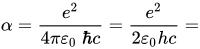
where e is the elementary charge, ħ is the reduced Planck constant, c is the speed of light in vacuum, and ε0 is the permittivity of free space. The fine-structure constant is fixed to the strength of the electromagnetic force. At low energies, α ≈ 1/137, whereas at the scale of the Z boson, about 90 GeV, one measures α ≈ 1/127. There is no accepted theory explaining the value of α; Richard Feynman elaborates:
There is a most profound and beautiful question associated with the observed coupling constant, e – the amplitude for a real electron to emit or absorb a real photon. It is a simple number that has been experimentally determined to be close to 0.08542455. (My physicist friends won't recognize this number, because they like to remember it as the inverse of its square: about 137.03597 with about an uncertainty of about 2 in the last decimal place. It has been a mystery ever since it was discovered more than fifty years ago, and all good theoretical physicists put this number up on their wall and worry about it.) Immediately you would like to know where this number for a coupling comes from: is it related to pi or perhaps to the base of natural logarithms? Nobody knows. It's one of the greatest damn mysteries of physics: a magic number that comes to us with no understanding by man. You might say the "hand of God" wrote that number, and "we don't know how He pushed his pencil." We know what kind of a dance to do experimentally to measure this number very accurately, but we don't know what kind of dance to do on the computer to make this number come out, without putting it in secretly!
Standard Model
[edit source]The original Standard Model of particle physics from the 1970s contained 19 fundamental dimensionless constants describing the masses of the particles and the strengths of the electroweak and strong forces. In the 1990s, neutrinos were discovered to have nonzero mass, and a quantity called the vacuum angle was found to be indistinguishable from zero.[17]: 293–296
The complete Standard Model requires 25 fundamental dimensionless constants (Baez, 2011). At present, their numerical values are not understood in terms of any widely accepted theory and are determined only from measurement. These 25 constants are:
- the fine structure constant;
- the strong coupling constant;
- fifteen masses of the fundamental particles (relative to the Planck mass mP = 1.22089(6)×1019 GeV/c2), namely:
- six quarks
- six leptons
- the Higgs boson
- the W boson
- the Z boson
- four parameters of the Cabibbo–Kobayashi–Maskawa matrix, describing how quarks oscillate between different forms;
- four parameters of the Pontecorvo–Maki–Nakagawa–Sakata matrix, which does the same thing for neutrinos.
| Dimensionless constants of the Standard Model | |||
|---|---|---|---|
| Symbol | Description | Dimensionless value | Alternative value representation |
| mu / mP | up quark mass | 1.4×10⁻²² – 2.7×10⁻²² | 1.7–3.3 MeV/c2 |
| md / mP | down quark mass | 3.4×10⁻²² – 4.8×10⁻²² | 4.1–5.8 MeV/c2 |
| mc / mP | charm quark mass | 1.04431+0.0204768 −0.0286675×10⁻¹⁹ |
1.275+0.025 −0.035 GeV/c2 |
| ms / mP | strange quark mass | 8.27×10⁻²¹ | 95+9 −3 MeV/c2 |
| mt / mP | top quark mass | (1.415±0.00245721)×10−17 | 172.76±0.3 GeV/c2 |
| mb / mP | bottom quark mass | 3.43×10⁻¹⁹ | 4.19 GeV/c2 |
| θ12,CKM | CKM 12-mixing angle | 0.22759±0.000873 | 13.04°±0.05° |
| θ23,CKM | CKM 23-mixing angle | 0.04154±0.00105 | 2.38°±0.06° |
| θ13,CKM | CKM 13-mixing angle | 0.003508±0.000192 | 0.201°±0.011° |
| δ13,CKM | CKM CP-violating phase | 1.201±0.0785 | 68.8°±4.5° |
| me / mP | electron mass | 4.18546×10⁻²³ | 0.511 MeV/c2 |
| mνe / mP | electron neutrino mass | below 9×10⁻³⁰ | below 0.11 eV/c2 |
| mμ / mP | muon mass | 8.65418×10⁻²¹ | 105.7 MeV/c2 |
| mνμ / mP | muon neutrino mass | below 1.6×10⁻²⁸ | below 2 eV/c2 |
| mτ / mP | tau mass | 1.45535×10⁻¹⁹ | 1.78 GeV/c2 |
| mντ / mP | tau neutrino mass | below 1.6×10⁻²⁸ | below 2 eV/c2 |
| θ12,PMNS | PMNS 12-mixing angle | 0.58364±0.0122 | 33.44°+0.77° −0.74° |
| θ23,PMNS | PMNS 23-mixing angle | 0.8587+0.0175 −0.0227 |
49.2°+1.0° −1.3° |
| θ13,PMNS | PMNS 13-mixing angle | 0.1496+0.00227 −0.00209 |
8.57°+0.13° −0.12° |
| δCp,PMNS | PMNS CP-violating phase | 2.95 ≤ δ ≤ 4.294 | 169° ≤ δ ≤ 246° |
| α | fine-structure constant | 0.00729735 | 1 / 137.036 |
| αs | strong coupling constant | ≈ 1 | ≈ 1 |
| mW± / mP | W boson mass | (6.5841±0.0012)×10−18 | 80.385±0.015 GeV/c2 |
| mZ0 / mP | Z boson mass | (7.46888±0.00016)×10−18 | 91.1876±0.002 GeV/c2 |
| mH / mP | Higgs boson mass | ≈ 1.02×10⁻¹⁷ | 125.09±0.24 GeV/c2 |
Gravitational coupling constant
[edit source]A gravitational coupling constant is a constant characterizing the gravitational attraction between a given pair of elementary particles. The electron mass is typically used, and the associated constant typically denoted αG. It is a dimensionless quantity, with the result that its numerical value does not vary with the choice of units of measurement, only with the choice of particle.
The gravitational coupling constant, αG, can be defined in terms of the gravitational attraction between two elementary particles:[18]

where:
- G is the gravitational constant;
- mp is the particle rest mass;
- c is the speed of light in vacuum;
- ħ is the reduced Planck constant.
For a proton the value of the dimensionless constant is approximately 5×10−39.[18][19]: 25
In natural units where c = ħ = 1, the expression becomes[20]: 1153

In 1961, a dimensionless gravitational coupling constant was used by Robert H. Dicke.[18] Dicke's work has been described as perhaps the first explicit discussion of the weak anthropic principle. This principle has various forms. The basic idea is that the constants in physical laws are limited to values which can give rise to physicists. Dicke reasoned that the gravitational coupling must be an extremely small number to ensure that expansion of the universe could continue against the force of gravity caused by all the matter in the universe.[21]: 7 Dicke's analysis countered an earlier hypothesis by Paul Dirac, suggesting that the gravitational coupling constant depends on cosmic density. In a Big Bang model of the universe, the density varies strongly with time. Dicke noted that sufficient time must elapse for stars to form and this requires a very small gravitational coupling constant.[20]: 1150
Cosmological constants
[edit source]The cosmological constant, which can be thought of as the density of dark energy in the universe, is a fundamental constant in physical cosmology that has a dimensionless value of approximately 10−122.[22] Other dimensionless constants are the measure of homogeneity in the universe, denoted by Q, which is explained below by Martin Rees, the baryon mass per photon, the cold dark matter mass per photon and the neutrino mass per photon.[23]
Barrow and Tipler
[edit source]Barrow and Tipler (1986) anchor their broad-ranging discussion of astrophysics, cosmology, quantum physics, teleology, and the anthropic principle in the fine-structure constant, the proton-to-electron mass ratio (which they, along with Barrow (2002), call β), and the coupling constants for the strong force and gravitation.
Martin Rees's 'six numbers'
[edit source]Martin Rees, in his book Just Six Numbers,[24] mulls over the following six dimensionless constants, whose values he deems fundamental to present-day physical theory and the known structure of the universe:
- N ≈ 1036: the ratio of the electrostatic and the gravitational forces between two protons. This ratio is denoted α/αG in Barrow and Tipler (1986). N governs the relative importance of gravity and electrostatic attraction/repulsion in explaining the properties of baryonic matter;[25]
- ε ≈ 0.007: The fraction of the mass of four protons that is released as energy when fused into a helium nucleus. ε governs the energy output of stars, and is determined by the coupling constant for the strong force;[26]
- Ω ≈ 0.3: the ratio of the actual density of the universe to the critical (minimum) density required for the universe to eventually collapse under its gravity. Ω determines the ultimate fate of the universe. If Ω ≥ 1, the universe may experience a Big Crunch. If Ω < 1, the universe may expand forever.[25]
- λ ≈ 0.7: The ratio of the energy density of the universe, due to the cosmological constant, to the critical density of the universe. Others denote this ratio by ;[27]
- Q ≈ 10−5: The energy required to break up and disperse an instance of the largest known structures in the universe, namely a galactic cluster or supercluster, expressed as a fraction of the energy equivalent to the rest mass m of that structure, namely mc2;[28]
- D = 3: the number of macroscopic spatial dimensions.

N and ε govern the fundamental interactions of physics. The other constants (D excepted) govern the size, age, and expansion of the universe. These five constants must be estimated empirically. D, on the other hand, is necessarily a nonzero natural number and does not have an uncertainty. Hence most physicists would not deem it a dimensionless physical constant of the sort discussed in this entry.
Any plausible fundamental physical theory must be consistent with these six constants, and must either derive their values from the mathematics of the theory, or accept their values as empirical.
See also
[edit source]References
[edit source]- ↑ Stroke, H. H., ed., The Physical Review: The First Hundred Years (Berlin/Heidelberg: Springer, 1995), p. 525.
- ↑ Kunes, Josef (13 February 2012). Dimensionless Physical Quantities in Science and Engineering. Elsevier Science. ISBN 978-0-12-391458-3.
- ↑ Baez, John (22 April 2011). "How Many Fundamental Constants Are There?". math.ucr.edu. Retrieved 13 April 2018.
- ↑ Michael Duff (2014). "How fundamental are fundamental constants?". Contemporary Physics. 56 (1): 35–47. arXiv:1412.2040. Bibcode:2015ConPh..56...35D. doi:10.1080/00107514.2014.980093. S2CID 118347723.
- ↑ Duff, M. J. (13 August 2002). "Comment on time-variation of fundamental constants". arXiv:hep-th/0208093.
- ↑ Duff, M. J.; Okun, L. B.; Veneziano, G. (2002). "Trialogue on the number of fundamental constants". Journal of High Energy Physics. 2002 (3): 023. arXiv:physics/0110060. Bibcode:2002JHEP...03..023D. doi:10.1088/1126-6708/2002/03/023. S2CID 15806354.
- 1 2 "Introduction to the Fundamental Physical Constants". physics.nist.gov. Retrieved 13 April 2018.
- ↑ http://physics.nist.gov/cuu/Constants/ NIST
- ↑ "Physical constant". Encyclopedia Britannica. Retrieved 13 April 2018.
- ↑ Karshenboim, Savely G. (August 2005). "Fundamental Physical Constants: Looking from Different Angles". Canadian Journal of Physics. 83 (8): 767–811. arXiv:physics/0506173. Bibcode:2005CaJPh..83..767K. doi:10.1139/p05-047. ISSN 0008-4204. S2CID 475086.
- ↑ Mohr, Peter J.; Newell, David B.; Taylor, Barry N. (26 September 2016). "CODATA Recommended Values of the Fundamental Physical Constants: 2014". Reviews of Modern Physics. 88 (3) 035009. arXiv:1507.07956. Bibcode:2016RvMP...88c5009M. doi:10.1103/RevModPhys.88.035009. ISSN 0034-6861. S2CID 1115862.
- ↑ Kuntz, I., Gravitational Theories Beyond General Relativity, (Berlin/Heidelberg: Springer, 2019), pp. 58–61.
- ↑ "2022 CODATA Value: inverse fine-structure constant". The NIST Reference on Constants, Units, and Uncertainty. NIST. May 2024. Retrieved 18 May 2024.
- ↑ Kragh, Helge (14 October 2015). "On Arthur Eddington's Theory of Everything". arXiv:1510.04046 [physics.hist-ph].
- ↑ Gamow, G. (1 February 1968). "Numerology of the Constants of Nature". Proceedings of the National Academy of Sciences. 59 (2): 313–318. Bibcode:1968PNAS...59..313G. doi:10.1073/pnas.59.2.313. ISSN 0027-8424. PMC 224670. PMID 16591598.
- ↑ Rivero, A.; Gsponer, A. (2 February 2008). "The strange formula of Dr. Koide". p. 4. arXiv:hep-ph/0505220.
- ↑ Quint, W., & M. Vogel, Fundamental Physics in Particle Traps (Berlin/Heidelberg: Springer, 2014), pp. 293–296.
- 1 2 3 Dicke, R. H. (November 1961). "Dirac's Cosmology and Mach's Principle". Nature. 192 (4801): 440–441. doi:10.1038/192440a0. ISSN 0028-0836.
- ↑ Rohlf, James William; Rohlf, James (1994). Modern Physics from Alpha to Z (International ed.). New York, NY: Wiley. ISBN 978-0-471-02126-1.
- 1 2 Hogan, Craig J. (1 October 2000). "Why the universe is just so". Reviews of Modern Physics. 72 (4): 1149–1161. doi:10.1103/RevModPhys.72.1149. ISSN 0034-6861.
- ↑ Weinberg, Steven (1 January 1989). "The cosmological constant problem". Reviews of Modern Physics. 61 (1): 1–23. doi:10.1103/RevModPhys.61.1. ISSN 0034-6861.
- ↑ Jaffe, R. L., & Taylor, W., The Physics of Energy (Cambridge: Cambridge University Press, 2018), p. 419.
- ↑ Tegmark, Max (2014). Our Mathematical Universe: My Quest for the Ultimate Nature of Reality. Knopf Doubleday Publishing Group. p. 252. ISBN 978-0-307-59980-3.
- ↑ Radford, T., "Just Six Numbers: The Deep Forces that Shape the Universe by Martin Rees—review", The Guardian, 8 June 2012.
- 1 2 Rees, M. (2000)
- ↑ Rees, M. (2000), p. 53.
- ↑ Rees, M. (2000), p. 110.
- ↑ Rees, M. (2000), p. 118.
Bibliography
[edit source]- Martin Rees, 1999. Just Six Numbers: The Deep Forces that Shape the Universe. London: Weidenfeld & Nicolson. ISBN 0-7538-1022-0
- Josef Kuneš, 2012. Dimensionless Physical Quantities in Science and Engineering. Amsterdam: Elsevier. ISBN 978-0-12-416013-2
External articles
[edit source]- General
- John Barrow (2002), The Constants of Nature; From Alpha to Omega – The Numbers that Encode the Deepest Secrets of the Universe, Pantheon Books, ISBN 0-375-42221-8
- Barrow, John D.; Tipler, Frank J. (1986). The Anthropic Cosmological Principle (1st ed.). Oxford University Press. ISBN 978-0-19-282147-8. LCCN 87028148.
- Michio Kaku (1994), Hyperspace: A Scientific Odyssey Through Parallel Universes, Time Warps, and the Tenth Dimension, Oxford University Press, Bibcode:1994hsot.book.....K
- Fundamental Physical Constants from NIST
- Values of fundamental constants. CODATA, 2002.
- John Baez, 2002, "How Many Fundamental Constants Are There?"
- Simon Plouffe, 2004, "A search for a mathematical expression for mass ratios using a large database. Archived 2007-02-19 at the Wayback Machine"
- Articles on variance of the fundamental constants
- Bahcall, John N.; Steinhardt, Charles L.; Schlegel, David (10 January 2004). "Does the Fine-Structure Constant Vary with Cosmological Epoch?". The Astrophysical Journal. 600 (2): 520–543. arXiv:astro-ph/0301507. Bibcode:2004ApJ...600..520B. doi:10.1086/379971. ISSN 0004-637X. S2CID 8875571.
- John D. Barrow and Webb, J. K., "Inconstant Constants – Do the inner workings of nature change with time?" Scientific American (June 2005).
- Michael Duff, 2002 "Comment on time-variation of fundamental constants."
- Marion, H.; Pereira Dos Santos, F.; Abgrall, M.; Zhang, S.; Sortais, Y.; et al. (18 April 2003). "Search for Variations of Fundamental Constants using Atomic Fountain Clocks". Physical Review Letters. 90 (15) 150801. arXiv:physics/0212112. Bibcode:2003PhRvL..90o0801M. doi:10.1103/physrevlett.90.150801. ISSN 0031-9007. PMID 12732023. S2CID 20986115.
- Martins, C.J.A.P; Melchiorri, A; Rocha, G; Trotta, R; Avelino, P.P; Viana, P.T.P (2004). "WMAP constraints on varying α and the promise of reionization". Physics Letters B. 585 (1–2): 29–34. arXiv:astro-ph/0302295. Bibcode:2004PhLB..585...29M. doi:10.1016/j.physletb.2003.11.080. ISSN 0370-2693. S2CID 113017.
- Olive, Keith A.; Pospelov, Maxim; Qian, Yong-Zhong; Coc, Alain; Cassé, Michel; Vangioni-Flam, Elisabeth (23 August 2002). "Constraints on the variations of the fundamental couplings". Physical Review D. 66 (4) 045022. arXiv:hep-ph/0205269. Bibcode:2002PhRvD..66d5022O. doi:10.1103/physrevd.66.045022. ISSN 0556-2821. S2CID 43436585.
- Uzan, Jean-Philippe [in French] (7 April 2003). "The fundamental constants and their variation: observational and theoretical status". Reviews of Modern Physics. 75 (2): 403–455. arXiv:hep-ph/0205340. Bibcode:2003RvMP...75..403U. doi:10.1103/revmodphys.75.403. ISSN 0034-6861. S2CID 118684485.
- Webb, J. K.; Murphy, M. T.; Flambaum, V. V.; Dzuba, V. A.; Barrow, J. D.; Churchill, C. W.; Prochaska, J. X.; Wolfe, A. M. (9 August 2001). "Further Evidence for Cosmological Evolution of the Fine Structure Constant". Physical Review Letters. 87 (9) 091301. arXiv:astro-ph/0012539. Bibcode:2001PhRvL..87i1301W. doi:10.1103/physrevlett.87.091301. ISSN 0031-9007. PMID 11531558. S2CID 40461557.