


One-third octave

A one-third octave is a logarithmic unit of frequency ratio equal to either one third of an octave (1200/3 = 400 cents: major third) or one tenth of a decade (3986.31/10 = 398.631 cents: M3 ⓘ).[1] An alternative (unambiguous) term for one tenth of a decade is a decidecade.[2][3]
Definitions
[edit]Base 2
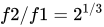
[edit]ISO 18405:2017 defines a "one-third octave" (or "one-third octave (base 2)") as one third of an octave, corresponding to a frequency ratio of . A one-third octave (base 2) is precisely 400 cents.

Base 10
[edit]IEC 61260-1:2014 and ANSI S1.6-2016 define a "one-third octave" as one tenth of a decade, corresponding to a frequency ratio of . This unit is referred to by ISO 18405 as a "decidecade" or "one-third octave (base 10)".[4]

One decidecade is equal to 100 savarts (approximately 398.631 cents).
See also
[edit]References
[edit]- ↑ Malcolm J. Crocker, Handbook of Acoustics (1997)
- ↑ von Benda-Beckmann, A. M., Aarts, G., Sertlek, H. Ö., Lucke, K., Verboom, W. C., Kastelein, R. A., ... & Ainslie, M. A. (2015). Assessing the impact of underwater clearance of unexploded ordnance on harbour porpoises (Phocoena phocoena) in the Southern North Sea. Aquatic Mammals, 41(4), 503.
- ↑ ISO 18405 Underwater Acoustics - Terminology (International Organization for Standardization, Geneva, 2017)
- ↑ (This makes sense as, if we want one third of an octave, the ratio will be , and if we log10 both members of equation we have, , which is approximately 0,1.

Further reading
[edit]- Ainslie, Michael A.; Halvorsen, Michele B.; Robinson, Stephen P. (January 2022) [2021-11-09]. "A terminology standard for underwater acoustics and the benefits of international standardization". IEEE Journal of Oceanic Engineering. 47 (1). IEEE: 179–200. doi:10.1109/JOE.2021.3085947. eISSN 1558-1691. ISSN 0364-9059. S2CID 243948953. (22 pages)