


Cornacchia's algorithm
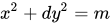
In computational number theory, Cornacchia's algorithm is an algorithm for solving the Diophantine equation , where and d and m are coprime. The algorithm was described in 1908 by Giuseppe Cornacchia.[1]

The algorithm
[edit]First, one finds any solution to ; if no such exist, there can be no primitive solution to the original equation. Without loss of generality, one can assume that r0 ≤ m/2 (if not, then replace r0 with m - r0, which will still be a root of -d). Then the Euclidean algorithm can be employed to find , and so on; stopping when . If is an integer, then the solution is ; otherwise try another root of -d until either a solution is found or all roots have been exhausted. In this case there is no primitive solution.







This algorithm can also be used to find non-primitive solutions (x, y) where gcd(x, y) = g ≠ 1, because the existence of such a solution implies that g2 divides m (and equivalently, that if m is square-free, then all solutions are primitive). Thus the above algorithm can be used to search for a primitive solution (u, v) to u2 + dv2 = m/g2. If such a solution is found, then (gu, gv) will be a solution to the original equation.
Example
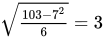
[edit]Solve the equation . A square root of −6 (mod 103) is 32, and 103 ≡ 7 (mod 32); since and , there is a solution x = 7, y = 3.


References
[edit]- ↑ Cornacchia, G. (1908). "Su di un metodo per la risoluzione in numeri interi dell' equazione ". Giornale di Matematiche di Battaglini. 46: 33–90.
External links
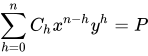
[edit]- Basilla, J. M. (2004). "On the solutions of " (PDF). Proc. Japan Acad. 80(A): 40–41. doi:10.3792/pjaa.80.40.