


Dynamic risk measure
In financial mathematics, a conditional risk measure is a random variable of the financial risk (particularly the downside risk) as if measured at some point in the future. A risk measure can be thought of as a conditional risk measure on the trivial sigma algebra.
A dynamic risk measure is a risk measure that deals with the question of how evaluations of risk at different times are related. It can be interpreted as a sequence of conditional risk measures.[1]
A different approach to dynamic risk measurement has been suggested by Novak.[2]
Conditional risk measure
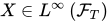
[edit]Consider a portfolio's returns at some terminal time as a random variable that is uniformly bounded, i.e., denotes the payoff of a portfolio. A mapping is a conditional risk measure if it has the following properties for random portfolio returns :[3][4]



- Conditional cash invariance
- [clarification needed]

- Monotonicity
- [clarification needed]

- Normalization
- [clarification needed]

If it is a conditional convex risk measure then it will also have the property:
- Conditional convexity
- [clarification needed]

A conditional coherent risk measure is a conditional convex risk measure that additionally satisfies:
- Conditional positive homogeneity
- [clarification needed]

Acceptance set
[edit]The acceptance set at time associated with a conditional risk measure is

- .

If you are given an acceptance set at time then the corresponding conditional risk measure is

where is the essential infimum.[5]

Regular property
[edit]A conditional risk measure is said to be regular if for any and then where is the indicator function on . Any normalized conditional convex risk measure is regular.[3]





The financial interpretation of this states that the conditional risk at some future node (i.e. ) only depends on the possible states from that node. In a binomial model this would be akin to calculating the risk on the subtree branching off from the point in question.
![{\displaystyle \rho _{t}(X)[\omega ]}](https://wikimedia.org/api/rest_v1/media/math/render/svg/64a2bc9f5f841a33948997496b2fd37af82e3512)
Time consistent property
[edit]A dynamic risk measure is time consistent if and only if .[6]

Example: dynamic superhedging price
[edit]The dynamic superhedging price involves conditional risk measures of the form . It is shown that this is a time consistent risk measure.
![{\displaystyle \rho _{t}(-X)=\operatorname {*} {ess\sup }_{Q\in EMM}\mathbb {E} ^{Q}[X|{\mathcal {F}}_{t}]}](https://wikimedia.org/api/rest_v1/media/math/render/svg/278257a5aa933df147c030479735baa44ced3326)
References
[edit]- ↑ Acciaio, Beatrice; Penner, Irina (2011). "Dynamic risk measures" (PDF). Advanced Mathematical Methods for Finance: 1–34. Archived from the original (PDF) on September 2, 2011. Retrieved July 22, 2010.
- ↑ Novak, S.Y. (2015). On measures of financial risk. pp. 541–549. ISBN 978-849844-4964.
{{cite book}}:|journal=ignored (help) - 1 2 Detlefsen, K.; Scandolo, G. (2005). "Conditional and dynamic convex risk measures". Finance and Stochastics. 9 (4): 539–561. doi:10.1007/s00780-005-0159-6. S2CID 10579202.
- ↑ Föllmer, Hans; Penner, Irina (2006). "Convex risk measures and the dynamics of their penalty functions". Statistics & Decisions. 24 (1): 61–96. doi:10.1524/stnd.2006.24.1.61. S2CID 54734936.
- ↑ Penner, Irina (2007). "Dynamic convex risk measures: time consistency, prudence, and sustainability" (PDF). Archived from the original (PDF) on July 19, 2011. Retrieved February 3, 2011.
{{cite journal}}: Cite journal requires|journal=(help) - ↑ Cheridito, Patrick; Stadje, Mitja (2009). "Time-inconsistency of VaR and time-consistent alternatives". Finance Research Letters. 6 (1): 40–46. doi:10.1016/j.frl.2008.10.002.