


Completely positive map
(Redirected from Completely positive)
 | This article needs more citations. (July 2020) |
In mathematics a positive map is a map between C*-algebras that sends positive elements to positive elements. A completely positive map is one that satisfies a stronger, more robust condition.
Definition
[edit]Let and be C*-algebras. A linear map is called a positive map if maps positive elements to positive elements: .



Any linear map induces another map

in a natural way. If is identified with the C*-algebra of -matrices with entries in , then acts as


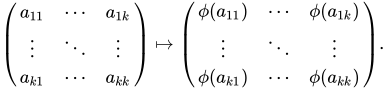
We then say is k-positive if is a positive map and completely positive if is k-positive for all k.

Properties
[edit]- Positive maps are monotone, i.e. for all self-adjoint elements .
- Since for all self-adjoint elements , every positive map is automatically continuous with respect to the C*-norms and its operator norm equals . A similar statement with approximate units holds for non-unital algebras.
- The set of positive functionals is the dual cone of the cone of positive elements of .





Examples
[edit]- Every *-homomorphism is completely positive.[1]
- For every linear operator between Hilbert spaces, the map is completely positive.[2] Stinespring's theorem says that all completely positive maps are compositions of *-homomorphisms and these special maps.
- Every positive functional (in particular every state) is automatically completely positive.
- Given the algebras and of complex-valued continuous functions on compact Hausdorff spaces , every positive map is completely positive.
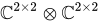
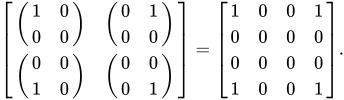
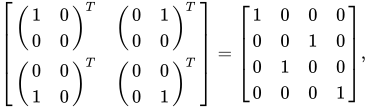
- The transposition of matrices is a standard example of a positive map that fails to be 2-positive. Let T denote this map on . The following is a positive matrix in : The image of this matrix under is which is clearly not positive, having determinant −1. Moreover, the eigenvalues of this matrix are 1,1,1 and −1. (This matrix happens to be the Choi matrix of T, in fact.) Incidentally, a map Φ is said to be co-positive if the composition Φ T is positive. The transposition map itself is a co-positive map.






See also
[edit]References
[edit]- ↑ K. R. Davidson: C*-Algebras by Example, American Mathematical Society (1996), ISBN 0-821-80599-1, Thm. IX.4.1
- ↑ R.V. Kadison, J. R. Ringrose: Fundamentals of the Theory of Operator Algebras II, Academic Press (1983), ISBN 0-1239-3302-1, Sect. 11.5.21