


Complete set of invariants
In mathematics, a complete set of invariants for a classification problem is a collection of maps

(where is the collection of objects being classified, up to some equivalence relation , and the are some sets), such that if and only if for all . In words, such that two objects are equivalent if and only if all invariants are equal.[1]


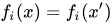

Symbolically, a complete set of invariants is a collection of maps such that

is injective.
As invariants are, by definition, equal on equivalent objects, equality of invariants is a necessary condition for equivalence; a complete set of invariants is a set such that equality of these is also sufficient for equivalence. In the context of a group action, this may be stated as: invariants are functions of coinvariants (equivalence classes, orbits), and a complete set of invariants characterizes the coinvariants (is a set of defining equations for the coinvariants).
Examples
[edit]- In the classification of two-dimensional closed manifolds, Euler characteristic (or genus) and orientability are a complete set of invariants.
- The Jordan normal form of a matrix is a complete invariant for matrices over a field up to conjugation (similarity), but eigenvalues (with multiplicities) are not.
- The elementary divisors are a complete invariant for matrices over a principal ideal domain up to conjugation (or for finitely generated modules over a PID up to isomorphism).
- The signature and rank of a matrix are a complete set of invariants for real symmetric matrices up to congruence (or for real quadratic forms up to equivalence), by Sylvester's law of inertia.
Realizability of invariants
[edit]A complete set of invariants does not immediately yield a classification theorem: not all combinations of invariants may be realized. Symbolically, one must also determine the image of

References
[edit]- ↑ Faticoni, Theodore G. (2006), "Modules and point set topological spaces", Abelian groups, rings, modules, and homological algebra, Lect. Notes Pure Appl. Math., vol. 249, Chapman & Hall/CRC, Boca Raton, Florida, pp. 87–105, doi:10.1201/9781420010763.ch10 (inactive 11 July 2025), ISBN 978-1-58488-552-8, MR 2229105
{{citation}}: CS1 maint: DOI inactive as of July 2025 (link). See in particular p. 97.