


Lie coalgebra
In mathematics a Lie coalgebra is the dual structure to a Lie algebra.
In finite dimensions, these are dual objects: the dual vector space to a Lie algebra naturally has the structure of a Lie coalgebra, and conversely.
Definition
[edit]Let be a vector space over a field equipped with a linear mapping from to the exterior product of with itself. It is possible to extend uniquely to a graded derivation (this means that, for any which are homogeneous elements, ) of degree 1 on the exterior algebra of :






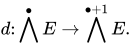
Then the pair is said to be a Lie coalgebra if , i.e., if the graded components of the exterior algebra with derivation form a cochain complex:



Relation to de Rham complex
[edit]Just as the exterior algebra (and tensor algebra) of vector fields on a manifold form a Lie algebra (over the base field ), the de Rham complex of differential forms on a manifold form a Lie coalgebra (over the base field ). Further, there is a pairing between vector fields and differential forms.
However, the situation is subtler: the Lie bracket is not linear over the algebra of smooth functions (the error is the Lie derivative), nor is the exterior derivative: (it is a derivation, not linear over functions): they are not tensors. They are not linear over functions, but they behave in a consistent way, which is not captured simply by the notion of Lie algebra and Lie coalgebra.


Further, in the de Rham complex, the derivation is not only defined for , but is also defined for .


The Lie algebra on the dual
[edit]A Lie algebra structure on a vector space is a map which is skew-symmetric, and satisfies the Jacobi identity. Equivalently, a map that satisfies the Jacobi identity.
![{\displaystyle [\cdot ,\cdot ]\colon {\mathfrak {g}}\times {\mathfrak {g}}\to {\mathfrak {g}}}](https://wikimedia.org/api/rest_v1/media/math/render/svg/05d6eb7382ea0aec11abacb3ecdde0f4e41cc400)
![{\displaystyle [\cdot ,\cdot ]\colon {\mathfrak {g}}\wedge {\mathfrak {g}}\to {\mathfrak {g}}}](https://wikimedia.org/api/rest_v1/media/math/render/svg/c38354eb26ea415de32ec5f70efdf433a5f5b144)
Dually, a Lie coalgebra structure on a vector space E is a linear map which is antisymmetric (this means that it satisfies , where is the canonical flip ) and satisfies the so-called cocycle condition (also known as the co-Leibniz rule)




- .

Due to the antisymmetry condition, the map can be also written as a map .
The dual of the Lie bracket of a Lie algebra yields a map (the cocommutator)

![{\displaystyle [\cdot ,\cdot ]^{*}\colon {\mathfrak {g}}^{*}\to ({\mathfrak {g}}\wedge {\mathfrak {g}})^{*}\cong {\mathfrak {g}}^{*}\wedge {\mathfrak {g}}^{*}}](https://wikimedia.org/api/rest_v1/media/math/render/svg/4dcce759333e6d8cff4c66a2e991272f59106646)
where the isomorphism holds in finite dimension; dually for the dual of Lie comultiplication. In this context, the Jacobi identity corresponds to the cocycle condition.

More explicitly, let be a Lie coalgebra over a field of characteristic neither 2 nor 3. The dual space carries the structure of a bracket defined by

, for all and .
![{\displaystyle \alpha ([x,y])=d\alpha (x\wedge y)}](https://wikimedia.org/api/rest_v1/media/math/render/svg/7acb6ffc997c2abec2d4ad00f7de475100a1ba4e)


We show that this endows with a Lie bracket. It suffices to check the Jacobi identity. For any and ,

![{\displaystyle {\begin{aligned}d^{2}\alpha (x\wedge y\wedge z)&={\frac {1}{3}}d^{2}\alpha (x\wedge y\wedge z+y\wedge z\wedge x+z\wedge x\wedge y)\\&={\frac {1}{3}}\left(d\alpha ([x,y]\wedge z)+d\alpha ([y,z]\wedge x)+d\alpha ([z,x]\wedge y)\right),\end{aligned}}}](https://wikimedia.org/api/rest_v1/media/math/render/svg/1cddcccef5c4e7738ff3718aed34a2fc70f0ebc7)
where the latter step follows from the standard identification of the dual of a wedge product with the wedge product of the duals. Finally, this gives
![{\displaystyle d^{2}\alpha (x\wedge y\wedge z)={\frac {1}{3}}\left(\alpha ([[x,y],z])+\alpha ([[y,z],x])+\alpha ([[z,x],y])\right).}](https://wikimedia.org/api/rest_v1/media/math/render/svg/0ec2920ff8ebb8c3c4eb476fb180dd612a775462)
Since , it follows that
- , for any , , , and .
![{\displaystyle \alpha ([[x,y],z]+[[y,z],x]+[[z,x],y])=0}](https://wikimedia.org/api/rest_v1/media/math/render/svg/00aacd02b77d67f1bbd63c447efaa915e2bc2b78)


Thus, by the double-duality isomorphism (more precisely, by the double-duality monomorphism, since the vector space needs not be finite-dimensional), the Jacobi identity is satisfied.
In particular, note that this proof demonstrates that the cocycle condition is in a sense dual to the Jacobi identity.
References
[edit]- Michaelis, Walter (1980), "Lie coalgebras", Advances in Mathematics, 38 (1): 1–54, doi:10.1016/0001-8708(80)90056-0, ISSN 0001-8708, MR 0594993