


Golod–Shafarevich theorem
 | This article includes a list of references, related reading, or external links, but its sources remain unclear because it lacks inline citations. (September 2026) |
In mathematics, the Golod–Shafarevich theorem is a result in non-commutative homological algebra which solves the class field tower problem by showing that class field towers can be infinite. It is named after Evgeny Golod and Igor Shafarevich, who proved it in 1964.
Statement of the inequality
[edit]Let be the free algebra over a field in non-commuting variables, and let be the two-sided ideal of generated by homogeneous elements of of degree with


where tends to infinity. Let be the number of equal to , for all .


Let ; this is a graded algebra. Let . The fundamental inequality of Golod and Shafarevich states that


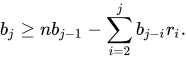
for all . As a consequence, is infinite-dimensional if for all .


Applications
[edit]This result has important applications in combinatorial group theory:
- If is a non-trivial finite p-group, then , where and (the mod cohomology groups of ). In particular, if is a finite -group with minimal number of generators and has relators in a given presentation, then .


- For each prime , there is an infinite group generated by three elements in which each element has order a power of . The group provides a counterexample to the generalised Burnside conjecture: it is a finitely generated infinite torsion group, although there is no uniform bound on the order of its elements.
Class field theory
[edit]In class field theory, the class field tower of a number field is created by iterating the Hilbert class field construction. The class field tower problem asks whether this tower is always finite. A consequence of the Golod–Shafarevich theorem is that such towers may be infinite (in other words, do not always terminate in a field equal to its Hilbert class field). Specifically, if is an imaginary quadratic field whose discriminant has at least six prime factors, then the maximal unramified 2-extension of has infinite degree.
More generally, a number field with sufficiently many prime factors in the discriminant has an infinite class field tower.
References
[edit]- Golod, E. S.; Shafarevich, I. R. (1964). "On the class field tower". Izv. Akad. Nauk SSSR (in Russian). 28: 261–272. MR 0161852.
- Golod, E. S. (1964). "On nil-algebras and finitely approximable p-groups". Izv. Akad. Nauk SSSR (in Russian). 28: 273–276. MR 0161878.
- Herstein, I. N. (2005) [1968]. Noncommutative Rings. Carus Mathematical Monographs (5th ed.). Mathematical Association of America. ISBN 0-88385-039-7. See chapter 8.
- Hasse, Helmut (1926). "Bericht über neuere Unterschungen und Probleme aus der Theorie der algebraischen Zahlkörper". Jahresbericht der Deutschen Mathematiker-Vereinigung (in German). 35: 1–55. JFM 52.0150.19.
- Johnson, D. L. (1980). Topics in the Theory of Group Presentations. London Mathematical Society Lecture Note Series. Vol. 42. Cambridge University Press. ISBN 978-0-521-23108-4. See chapter VI.
- Koch, Helmut (1992). Number Theory II: Algebraic Number Theory. Encyclopedia of Mathematical Sciences. Vol. 62. Berlin, Heidelberg: Springer. p. 180. ISBN 978-3-540-53386-3. Zbl 0819.11044.
- Narkiewicz, W. (2004) [1974]. Elementary and Analytic Theory of Algebraic Numbers. Springer Monographs in Mathematics (3rd ed.). Berlin, Heidelberg: Springer. p. 194. ISBN 978-3-540-21902-6. Zbl 1159.11039.
- Roquette, Peter (1986) [1967]. "On class field towers". In Cassels, J. W. S.; Fröhlich, A. (eds.). Algebraic number theory, Proceedings of the instructional conference held at the University of Sussex, Brighton, September 1–17, 1965 (Reprint of the 1967 original ed.). London: Academic Press. pp. 231–249. ISBN 0-12-163251-2.
- Serre, Jean-Pierre (2001) [1964]. Galois Cohomology. Springer Monographs in Mathematics. Berlin, Heidelberg: Springer. ISBN 978-3-540-42192-4.