From Wikipedia, the free encyclopedia
Method for calculating the value of pi
Borwein's algorithm was devised by Jonathan and Peter Borwein to calculate the value of
1
/
π
{\displaystyle 1/\pi }
Pi and the AGM – A Study in Analytic Number Theory and Computational Complexity .[ 1]
[ edit ] These two are examples of a Ramanujan–Sato series . The related Chudnovsky algorithm uses a discriminant with class number 1.
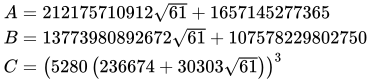
[ edit ] Start by setting[ 2]
A
=
212175710912
61
+
1657145277365
B
=
13773980892672
61
+
107578229802750
C
=
(
5280
(
236674
+
30303
61
)
)
3
{\displaystyle {\begin{aligned}A&=212175710912{\sqrt {61}}+1657145277365\\B&=13773980892672{\sqrt {61}}+107578229802750\\C&=\left(5280\left(236674+30303{\sqrt {61}}\right)\right)^{3}\end{aligned}}}
Then
1
π
=
12
∑
n
=
0
∞
(
−
1
)
n
(
6
n
)
!
(
A
+
n
B
)
(
n
!
)
3
(
3
n
)
!
C
n
+
1
2
{\displaystyle {\frac {1}{\pi }}=12\sum _{n=0}^{\infty }{\frac {(-1)^{n}(6n)!\,(A+nB)}{(n!)^{3}(3n)!\,C^{n+{\frac {1}{2}}}}}}
Each additional term of the partial sum yields approximately 25 digits.
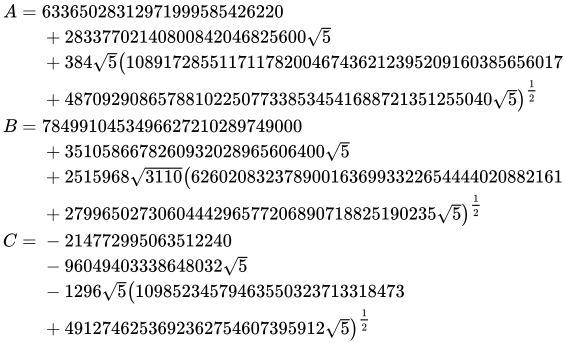
[ edit ] Start by setting[ 3]
A
=
63365028312971999585426220
+
28337702140800842046825600
5
+
384
5
(
10891728551171178200467436212395209160385656017
+
4870929086578810225077338534541688721351255040
5
)
1
2
B
=
7849910453496627210289749000
+
3510586678260932028965606400
5
+
2515968
3110
(
6260208323789001636993322654444020882161
+
2799650273060444296577206890718825190235
5
)
1
2
C
=
−
214772995063512240
−
96049403338648032
5
−
1296
5
(
10985234579463550323713318473
+
4912746253692362754607395912
5
)
1
2
{\displaystyle {\begin{aligned}A={}&63365028312971999585426220\\&{}+28337702140800842046825600{\sqrt {5}}\\&{}+384{\sqrt {5}}{\big (}10891728551171178200467436212395209160385656017\\&{}+\left.4870929086578810225077338534541688721351255040{\sqrt {5}}\right)^{\frac {1}{2}}\\B={}&7849910453496627210289749000\\&{}+3510586678260932028965606400{\sqrt {5}}\\&{}+2515968{\sqrt {3110}}{\big (}6260208323789001636993322654444020882161\\&{}+\left.2799650273060444296577206890718825190235{\sqrt {5}}\right)^{\frac {1}{2}}\\C={}&-214772995063512240\\&{}-96049403338648032{\sqrt {5}}\\&{}-1296{\sqrt {5}}{\big (}10985234579463550323713318473\\&{}+\left.4912746253692362754607395912{\sqrt {5}}\right)^{\frac {1}{2}}\end{aligned}}}
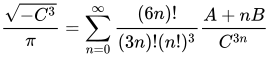
Then
−
C
3
π
=
∑
n
=
0
∞
(
6
n
)
!
(
3
n
)
!
(
n
!
)
3
A
+
n
B
C
3
n
{\displaystyle {\frac {\sqrt {-C^{3}}}{\pi }}=\sum _{n=0}^{\infty }{{\frac {(6n)!}{(3n)!(n!)^{3}}}{\frac {A+nB}{C^{3n}}}}}
Each additional term of the series yields approximately 50 digits.
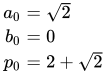
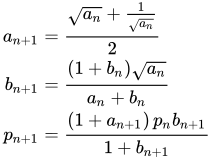
Iterative algorithms [ edit ] [ edit ] Start by setting[ 4]
a
0
=
2
b
0
=
0
p
0
=
2
+
2
{\displaystyle {\begin{aligned}a_{0}&={\sqrt {2}}\\b_{0}&=0\\p_{0}&=2+{\sqrt {2}}\end{aligned}}}
Then iterate
a
n
+
1
=
a
n
+
1
a
n
2
b
n
+
1
=
(
1
+
b
n
)
a
n
a
n
+
b
n
p
n
+
1
=
(
1
+
a
n
+
1
)
p
n
b
n
+
1
1
+
b
n
+
1
{\displaystyle {\begin{aligned}a_{n+1}&={\frac {{\sqrt {a_{n}}}+{\frac {1}{\sqrt {a_{n}}}}}{2}}\\b_{n+1}&={\frac {(1+b_{n}){\sqrt {a_{n}}}}{a_{n}+b_{n}}}\\p_{n+1}&={\frac {(1+a_{n+1})\,p_{n}b_{n+1}}{1+b_{n+1}}}\end{aligned}}}
Then p k π ; that is, each iteration approximately doubles the number of correct digits. The algorithm is not self-correcting; each iteration must be performed with the desired number of correct digits for π 's final result.
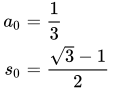
[ edit ] Start by setting
a
0
=
1
3
s
0
=
3
−
1
2
{\displaystyle {\begin{aligned}a_{0}&={\frac {1}{3}}\\s_{0}&={\frac {{\sqrt {3}}-1}{2}}\end{aligned}}}
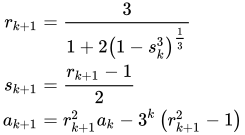
Then iterate
r
k
+
1
=
3
1
+
2
(
1
−
s
k
3
)
1
3
s
k
+
1
=
r
k
+
1
−
1
2
a
k
+
1
=
r
k
+
1
2
a
k
−
3
k
(
r
k
+
1
2
−
1
)
{\displaystyle {\begin{aligned}r_{k+1}&={\frac {3}{1+2\left(1-s_{k}^{3}\right)^{\frac {1}{3}}}}\\s_{k+1}&={\frac {r_{k+1}-1}{2}}\\a_{k+1}&=r_{k+1}^{2}a_{k}-3^{k}\left(r_{k+1}^{2}-1\right)\end{aligned}}}
Then ak converges cubically to 1 / π
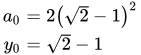
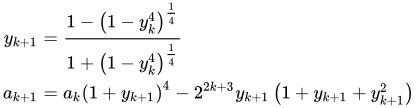
[ edit ] Start by setting[ 5]
a
0
=
2
(
2
−
1
)
2
y
0
=
2
−
1
{\displaystyle {\begin{aligned}a_{0}&=2\left({\sqrt {2}}-1\right)^{2}\\y_{0}&={\sqrt {2}}-1\end{aligned}}}
Then iterate
y
k
+
1
=
1
−
(
1
−
y
k
4
)
1
4
1
+
(
1
−
y
k
4
)
1
4
a
k
+
1
=
a
k
(
1
+
y
k
+
1
)
4
−
2
2
k
+
3
y
k
+
1
(
1
+
y
k
+
1
+
y
k
+
1
2
)
{\displaystyle {\begin{aligned}y_{k+1}&={\frac {1-\left(1-y_{k}^{4}\right)^{\frac {1}{4}}}{1+\left(1-y_{k}^{4}\right)^{\frac {1}{4}}}}\\a_{k+1}&=a_{k}\left(1+y_{k+1}\right)^{4}-2^{2k+3}y_{k+1}\left(1+y_{k+1}+y_{k+1}^{2}\right)\end{aligned}}}
Then a k 1 / π not self-correcting; each iteration must be performed with the desired number of correct digits for π 's final result.
One iteration of this algorithm is equivalent to two iterations of the Gauss–Legendre algorithm .
A proof of these algorithms can be found here:[ 6]
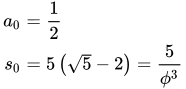
Quintic convergence [ edit ] Start by setting
a
0
=
1
2
s
0
=
5
(
5
−
2
)
=
5
ϕ
3
{\displaystyle {\begin{aligned}a_{0}&={\frac {1}{2}}\\s_{0}&=5\left({\sqrt {5}}-2\right)={\frac {5}{\phi ^{3}}}\end{aligned}}}
where
ϕ
=
1
+
5
2
{\displaystyle \phi ={\tfrac {1+{\sqrt {5}}}{2}}}
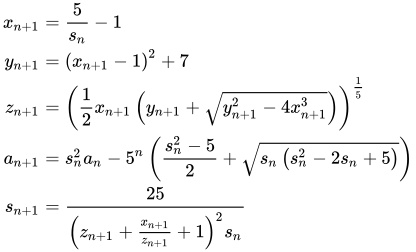
golden ratio . Then iterate
x
n
+
1
=
5
s
n
−
1
y
n
+
1
=
(
x
n
+
1
−
1
)
2
+
7
z
n
+
1
=
(
1
2
x
n
+
1
(
y
n
+
1
+
y
n
+
1
2
−
4
x
n
+
1
3
)
)
1
5
a
n
+
1
=
s
n
2
a
n
−
5
n
(
s
n
2
−
5
2
+
s
n
(
s
n
2
−
2
s
n
+
5
)
)
s
n
+
1
=
25
(
z
n
+
1
+
x
n
+
1
z
n
+
1
+
1
)
2
s
n
{\displaystyle {\begin{aligned}x_{n+1}&={\frac {5}{s_{n}}}-1\\y_{n+1}&=\left(x_{n+1}-1\right)^{2}+7\\z_{n+1}&=\left({\frac {1}{2}}x_{n+1}\left(y_{n+1}+{\sqrt {y_{n+1}^{2}-4x_{n+1}^{3}}}\right)\right)^{\frac {1}{5}}\\a_{n+1}&=s_{n}^{2}a_{n}-5^{n}\left({\frac {s_{n}^{2}-5}{2}}+{\sqrt {s_{n}\left(s_{n}^{2}-2s_{n}+5\right)}}\right)\\s_{n+1}&={\frac {25}{\left(z_{n+1}+{\frac {x_{n+1}}{z_{n+1}}}+1\right)^{2}s_{n}}}\end{aligned}}}
Then ak converges quintically to 1 / π
0
<
a
n
−
1
π
<
16
⋅
5
n
⋅
e
−
5
n
π
{\displaystyle 0<a_{n}-{\frac {1}{\pi }}<16\cdot 5^{n}\cdot e^{-5^{n}}\pi \,\!}
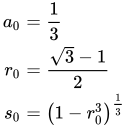
Start by setting
a
0
=
1
3
r
0
=
3
−
1
2
s
0
=
(
1
−
r
0
3
)
1
3
{\displaystyle {\begin{aligned}a_{0}&={\frac {1}{3}}\\r_{0}&={\frac {{\sqrt {3}}-1}{2}}\\s_{0}&=\left(1-r_{0}^{3}\right)^{\frac {1}{3}}\end{aligned}}}
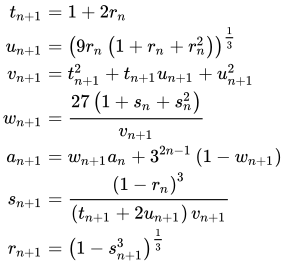
Then iterate
t
n
+
1
=
1
+
2
r
n
u
n
+
1
=
(
9
r
n
(
1
+
r
n
+
r
n
2
)
)
1
3
v
n
+
1
=
t
n
+
1
2
+
t
n
+
1
u
n
+
1
+
u
n
+
1
2
w
n
+
1
=
27
(
1
+
s
n
+
s
n
2
)
v
n
+
1
a
n
+
1
=
w
n
+
1
a
n
+
3
2
n
−
1
(
1
−
w
n
+
1
)
s
n
+
1
=
(
1
−
r
n
)
3
(
t
n
+
1
+
2
u
n
+
1
)
v
n
+
1
r
n
+
1
=
(
1
−
s
n
+
1
3
)
1
3
{\displaystyle {\begin{aligned}t_{n+1}&=1+2r_{n}\\u_{n+1}&=\left(9r_{n}\left(1+r_{n}+r_{n}^{2}\right)\right)^{\frac {1}{3}}\\v_{n+1}&=t_{n+1}^{2}+t_{n+1}u_{n+1}+u_{n+1}^{2}\\w_{n+1}&={\frac {27\left(1+s_{n}+s_{n}^{2}\right)}{v_{n+1}}}\\a_{n+1}&=w_{n+1}a_{n}+3^{2n-1}\left(1-w_{n+1}\right)\\s_{n+1}&={\frac {\left(1-r_{n}\right)^{3}}{\left(t_{n+1}+2u_{n+1}\right)v_{n+1}}}\\r_{n+1}&=\left(1-s_{n+1}^{3}\right)^{\frac {1}{3}}\end{aligned}}}
Then a k 1 / π [ 7]
↑ Jonathan M. Borwein, Peter B. Borwein, Pi and the AGM – A Study in Analytic Number Theory and Computational Complexity , Wiley, New York, 1987. Many of their results are available in: Jorg Arndt, Christoph Haenel, Pi Unleashed, Springer, Berlin, 2001, ISBN 3-540-66572-2 ↑ Bailey, David H (2023-04-01). "Peter Borwein: A Visionary Mathematician" . Notices of the American Mathematical Society . 70 (4): 610– 613. doi :10.1090/noti2675 ISSN 0002-9920 . ↑ Borwein, J.M.; Borwein, P.B. (1993). "Class number three Ramanujan type series for 1/π" . Journal of Computational and Applied Mathematics . 46 (1– 2): 281– 290. doi :10.1016/0377-0427(93)90302-R ↑ Arndt, Jörg; Haenel, Christoph (1998). π Unleashed 236. ISBN 3-540-66572-2 ↑ Mak, Ronald (2003). The Java Programmers Guide to Numerical Computation . Pearson Educational. p. 353. ISBN 0-13-046041-9 ↑ Milla, Lorenz (2019), Easy Proof of Three Recursive π -Algorithms , arXiv :1907.04110 ↑ Henrik Vestermark (4 November 2016). "Practical implementation of π Algorithms" (PDF) . Retrieved 29 November 2020 .