


Böttcher's equation
Böttcher's equation, named after Lucjan Böttcher, is the functional equation

where
- h is a given analytic function with a superattracting fixed point of order n at a, (that is, in a neighbourhood of a), with n ≥ 2
- F is a sought function.

The logarithm of this functional equation amounts to Schröder's equation.
Solution
[edit]Solution of functional equation is a function in implicit form.
Lucian Emil Böttcher sketched a proof in 1904 on the existence of solution: an analytic function F in a neighborhood of the fixed point a, such that:[1]

This solution is sometimes called:
- the Böttcher coordinate
- the Böttcher function[2]
- the Boettcher map.
The complete proof was published by Joseph Ritt in 1920,[3] who was unaware of the original formulation.[4]
Böttcher's coordinate (the logarithm of the Schröder function) conjugates h(z) in a neighbourhood of the fixed point to the function zn. An especially important case is when h(z) is a polynomial of degree n, and a = ∞ .[5]
Explicit
[edit]One can explicitly compute Böttcher coordinates for:[6]
- power maps
- Chebyshev polynomials

Examples
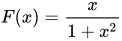
[edit]For the function h and n=2[7]
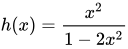
the Böttcher function F is:
Applications
[edit]Böttcher's equation plays a fundamental role in the part of holomorphic dynamics which studies iteration of polynomials of one complex variable.
Global properties of the Böttcher coordinate were studied by Fatou[8] [9] and Douady and Hubbard.[10]
See also
[edit]References
[edit]- ↑ Böttcher, L. E. (1904). "The principal laws of convergence of iterates and their application to analysis (in Russian)". Izv. Kazan. Fiz.-Mat. Obshch. 14: 155–234.
- ↑ J. F. Ritt. On the iteration of rational functions . Trans. Amer. Math. Soc. 21 (1920) 348-356. MR 1501149.
- ↑ Ritt, Joseph (1920). "On the iteration of rational functions". Trans. Amer. Math. Soc. 21 (3): 348–356. doi:10.1090/S0002-9947-1920-1501149-6.
- ↑ Stawiska, Małgorzata (November 15, 2013). "Lucjan Emil Böttcher (1872–1937) - The Polish Pioneer of Holomorphic Dynamics". arXiv:1307.7778 [math.HO].
- ↑ Cowen, C. C. (1982). "Analytic solutions of Böttcher's functional equation in the unit disk". Aequationes Mathematicae. 24: 187–194. doi:10.1007/BF02193043.
- ↑ math.stackexchange question: explicitly-calculating-greens-function-in-complex-dynamics
- ↑ Chaos by Arun V. Holden Princeton University Press, 14 lip 2014 - 334
- ↑ Alexander, Daniel S.; Iavernaro, Felice; Rosa, Alessandro (2012). Early Days in Complex Dynamics: A history of complex dynamics in one variable during 1906–1942. American Mathematical Soc. ISBN 978-0-8218-4464-9.
- ↑ Fatou, P. (1919). "Sur les équations fonctionnelles, I". Bulletin de la Société Mathématique de France. 47: 161–271. doi:10.24033/bsmf.998. JFM 47.0921.02.; Fatou, P. (1920). "Sur les équations fonctionnelles, II". Bulletin de la Société Mathématique de France. 48: 33–94. doi:10.24033/bsmf.1003. JFM 47.0921.02.; Fatou, P. (1920). "Sur les équations fonctionnelles, III". Bulletin de la Société Mathématique de France. 48: 208–314. doi:10.24033/bsmf.1008. JFM 47.0921.02.
- ↑ Douady, A.; Hubbard, J. (1984). "Étude dynamique de polynômes complexes (première partie)". Publ. Math. Orsay. Archived from the original on 2013-12-24. Retrieved 2012-01-22.; Douady, A.; Hubbard, J. (1985). "Étude dynamique des polynômes convexes (deuxième partie)". Publ. Math. Orsay. Archived from the original on 2013-12-24. Retrieved 2012-01-22.