


Alexander's subbase lemma
In mathematics, specifically topology, Alexander's subbase lemma states that for a topological space to be a compact, it is necessary and sufficient that each open cover of the space consisting of sets in a (fixed) subbase has a finite subcover. Precisely,[1][2][3]
- given a topological space and a subbase for it, a subset is compact if and only if for each cover of consisting of sets in , there exists a finite subcover of it.


The lemma, also often called Alexander's subbase theorem, is due to James Waddell Alexander II. The lemma is typically used to prove Tychonoff's theorem.
Proof
[edit]If is compact, the existence of a finite cover holds by definition. So, we shall show the converse and without loss of generality, replace by .
Suppose for the sake of contradiction that the space is not compact (so is an infinite set), yet every subbasic cover from has a finite subcover. Let denote the set of all open covers of that do not have any finite subcover of Partially order by subset inclusion and use Zorn's Lemma to find an element that is a maximal element of Observe that:


- Since by definition of is an open cover of and there does not exist any finite subset of that covers (so in particular, is infinite).
- The maximality of in implies that if is an open set of such that then has a finite subcover, which must necessarily be of the form for some finite subset of (this finite subset depends on the choice of ).


We will begin by showing that is not a cover of Suppose that was a cover of which in particular implies that is a cover of by elements of The theorem's hypothesis on implies that there exists a finite subset of that covers which would simultaneously also be a finite subcover of by elements of (since ). But this contradicts which proves that does not cover


Since does not cover there exists some that is not covered by (that is, is not contained in any element of ). But since does cover there also exists some such that It follows that , because otherwise it would imply has a finite subcover of , namely the subcover contradicting Since and is a subbasis generating 's topology (together with ), from the definition of the topology generated by there must exist a finite collection of subbasic open sets with such that





We will now show by contradiction that for every If was such that then also so the fact that would then imply that is covered by which contradicts how was chosen (recall that was chosen specifically so that it was not covered by ).


As mentioned earlier, the maximality of in implies that for every there exists a finite subset of such that forms a finite cover of Define which is a finite subset of Observe that for every is a finite cover of so let us replace every with





Let denote the union of all sets in (which is an open subset of ) and let denote the complement of in Observe that for any subset covers if and only if In particular, for every the fact that covers implies that Since was arbitrary, we have Recalling that we thus have which is equivalent to being a cover of Moreover, is a finite cover of with Thus has a finite subcover of which contradicts the fact that Therefore, the original assumption that is not compact must be wrong, which proves that is compact.






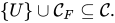

Although this proof makes use of Zorn's Lemma, the proof does not need the full strength of choice. Instead, it relies on the intermediate Ultrafilter principle.[2]
Application
[edit]Tychonoff's theorem, which states that the product of non-empty compact spaces is compact, has a short proof using the lemma.
The product topology on has, by definition, a subbase consisting of cylinder sets that are the inverse projections of an open set in one factor. Given a subbasic family of the product that does not have a finite subset which covers (we do not require is a cover of ), we can partition into subfamilies that consist of exactly those cylinder sets corresponding to a given factor space. By assumption, does not have a finite cover of . Being cylinder sets, this means their projections onto have no finite cover of . Since each is compact, these projections do not cover . Find a point not contained in any of the projections of onto . Repeating this for all yields a point which is not covered by .


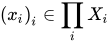
Note, that in the last step we implicitly used the axiom of choice (which is actually equivalent to Zorn's lemma) to ensure the existence of

References
[edit]- ↑ Goubault-Larrecq 2013, Theorem 4.4.29.
- 1 2 Muger, Michael (2020). Topology for the Working Mathematician.
- ↑ Rudin 1991, p. 392 Appendix A2.
- Goubault-Larrecq, Jean (2013). Non-Hausdorff Topology and Domain Theory: Selected Topics in Point-Set Topology. Cambridge University Press. ISBN 978-1-107-03413-6.
- Rudin, Walter (1991). Functional Analysis. International Series in Pure and Applied Mathematics. Vol. 8 (Second ed.). New York, NY: McGraw-Hill Science/Engineering/Math. ISBN 978-0-07-054236-5. OCLC 21163277.