


Akhiezer's theorem
In the mathematical field of complex analysis, Akhiezer's theorem is a result about entire functions proved by Naum Akhiezer.[1]
Statement
[edit]Let be an entire function of exponential type , with for real . Then the following are equivalent:


- There exists an entire function , of exponential type , having all its zeros in the (closed) upper half plane, such that


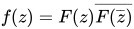
- One has:

where are the zeros of .


Related results
[edit]It is not hard to show that the Fejér–Riesz theorem is a special case.[2]
Notes
[edit]- ↑ see Akhiezer (1948).
- ↑ see Boas (1954) and Boas (1944) for references.
References
[edit]- Boas, Jr., Ralph Philip (1954), Entire functions, New York: Academic Press Inc., pp. 124–132
{{citation}}: CS1 maint: multiple names: authors list (link) - Boas, Jr., R. P. (1944), "Functions of exponential type. I", Duke Math. J., 11: 9–15, doi:10.1215/s0012-7094-44-01102-6, ISSN 0012-7094
{{citation}}: CS1 maint: multiple names: authors list (link) - Akhiezer, N. I. (1948), "On the theory of entire functions of finite degree", Doklady Akademii Nauk SSSR, New Series, 63: 475–478, MR 0027333