


Affine hull
(Redirected from Affine span)
 | This article relies on a single source. (June 2022) |
In mathematics, the affine hull or affine span of a set in Euclidean space is the smallest affine set containing ,[1] or equivalently, the intersection of all affine sets containing . Here, an affine set may be defined as the translation of a vector subspace.


The affine hull of is what would be if the origin was moved to .

The affine hull aff() of is the set of all affine combinations of elements of , that is,

Examples
[edit]- The affine hull of the empty set is the empty set.
- The affine hull of a singleton (a set made of one single element) is the singleton itself.
- The affine hull of a set of two different points is the line through them.
- The affine hull of a set of three points not on one line is the plane going through them.
- The affine hull of a set of four points not in a plane in is the entire space .

Properties
[edit]For any subsets

- .
- is a closed set if is finite dimensional.
- .
- .
- If then .
- If then is a linear subspace of .
- if .
- So, is always a vector subspace of if .
- If is convex then
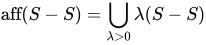
- For every , where is the smallest cone containing (here, a set is a cone if for all and all non-negative ).
- Hence is always a linear subspace of parallel to if .
- Note: says that if we translate so that it contains the origin, take its span, and translate it back, we get . Moreover, or is what would be if the origin was at .













Related sets
[edit]- If instead of an affine combination one uses a convex combination, that is, one requires in the formula above that all be non-negative, one obtains the convex hull of , which cannot be larger than the affine hull of , as more restrictions are involved.
- The notion of conical combination gives rise to the notion of the conical hull .
- If however one puts no restrictions at all on the numbers , instead of an affine combination one has a linear combination, and the resulting set is the linear span of , which contains the affine hull of .


References
[edit]- ↑ Roman 2008, p. 430 §16
Sources
[edit]- R.J. Webster, Convexity, Oxford University Press, 1994. ISBN 0-19-853147-8.
- Roman, Stephen (2008), Advanced Linear Algebra, Graduate Texts in Mathematics (Third ed.), Springer, ISBN 978-0-387-72828-5