HD 10550
| Observation data Epoch J2000 Equinox ICRS | |
|---|---|
| Constellation | Cetus[1] |
| Right ascension | 01h 42m 43.51077s[2] |
| Declination | −03° 41′ 24.7210″[2] |
| Apparent magnitude (V) | 4.98[1] |
| Characteristics | |
| Spectral type | K2/3 III CN II[3] |
| B−V color index | 1.378±0.003[1] |
| Astrometry | |
| Radial velocity (Rv) | −33.28±0.15[2] km/s |
| Proper motion (μ) | RA: −8.989[2] mas/yr Dec.: −33.238[2] mas/yr |
| Parallax (π) | 2.9564±0.1730 mas[2] |
| Distance | 1,100 ± 60 ly (340 ± 20 pc) |
| Absolute magnitude (MV) | −2.82[1] |
| Details | |
| Radius | 77[4] R☉ |
| Luminosity | 2,537[1] L☉ |
| Surface gravity (log g) | 1.83[5] cgs |
| Temperature | 4,110[5] K |
| Metallicity [Fe/H] | −0.12[5] dex |
| Rotational velocity (v sin i) | 10[6] km/s |
| Other designations | |
| BD−04°260, FK5 1049, HD 10550, HIP 7999, HR 500, SAO 129465[7] | |
| Database references | |
| SIMBAD | data |
HD 10550 is a single[8] star in the equatorial constellation of Cetus. It is a faint star but visible to the naked eye with an apparent visual magnitude of 4.98.[1] Based upon an annual parallax shift of 2.9564 mas,[2] it is located around 1,100 light years from the Sun. The star is moving closer with a heliocentric radial velocity of −33 km/s.[2] It has a high peculiar velocity of 72.7+5.7
−4.3 km/s and may be a runaway star.[9]
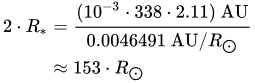
The stellar classification of this star is K2/3 III CN II,[3] showing the spectrum of an evolved K-type giant star with an overabundance of CN in the atmosphere. The measured angular diameter of this star, after correction for limb darkening, is 2.11±0.04 mas.[10] At the estimated distance of this star, this yields a physical size of about 77 times the radius of the Sun.[4] The star is radiating around 2,537[1] times the Sun's luminosity from its enlarged photosphere at an effective temperature of 4,110 K.[5]
References
[edit]- 1 2 3 4 5 6 7 Anderson, E.; Francis, Ch. (2012). "XHIP: An extended hipparcos compilation". Astronomy Letters. 38 (5): 331. arXiv:1108.4971. Bibcode:2012AstL...38..331A. doi:10.1134/S1063773712050015. XHIP record for this object at VizieR.
- 1 2 3 4 5 6 7 8 Brown, A. G. A.; et al. (Gaia collaboration) (August 2018). "Gaia Data Release 2: Summary of the contents and survey properties". Astronomy & Astrophysics. 616. A1. arXiv:1804.09365. Bibcode:2018A&A...616A...1G. doi:10.1051/0004-6361/201833051.
- 1 2 Houk, N.; Swift, C. (1999), "Michigan catalogue of two-dimensional spectral types for the HD Stars", Michigan Spectral Survey, 5, Bibcode:1999MSS...C05....0H.
- 1 2 Lang, Kenneth R. (2006), Astrophysical formulae, Astronomy and astrophysics library, vol. 1 (3 ed.), Birkhäuser, ISBN 3-540-29692-1.. The radius (R*) is given by:
- 1 2 3 4 Soubiran, C.; et al. (June 2010), "The PASTEL catalogue of stellar parameters", Astronomy and Astrophysics, 515: A111, arXiv:1004.1069, Bibcode:2010A&A...515A.111S, doi:10.1051/0004-6361/201014247, S2CID 118362423.
- ↑ Bernacca, P. L.; Perinotto, M. (1970), "A catalogue of stellar rotational velocities", Contributi Osservatorio Astronomico di Padova in Asiago, 239 (1): 1, Bibcode:1970CoAsi.239....1B.
- ↑ "HD 10550". SIMBAD. Centre de données astronomiques de Strasbourg. Retrieved 2018-07-12.
- ↑ Eggleton, P. P.; Tokovinin, A. A. (September 2008), "A catalogue of multiplicity among bright stellar systems", Monthly Notices of the Royal Astronomical Society, 389 (2): 869–879, arXiv:0806.2878, Bibcode:2008MNRAS.389..869E, doi:10.1111/j.1365-2966.2008.13596.x, S2CID 14878976.
- ↑ Tetzlaff, N.; et al. (January 2011), "A catalogue of young runaway Hipparcos stars within 3 kpc from the Sun", Monthly Notices of the Royal Astronomical Society, 410 (1): 190–200, arXiv:1007.4883, Bibcode:2011MNRAS.410..190T, doi:10.1111/j.1365-2966.2010.17434.x, S2CID 118629873.
- ↑ Richichi, A.; et al. (February 2005), "CHARM2: An updated Catalog of High Angular Resolution Measurements", Astronomy and Astrophysics, 431 (2): 773–777, Bibcode:2005A&A...431..773R, doi:10.1051/0004-6361:20042039