


Talk:Leonidas Polk
Add topic | A fact from this article was featured on Wikipedia's Main Page in the On this day section on June 14, 2018 and June 14, 2024. |
 | This article is rated C-class on Wikipedia's content assessment scale. It is of interest to the following WikiProjects: | |||||||||||||||||||||||||||||||||||||||||||||||||||||||||||||||||||||||||||||||||||||
| ||||||||||||||||||||||||||||||||||||||||||||||||||||||||||||||||||||||||||||||||||||||


.svg)


Name
[edit]I have reverted the title of the article from "Leonidas Lafayette Polk" back to "Leonidas Polk."
There was a Leonidas Lafayette Polk (1837-1892), and like the subject of this article, he was a North Carolinian and served in the War Between the States. But Leonidas Lafayette Polk survived the war, was in the North Carolina legislature, served as a newspaper editor, and outlived Bishop Polk by 27 years.
He's perhaps worthy of his own entry, but he's someone else altogether. If you do an article, we'll need a disambiguation page.
death and burial
[edit]I have reverted an uncited edit that said he was buried "in a crypt underneath the present-day altar. The original grave marker in the crypt, which can be visited, reads "He tried to do his duty."" The website of the church, http://www.saintpauls.org/history/history04.shtml, says "his remains are interred beneath the chancel window." Please provide a citation or whatever text you wish to add. Hal Jespersen (talk) 23:06, 5 July 2010 (UTC)
Foote's book, p.356 states that Polk was killed by Capt. Hubert Dilger, of the 1st Ohio Light Artillery. I do not know about the other source cited. I simply removed some of the detail, about which Union artillery unit killed him.
Photographs of Polk
[edit]As far as I can tell, we only have the two pictures of Polk, though there are apparently others of him in CSA uniform (see this and this). These highlight an issue with the image we do have of him in uniform: it appears to be a mashup of his episcopal portrait and a (dubious) uniform, and almost certainly does not provide and accurate image of his appearance during the war. OTOH the wartime pictures are rather poor.

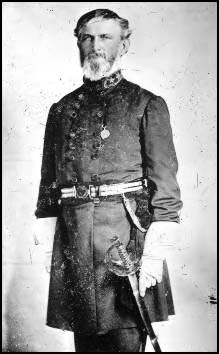
I would prefer to depict him in the various battle articles (e.g. Battle of Perryville) in uniform rather than in clericals, and I made this change for a couple already. But I would like to have an accurate picture. Any comments? Mangoe (talk) 19:21, 11 August 2011 (UTC)
- It seems likely to me that the photograph in uniform is a composite; the uniform seems to be drawn in, rather than photographed. This is only my personal opinion, however, not the judgment of a secondary source. In Kenneth Noe's book about Perryville, he cites this photograph as "courtesy Library of Congress, LC-38171-1320," but I cannot find that version online at the Library of Congress website. The Wikipedia version of this photograph was derived from the Duke University website and I question our ability to use it, based on the copyright notice listed there. I will let the copyright lawyers worry about that, but in the meantime the clerical garb works well enough for me. Hal Jespersen (talk) 16:16, 23 August 2011 (UTC)
relationship to President Polk
[edit]The lead says Leonidas was a second cousin of James Polk, while the Legacy section says he was a first cousin twice removed. These are not equivalent terms, so can anyone provide clarity? Esrever (klaT) 19:14, 16 August 2017 (UTC)
- They were second cousins. (I watched an episode of Chef Walter Staib's PBS series A Taste of History which was about the Rattle and Snap estate in Columbia TN and was built by Leonidas's parents, which mentioned both Leonidas and James and that aroused my curiosity.) I just researched their relationship by going to both men's entries on findagrave.com. Their common ancestors were their great-grandparents William Polk (1700-1757) and Margaret Taylor Polk (1703-1763). Leonidas's father was also named William Polk (1758-1834), whose father was Thomas Polk (1730-1794). President James K. Polk's father was Samuel Polk (1772-1827), whose father was Ezekiel Polk (1747-1824). Thomas and Ezekiel were brothers. Maybe whoever thought the Confederate general and the POTUS were 1st cousins twice removed confused Leonidas's father with the great-grandfather of both men, even though that still doesn't add up. [] and [] 06:05, 12 January 2025 (UTC) PhantomWSO (talk) 06:05, 12 January 2025 (UTC)
External links modified
[edit]Hello fellow Wikipedians,
I have just modified 2 external links on Leonidas Polk. Please take a moment to review my edit. If you have any questions, or need the bot to ignore the links, or the page altogether, please visit this simple FaQ for additional information. I made the following changes:
- Added archive https://web.archive.org/web/20070927082134/http://www.bryansbush.com/hub.php?page=articles&layer=a0409 to http://www.bryansbush.com/hub.php?page=articles&layer=a0409
- Added archive https://web.archive.org/web/20110727232134/http://www.saintpauls.org/cbf/polkFuneral.php to http://www.saintpauls.org/cbf/polkFuneral.php
When you have finished reviewing my changes, you may follow the instructions on the template below to fix any issues with the URLs.
This message was posted before February 2018. After February 2018, "External links modified" talk page sections are no longer generated or monitored by InternetArchiveBot. No special action is required regarding these talk page notices, other than regular verification using the archive tool instructions below. Editors have permission to delete these "External links modified" talk page sections if they want to de-clutter talk pages, but see the RfC before doing mass systematic removals. This message is updated dynamically through the template {{source check}} (last update: 5 June 2024).
- If you have discovered URLs which were erroneously considered dead by the bot, you can report them with this tool.
- If you found an error with any archives or the URLs themselves, you can fix them with this tool.
Cheers.—InternetArchiveBot (Report bug) 14:26, 15 December 2017 (UTC)
Replacing Polk's image
[edit]Hi folks, just to let you know I went ahead and changed the main image to a real photograph of him, instead of the sketching for a more realistic portrayal of what he looked like. IIRC, Wikipedia does prefer images over sketchings/paintings. Also, this is the latest image we have of him before he was killed. Does anyone have any objections? I don't see why, but that's why I'm starting this section. 154thTN Pvt. Seth Adam (talk) 01:32, 2 November 2018 (UTC)
- Deleted repeated identical image. --Taterian (talk) 01:11, 18 January 2019 (UTC)
Photograph again
[edit]I've found this and this. If this pic is not Polk, Who is? Cratón (talk) 18:14, 26 September 2019 (UTC)
== "Although his [Polk's] record as a field commander was poor..." I take issue with this statement. I don't know anything of Polk when he was with Bragg but his performance as commander of the Confederate army at the Battle of Belmont was stellar as well as his commanding the Third Corps (the Army of Mississippi) of Gen. Johnston's Army of Tennessee. The comment about poor performance during the Meridian Campaign is also incorrect. Although his army should have confronted Sherman at Morton, Miss. he left that decision to the commanders there. Sherman's Meridian Campaign was not the success most think since his primary goal was either Selma or Mobile but he was stalled at Meridian because his left wing of cavalry was routed and sent back to Memphis by Forrest and his cavalrymen. Gen. Sherman waited in Meridian a few weeks but finally returned to Vicksburg having heard not one word as to what happened to his entire left wing of cavalry. Also naming a Union battery that fired upon Polk and suggesting that battery killed him should not be elaborated upon since there are several batteries that claimed they were the ones who killed Bishop Gen. Polk, the 5th Indiana Battery being one of several. Rjr1960 (talk) 23:29, 27 November 2019 (UTC)
Slaves & other apologia
[edit]I see he is called a "prosperous planter" but I don't see any mention of the number of people he kept in bondage, nor do I see his opinions on slavery.
I don't see mention of his command of Forrest who did the Fort Pillow massacre of Black soldiers, nor his telegraph to Forrest after the massacre became well-known, where he expressed contentment with Forrest.
This stuff should probably be added.
https://eji.org/news/fort-polk-louisiana/ ~2026-11661-94 (talk) 04:13, 7 April 2026 (UTC)
Use of quote box questioned
[edit]I removed a quote box placed at the beginning of the Battle of Shiloh section. The quote, attributed to "Leonidas Polk, July 1861", is:
- We have protested, and do protest, that all we desire is to be let alone, to repose in quickness under our own vine and our own fig tree. We have sought, and only sought, the undisturbed employment of the inherent and indefeasible right of self-government...
My comment on the edit: rm random quote box, unrelated to preceding and following sections. Its only value appears to be as wartime propaganda, so not encyclopedic.
User:DeoVindice reverted this, commenting: One of Polk's most famous quotes and reveals his motivation for fighting. It has historical value.
I do not think the comment addresses my concerns. It introduces new ones.
- The quote box is unrelated to the preceding and following sections.
- The quote has political content, justifying the Confederate cause. (It draws some of its rhetorical force from the Bible (Micah 4:4).) This is not encyclopedic content.
- This may be "one of Polk's most famous quotes" without being a "famous," hence notable, quote.
- If the quote does belong in the article, it belongs in context, supported by sources — not in a box divorced from context. ("Leonidas Polk, July 1861" is not sufficient context.)
DeoVindice says the quote has historical value. I say it doesn't belong in an encyclopedia, especially not in a quote box. — ℜob C. alias ALAROB 18:29, 18 May 2026 (UTC)
- The quote is important. Polk frames secession as a natural rights argument rooted in the American revolutionary tradition, echoing the Declaration of Independence's language of inherent rights. This was the standard Confederate constitutional argument: that states retained sovereign authority and that secession was a legitimate exercise of self-determination. The quote is historically significant not for its truth, but for what it reveals about how Polk constructed and sold the Confederate ideology — blending scripture, natural rights philosophy, and victimhood rhetoric into a memorable statement. DeoVindice (talk) 23:50, 18 May 2026 (UTC)
- Thanks, I agree that the article doesn't say much about Polk's ideology or philosophy. The section "Early life and education" covers his whole career through the founding of the University of the South. What about a new section there that deals with his career as a priest and southern nationalist? That's where the quote (or part of it) could go. It would make sense there.
- The section could be called "Career".
- I think we should refrain from defining a "standard Confederate constitutional argument" in an article about an individual -- any individual -- especially a military leader who held no political office.
- Do you have sources in mind? E.g. for Polk as blending scripture, natural rights, and victimhood in his rhetoric. If so, the quote makes a good example. I'd suggest making the reference to the Book of Micah explicit. — ℜob C. alias ALAROB 20:19, 19 May 2026 (UTC)
- I agree with you, I would want to see a weight of recent sources (so not written during the golden age of the lost cause myth) claiming this quote is so important to justify boxing it instead of linking to wikiquotes. And I also strongly agree with the start of your second paragraph. If we are to include such a quote in the meantime, we need to balance it by putting it into context that obviously the south caused the war because they were scared they would be forced to give up their human chattel. ~2026-11661-94 (talk) 15:01, 22 May 2026 (UTC)
- Selected anniversaries (June 2018)
- Selected anniversaries (June 2024)
- C-Class biography articles
- C-Class biography (military) articles
- Mid-importance biography (military) articles
- Military biography work group articles
- WikiProject Biography articles
- C-Class United States articles
- High-importance United States articles
- C-Class United States articles of High-importance
- C-Class Kentucky articles
- High-importance Kentucky articles
- WikiProject Kentucky articles
- Kentucky articles needing attention
- United States articles needing attention
- WikiProject United States articles
- C-Class Tennessee articles
- Mid-importance Tennessee articles
- C-Class Christianity articles
- Low-importance Christianity articles
- C-Class Anglicanism articles
- Low-importance Anglicanism articles
- WikiProject Anglicanism articles
- WikiProject Christianity articles
- C-Class Georgia (U.S. state) articles
- Mid-importance Georgia (U.S. state) articles
- WikiProject Georgia (U.S. state) articles
- C-Class military history articles
- C-Class North American military history articles
- North American military history task force articles
- C-Class United States military history articles
- United States military history task force articles
- C-Class American Civil War articles
- American Civil War task force articles