


Talk:Derivative (multivariable calculus)
Add topic| This is the talk page for discussing improvements to the Derivative (multivariable calculus) article. This is not a forum for general discussion of the subject of the article. |
Article policies
|
| Find sources: Google (books · news · scholar · free images · WP refs) · FENS · JSTOR · TWL |
 | This  level-5 vital article is rated B-class on Wikipedia's content assessment scale. level-5 vital article is rated B-class on Wikipedia's content assessment scale.It is of interest to the following WikiProjects: | ||||||||||||||||||||
| |||||||||||||||||||||
.jpg)


Relative error
[edit]At present, the article says: "in multiplication, the total relative error is the sum of the relative errors of the parameters." but I'd think this is not completely correct... for this to be true in general, don't we need to assume the errors of the parameters to be independent, and indeed to further qualify that this is correct true to first-order for small relative errors (i.e., it is a linearization in the size of the fractional error)? But I don't dare to correct the article myself since I'm not confident in my statistical abilities... --67.174.192.178 07:54, 13 September 2005 (UTC)
- You are right that this depends on the underlying assumptions of the error model (it's also a worst-case analysis). Ideally, there should be an article somewhere explaining this that we could link to, but I cannot find one. It might be a bit too much to explain the error model (which is by the way the usual one in measurements, I think) in this article. Do you have any suggestions on the best way to tackle this? -- Jitse Niesen (talk) 13:38, 13 September 2005 (UTC)
Some Serious Issues
[edit]Alright this page seems to have some serious issues
1) It is extremely confusing and unclear.
2) The references to differential operator seem confused. The cannonical differential operator is the map from functions to their derivitive. The derivitive itself is not a differential operator (in general) but the result of appling the differentiation operator to the function.
3) Δf doesn't equal f_x|Δx| + ..
4) Calling the total derivitive the sum of all partial derivitives is totally misleading. If df/dx=3 and df/dy=2 then the total derivitive is NOT 5
I'm going to try to rework this page but I may not finish and it is possible I am screwing up some terms since real analysis isn't the area of mathematics I work in. Logicnazi 23:19, 10 August 2006 (UTC)
- The total differential is widely used as a method of estimating errors, with the assumption that the variables are independent. You can't just plainly remove this from the article. --Vuo 19:06, 11 August 2006 (UTC)
- Could you give a reference? I never quite understood that part of the article. I think it is basically the meaning "derivative taking indirect dependencies into account", but I'd like to check. By the way, you marked your revert as a minor edit; I assume that was an oversight. -- Jitse Niesen (talk) 03:57, 12 August 2006 (UTC)
- I merged both versions for the moment, but we really need a reference for this. The formula
- Δf = fx |Δx| + fy |Δy| +...
- indeed needs some explanation. Are higher order terms ignored? Is Δf to be understood in some statistical sense? Why the absolute value? -- Jitse Niesen (talk) 04:10, 12 August 2006 (UTC)
In my opinion, one could help readers a lot by simply observing that it makes no sense to talk about a derivative of a function when the function is not (yet) defined. If you have defined a sufficiently smooth function of, say, three arguments, you can only define the partial derivatives of that function with respect to these three arguments. If you define the composition of this function with other functions in order to, eventually, obtain a function with a single argument, you can define the ordinary derivative (which is then exactly the same thing as the partial derivative) of this composed function with respect to this single argument. That's all, I don't need to understand anything else than differentiation with respect to arguments. Total derivative is just the name for an intermediate object appearing in the derivative of a composite function. Bas Michielsen (talk) 16:25, 8 September 2008 (UTC)
- Agreed. I find this page extremely confusing. As far as I know, the only standard meaning of "total derivative" is the one you described (the first in the list of the article). This page should be rewritten, and should explicitely state that "total derivative" IS NOT to be confused with other closely related but different meanings (such as "total differential"). From a pedagogical point of view, it is almost always better to stricly separate things even if the difference vanishes under some circumstances or if it may be fuzzy in practice. Flavio Guitian (talk) 22:41, 10 April 2009 (UTC)
Clean-up
[edit]I've made the existing material on this page mathematically correct (I hope) and added some material. I don't think the page is yet complete, but this is all I want to do for the time being. Geometry guy 18:44, 25 February 2007 (UTC)
- (Well, I added a few minor points. I noticed that some authors/editors distinguish between (total) derivative and (total) differential. Is this widespread? I mentioned both terminologies anyway. Geometry guy 23:48, 20 March 2007 (UTC))
- The current version is quite clean until the Application of the total derivative to error estimation section, where the formulae need to be correctly formatted into tex. 163.1.14.45 07:19, 25 July 2007 (UTC)
- The first two bullet points appear to be the same. Moreover, the introduction is written like a (very brief and unclear) first section, or a couple of sections. If the differences are that pronounced, shouldn't this have a disambiguation page? Also, the synonyms should be removed or put under a "Other meanings" type section. Do we know who wrote the original page? — Preceding unsigned comment added by 86.163.9.39 (talk) 19:41, 27 September 2013 (UTC)
Final periods within math tags
[edit]I now see that this is an issue of color preferences and dictates -- and ultimately, an accessibility issue.
Wikipedia now uses glaring bright white backgrounds for all formula-images. I don't let the page's style sheet render because it dictates a bright white background. My system is set to use a much more subdued amber-ish background for text.
PNG images can be created with transparent backgrounds. Why not use transparent backgrounds for these images instead of dictating that visitors must endure the glaring bright white backgrounds?
If the image backgrounds were transparent and the visitor doesn't know how to tone down the Windows duh-fault setting of a glaring bright white background, they'll continue to be blinded as before. But if a visitor has a background color preference, why punish them with bright white backgrounds in formulas?
As is, the final punctuation in formula-images are potentially confusing if the vistor's background color is not glaring bright white.
At first glance in my amber-ish background, the first formula in the latest edit (00:05, 23 September 2007) looks like the denominator in the last term might be @x@z' -- z-prime being a previously-unseen variable or some unfamiliar notation.
This would be a non-issue for me (and others who are using their own color schemes) if the background color in the PNG images was transparent.
It's an accessibility issue. Everyone's eyesight is not so tolerant of the abuse that Windows inflicts on people with the duh-fault bright white background. It promotes eye strain or worse.
I suggest that Wikipedia make use of the transparent-background capability of the PNG image format when rendering formulae as images.
-- Ac44ck 07:50, 23 September 2007 (UTC)
- The topic of locating punctuation is addressed in the manual of style:
- http://en.wikipedia.org/wiki/Wikipedia:Manual_of_Style_(mathematics)#Punctuation
- Just as in mathematics publications, a sentence which ends with a formula must have a period at the end of the formula. If the formula is written in LaTeX, that is, surrounded by the ... tags, then the period needs to also be inside the tags
- That the background color is bright white (rather than transparent) still seems to me like capitulation to the user-abusive Windows duh-fault settings. -- Ac44ck 00:23, 25 October 2007 (UTC)
Confusing Definition
[edit]Can somebody use simple sentences to define total derivative? The definition is very confusing with too many punctuations.
128.233.111.111 (talk) —Preceding comment was added at 23:53, 28 November 2007 (UTC)
I've modified the opening definition to be less confusing. And I have used t,x and y as the variables, because I find it very easy to grasp that other variables may have a mandatory dependency on time: easier than to grasp that z and y may depend on x. Darrel francis (talk) 21:49, 19 December 2007 (UTC)
- I've modified everything (in the first definition) to be in terms of t. There were still some z's in the equation that were not mentioned anywhere else. Note that the differential operator is *not* using total derivatives WITHIN the operator, while the explicit definition is. Maybe someone should clear that up. --TedPavlic | talk 13:38, 20 December 2007 (UTC)
Same definition, in an other way - more clear?
[edit]What do you think of my section User:Saippuakauppias/Fréchet (in fact, I samw this article much after. However, I think, in my version it's quite clear and more explicit, then here. What do you think of? - Please post your comments to the articles Talk site. Thanks for your comments! --Saippuakauppias ⇄ 19:22, 28 April 2008 (UTC)
Intuition, diagram?
[edit] | It is requested that one or more mathematical diagrams be included in this article to improve its quality. Specific illustrations, plots, or diagrams can be requested at the Graphics Lab. For more information, refer to discussion on this page and/or the listing at Wikipedia:Requested images. |
I would like to see a diagram and some discussion of the intuitive meaning of the total derivative. It seems like it comes up when I have a function of several variables with constraints among those variables. (I can't see what it means without constraints among the arguments.) If I have and constrain it with , then is a surface over a 2D domain and the constrained problem is a line on that surface. The partial derivative, , is just the slope of f in the y direction. The total derivative of the constrained problem is:



which is the slope along the constrained line (right?). What about the case when there is no constraint: when you just have a surface over an n-dimensional domain? Does the total derivative have meaning?
A diagram of this setup with would be helpful to show this distinction. —Ben FrantzDale (talk) 14:57, 12 December 2008 (UTC)
Hi I like your thinking. partial derivatives are slopes in unit vector directions. I will try to draw this on geogebra software and post it up petite (talk) 10:56, 30 January 2022 (UTC)
Redundant Page
[edit]What this page describes is the normal Liebniz derivative. The author(s) appear to have missed the point of the chain rule! I've put in a page delete request. 202.173.164.129 (talk) 11:34, 1 April 2012 (UTC)
Simpler more general demonstration?
[edit]I think the importance of total derivatives or divergences as they are called in the Calculus of Variations is not fully demonstrated here. Certainly for any parameter invariant Lagrangian (or Lagrangian density) where each of the coordinate parameters are on an equal footing, the following holds true:



This is often used and exploited in quantum field theory and General Relativity. I think an explanation along these lines needs to be included. Integration over an infinite range usually demands that "surface" terms go to zero. The order of integration does not matter in the most general cases of applicability to real problems. TonyMath (talk) 03:10, 9 April 2012 (UTC)
- No response so far. If nobody objects, can I not simply add this material to the article itself?TonyMath (talk) 02:10, 23 April 2012 (UTC)
- ok I put it in and added a reference. Let's see if anyone objects :-) TonyMath (talk) 01:15, 24 April 2012 (UTC)
- Objection! I do not think this is helpful at all. It is unclear what you want to tell with this. To me almost no word you are writing makes sense here. If you can clarify this, we can certainly discuss weather this is helpful in the article. For now, I would remove this part. Regards. Falktan (talk) 17:18, 19 October 2012 (UTC).
A total derivative is not a total differential
[edit]The intro claims, without a source, that "total derivative" can mean the same thing as "total differential". That's just not right--a total derivative is, roughly speaking, the ratio of differentials. So for example if
- x = f(y(t), t)
then the total differential of f is
- fyytdt + ft dt,
while dividing this through by dt gives the total derivative dx/dt.
This has been mentioned a couple of times in years past on this talk page. Since no one has disagreed and no one has put in a reference refuting this point, I'm taking out the false assertion. Loraof (talk) 16:46, 12 May 2015 (UTC)
- I just put at the start . It would be nice if someone added a section at the end explaining the difference, as is done briefly by Loraof above, but fleshed out a bit more. --editeur24 (talk) 04:26, 15 December 2020 (UTC)
- Hi. I just modified this article to clarify the difference between the total derivative and the total differential. Yes, they are definitely different concepts although the total derivative can be used to calculate the total differential. Goodphy (talk) 08:35, 23 November 2025 (UTC)
how to find df/dz if z is a function of x and y?
[edit]d(f(z(x,y)))/dz = ?
Conservation of mass(continuity equations)
[edit]Hi, I came here to review total derivative idea after watching geodynamics and in it they wrote total derivative in a 'strange' way. I thought someone more knowledge could explain why continuity equation is expresses in the form df/dt = partial-wrt-time(f)+∆.(fv) , with the dot product. After applying Leibnitz product we have an extra term f(∆.v) hence this is not like total derivative in the article. My suspicion is that the first definition of tot derivative is the most general and explains this continuity equation . the familiar total derivative without the extra term is due to f domain being flat(R^m) . proving this is a challenge , I am not mathematician , I am just user. Can someone please include this subtlety as I think it is useful for applications petite (talk) 23:03, 29 January 2022 (UTC)
Sorry for errors, I CNT find edit button petite (talk) 23:05, 29 January 2022 (UTC)
Application to Navier-stoke equation
[edit]Navier stoke equation can be thought of as total derivative of momentum density equaling body forces - which is analogous to newtons law- provided the definition of total derivative is extended such that after partial derivative wrt time , we have diffusive terms minus convective time: Total derivative = partial-wrt-time + diffusion - convectiin. d(pv)/dt= partial-wrt-t(f)+v.∆(pv) -∆.S=f ,, S is stress, f is body forces petite (talk) 23:37, 29 January 2022 (UTC)
Small error in definition?
[edit]The page gives the definition as

where we have

but this would appear to not make sense as we must have . Should it perhaps be ? I'm rusty on my analysis and so wanted another set of eyes before making a change.


Too formal too soon?
[edit]Could we add a more Basic Calculus Explanation before the section on a Linear Map? Meaning starting with an example more like a derivative of of a two variable function with respect to a parameter. I think going from there to the fascinating differential form would flow nicely. Then finish up with Linear Maps, and Frechet Differentials. RussellSmart32 (talk) 20:06, 9 September 2024 (UTC)
- Frechet * Derivatives * RussellSmart32 (talk) 20:13, 9 September 2024 (UTC)
Article subject/title mismatch
[edit]It strikes me that the article's title does not quite match the actual content. While the linear operator may be called the "total derivative" in some contexts, especially in contrast with partial derivatives, I think this usage is relatively uncommon compared with simply "derivative" or, in some settings, "differential". The terminology "total derivative" is more often used in multivariable calculus and applications for situations in which a function depends on variables that themselves depend on another variable, so that one distinguishes, for example, the derivative of from the derivative of along a parametrized dependence of its inputs. These cases are usually expressible in terms of composition and the chain rule, but the pedagogical and notational issue is different from the bare definition of as a linear map. In some applied contexts, such as thermodynamics, the question of whether a differential is being made "total" can also depend on which variables are regarded as ultimately independent or dependent (while the differential of the function is well-defined regardless of which variables one declares as intermediate). I propose to move this article to derivative in several variables Sławomir Biały (talk) 07:32, 3 May 2026 (UTC)

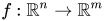

- The standard names for the linear transformation are "the differential" and "the derivative," and the standard notations for it are df and Df. (The names are also used in other senses.) See Williamson, Crowell, and Trotter, Calculus of Vector Functions, 2nd ed., pp. 143, 145; Loomis and Sternberg, Advanced Calculus, rev. ed., p. 142; Hirsch and Smale, Differential Equations, p. 178; and Lang, Calculus of Several Variables, p. 208–209. The proposed name is wholly inappropriate; for if the "several variables" were a single variable, the derivative would be a number or vector, which are not linear transformations. Moreover, the name is likely to be interpreted to refer to the partial derivative; a better one would be "derivative of a vector function."
- On the "little o," see Lang, p. 209; and Loomis and Sternberg, pp. 137, 139. No norm sign is needed in the equation ε(x) = o(x). It is only needed in an equation like ε(x) = o(|x|2), because one cannot square a vector. Therefore, one can write simply f(a + h) = f(a) + Dfa(h) + o(h), instead of f(a + h) = f(a) + Dfa(h) + ε(h) where |ε(h)| = o(|h|), as the article now does. Zophar (talk) 18:28, 5 May 2026 (UTC)
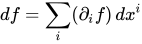
- Right, but the title of this article is "total derivative". That's my point. Total derivative has a separate, more specific meaning. I am open to a different title suggestion. I agree that is often called the "differential" in advanced calculus texts, and that terminology should be mentioned, but probably not emphaized. I am reluctant to treat "differential" as simply interchangeable with the topic of this article. In Euclidean coordinates the differential/tangent map is represented by the same linear map or Jacobian matrix, but the term "differential" also has broader uses: for scalar-valued functions it is often presented as the one-form , and in differential geometry it is the coordinate-independent tangent map . Those notions are closely related to the derivative discussed here, but they are not quite the same article topic. I guess I wouldn't insist too much on this if the article actually makes clear the sense in which "differential" is the same as "derivative", but it strikes me as potentially misleading without more careful elaboration. I would not rely on Loomis and Sternberg here, the text is not at all a standard one, and looking at it, it seems very idiosyncratic and reader-unfriendly. (If that is the sort of thing we would have to do to make derivative=differential in the article, then probably we shouldn't do it.) Regarding the little-oh point, I see what you mean. Sławomir Biały (talk) 18:56, 5 May 2026 (UTC)

Definition of best affine approximation
[edit]Let f, g, and h be functions with the same domain and codomain. (1) g is at least as good an approximation to f near a point as h iff there is a neighborhood of the point on which |f − g| ≤ |f − h|. (2) g is an equally good approximation iff there is a neighborhood on which |f − g| = |f − h|. (3) g is a better approximation iff g is at least as good but not an equally good approximation. (4) Then g is a better or equally good approximation iff g is at least as good an approximation.
(5) The relation "equally good" is an equivalence relation, and the equivalence classes are partially ordered by the relation "at least as good."
Now let g be an affine function. (6) g is a best affine approximation iff g is at least as good an approximation as any affine function. (7) g is the best affine approximation iff, in addition, there is no other best. (8) That there is no better does not imply that it is the best or even a best.
An elementary proof that the tangent line is the best affine approximation may be found on the web page Proof that derivative is the best linear approximation? (Set ε = 1.) The proof does not generalize to higher dimensions. Zophar (talk) 18:42, 18 May 2026 (UTC)
- I believe this doesn't work in higher dimensions at all. For example, if , then the affine function is not comparable to the tangent plane approximation at (which ought to be the "best"). Every neighborhood of (0,0) contains points where and where . Sławomir Biały (talk) 19:01, 18 May 2026 (UTC)


- B-Class level-5 vital articles
- Wikipedia level-5 vital articles in Mathematics
- B-Class vital articles in Mathematics
- B-Class physics articles
- Mid-importance physics articles
- B-Class physics articles of Mid-importance
- B-Class mathematics articles
- Mid-priority mathematics articles
- Wikipedia requested mathematical diagrams