


Talk:Bisection
Add topic | This  level-5 vital article is rated C-class on Wikipedia's content assessment scale. level-5 vital article is rated C-class on Wikipedia's content assessment scale.It is of interest to the following WikiProjects: | ||||||||||
| |||||||||||

Spanish names
[edit]In Spanish there are two different words for bisector (angle bisector) and perpendicular bisector, namely, bisectiz and mediatriz. Maybe it would be a good idea to separate these two concepts and link them with their Spanish equivalents. — Preceding unsigned comment added by 148.220.23.14 (talk) 16:46, 20 June 2007 (UTC)
- Same in catalan: Bisectriu (angle bisector) and mediatriu (segment bisector). The iw should be double.--83.33.82.168 (talk) 22:14, 18 February 2009 (UTC)
- Picture Bisectors.svg is cut in the article, and the E letter is seen as another F — Preceding unsigned comment added by Oabernhardt (talk • contribs) 10:22, 8 December 2011 (UTC)
Bisection construction
[edit]The construction of the bisection is technically valid, but is implicitly invoking the Compass equivalence theorem. To construct this with a collapsible compass: the two second circles should be constructed by intersecting them with the intersection of the two 'original' lines. 83.117.16.56 (talk) 21:20, 21 January 2015 (UTC)
Distinguish: dissection
[edit]bisect vt : to divide into two usu. equal parts ~ vi : SEPARATE; also : CROSS, INTERSECT
dissect vt 1: to separate into pieces : expose the several parts (as of an animal) for scientific examination 2: to analyze and interpret minutely ~ vi : to make a dissection
(Webster's Seventh New Collegiate Dictionary)
These two terms look similar, are pronounced almost identically, and have similar meanings. Per WP:HAT the Distinguish template "can be used when there can be confusion with a similar term." Since this template results in only one line at the beginning of the article and helps readers to distinguish the two terms, I see no good reason to remove it.—Anita5192 (talk) 17:49, 30 November 2016 (UTC)
- A week has passed and no one has posted a good reason for the removal of the template, so I have put it back the way it was. Before removing it again, please discuss here first.—Anita5192 (talk) 19:02, 8 December 2016 (UTC)
- It seems very unlikely to me that very many will confuse the two. Paul August ☎ 19:58, 8 December 2016 (UTC)
- It seems very likely to me.—Anita5192 (talk) 20:04, 8 December 2016 (UTC)
- I vote against keeping this template. Few people confuse bisection and dissection, and I see no reason to clutter this article with this unnecessary "Not to be confused" notice. If all potential confusions were similarly indicated on Wikipedia, nobody would read it. J.P. Martin-Flatin (talk) 14:27, 20 December 2016 (UTC)
Perpendicular bisector equation
[edit]The following text was recently inserted into the section, Line segment bisector:
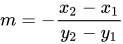
- Algebraically, the perpendicular bisector of a line segment with endpoints and is given by the equation



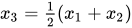
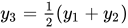
The equation is correct, but implicit and hence not very practical. I recommend changing the equation to the following:
- , where , , and .

— Anita5192 (talk) 00:55, 13 December 2017 (UTC)
- Two years have passed and no one has responded, so I made the change.—Anita5192 (talk) 17:23, 10 April 2020 (UTC)
Diagrams
[edit]Can the first/top diagram be removed. It does nothing to explain bisection and is confusing trying to incorporate so many "examples" in one diagram. For example, how ED is considered a line segment bisector is unknown. JeffCampsall (talk) 22:32, 23 September 2026 (UTC)
- ED is a bisector of the segment because it divides the segment's length into two equal pieces, but it's not a perpendicular bisector; the image doesn't do a great job of depicting this though.
- Overall, I agree that the image is confusing, and we could make a better one. –jacobolus (t) 00:36, 24 September 2026 (UTC)
“Something”
[edit]In the iOS app, the subtitle for bisection is "Division of something into two equal or congruent parts". And the first sentence is "In geometry, bisection is the division of something into two equal or congruent parts (having the same shape and size)." Something? How about "geometric figure"? And how about "In geometry, bisection is the division of a geometric figure into two congruent parts, each part having the same shape and size as the other."
JeffCampsall (talk) 18:25, 24 September 2026 (UTC)
Median of a triangle
[edit]Does a median of a triangle bisect the bisect the side? If so, how? I know that the median bisects the area into two equal areas. JeffCampsall (talk) 19:12, 27 September 2026 (UTC)
- I don't understand what you mean by
"If so, how?"
- The median bisects the side, because one of its endpoints is the midpoint of the side; it also bisects the area, dividing the triangle into two smaller triangles of equal area. –jacobolus (t) 19:58, 27 September 2026 (UTC)
- How is the median "constructed" such that it determines where the midpoint is?
- JeffCampsall (talk) 20:23, 27 September 2026 (UTC)
- Are you asking how to find the midpoint of a line segment using a straightedge and compass? –jacobolus (t) 23:09, 27 September 2026 (UTC)
- No. What I'm trying to get at is that various sources of geometry knowledge all have different "definitions"or "explanations" for the same thing. Which makes me question the source.
- For example, "The bisector of a line segment is a line which meets the line segment at its midpoint."
- But it's the chicken or the egg. Any number of line can meet the line segment at its midpoint without it being a bisector".
- Does the bisector determine the midpoint or the midpoint determine the bisector (since a point can be a bisector). Bisection or bisecting is the act of dividing. A line passing through the midpoint is just a line passing through the midpoint.
- Thoughts? JeffCampsall (talk) 23:56, 27 September 2026 (UTC)
- Any line which intersects the midpoint of a line segment is a "bisector", by definition. –jacobolus (t) 03:16, 28 September 2026 (UTC)
- Are you asking how to find the midpoint of a line segment using a straightedge and compass? –jacobolus (t) 23:09, 27 September 2026 (UTC)
Internal/external bisector of an angle
[edit]How does the description of internal/external bisects of an angle relate to the article on internal/external angles? The definitions of internal angle seem to disagree. JeffCampsall (talk) 14:13, 28 September 2026 (UTC)
- The internal bisector bisects the internal angle, and the external bisector bisects the external angle. –jacobolus (t) 08:10, 29 September 2026 (UTC)
Incenter diagram
[edit]Since there are not indications on the diagram the the red line are angle bisectors, it would be reasonable to assume that they are medians of the triangle. The lines appear to bisect each side. Instead, the angles need to be symbolized to indicate angle bisection and the red bisection lines need to only go slightly passed the incenter so as to not meet the sides. Thought? JeffCampsall (talk) 02:03, 29 September 2026 (UTC)
- Feel free to make a better diagram. I think that the caption and the text which directly state that they are angle bisectors should probably alert readers to that though, so if you don't feel like making a better diagram, the current one also seems passable. (I'm not sure removing this information from the caption was helpful.) –jacobolus (t) 02:48, 29 September 2026 (UTC)
Angle bisector theorem
[edit]That's a whole lot of words (relatively speaking). What about "an angle bisector of a triangle divides the opposite side into two line segments with lengths proportional to the lengths of the other two sides. JeffCampsall (talk) 15:48, 30 September 2026 (UTC)
Sub-sections of Concurrencies and Collinearities
[edit]Why are the sections for "Angle Bisector Theorem", "Lengths", and "Integer Triangles" under the section "Concurrencies and Collinearities"? JeffCampsall (talk) 23:07, 30 September 2026 (UTC)