Engineering is the practice of systematically applying natural science and mathematics to design and improve systems, devices, or processes that solve problems under constraints. It is typically motivated by satisfying human needs, resulting in creations such as bridges, engines, smartphones, pacemakers, the internet, spacecraft, and washing machines. Engineering involves balancing competing demands such as safety, performance, aesthetics, cost, laws and regulations, and time, while operating within fundamental limits such as the laws of physics.
As a human endeavor, engineering has existed since ancient times, starting with the six classic simple machines. Examples of large-scale engineering projects from antiquity include impressive structures like the pyramids, elegant temples such as the Parthenon, and water conveyances like hulled watercraft, canals, and the Roman aqueduct. Early machines were powered by humans and animals, then later by wind. Machines of war were invented for siegecraft. In Europe, the scientific and industrial revolutions advanced engineering into a scientific profession and resulted in continuing technological improvements. The steam engine provided much greater power than animals, leading to mechanical propulsion for ships and railways. Further scientific advances resulted in the application of engineering to electrical, chemical, and aerospace requirements, plus the use of new materials for greater efficiencies.
The word engineering is derived from the Latiningenium. Engineers typically follow a code of ethics that favors honesty and integrity, while being dedicated to public safety and welfare. Engineering tasks involve finding optimal solutions to constrained problems, with testing and simulations being used prior to production. When a deployed product fails, forensic engineering is used to determine what went wrong in order to find a fix. Much of this product lifecycle management is now assisted with computer software, from design to testing and manufacturing. At larger scales, this process is normally funded by a company, multiple investors, or the government, so a knowledge of economics and business practices is needed. (Full article...)
An engineer is a practitioner of engineering. The word engineer (Latiningeniator, Ir is the term and or title of an engineer in countries like Belgium, The Netherlands, and Indonesia) is derived from the Latin words ingeniare ("to contrive, devise") and ingenium ("cleverness"). The foundational qualifications of a licensed professional engineer typically include a four-year bachelor's degree in an engineering discipline, or in some jurisdictions, a master's degree in an engineering discipline plus four to six years of peer-reviewed professional practice (culminating in a project report or thesis) and passage of engineering board examinations. (Full article...)
The resulting dam would have created a lake roughly the size of Lake Erie, making it the largest man-made reservoir in the world. The plan for the dam itself called for a concrete structure 530 feet (162m) high with a top length of about 4,700 feet (1,430m). The proposed power facilities would have consistently generated between 3.5 and 5 gigawatts of electricity, based on the flow of the river as it differs between winter and summer. (Fullarticle...)
... that Carmel Naughton, having been told that girls were "stupid and couldn't do maths", sponsored a STEM scholarship fund?
... that Gerald Shirtcliff's fake engineering qualifications were exposed following the collapse of the CTV Building?
... that robotics engineers advised the developers of the Horizon franchise to design the game's machines with an exoskeleton-like framework instead of skeletons?
A valve is a device that regulates, directs or controls the flow of a fluid (gases, liquids, fluidized solids, or slurries) by opening, closing, or partially obstructing various passageways. Valves are technically fittings, but are usually discussed as a separate category. In an open valve, fluid flows in a direction from higher pressure to lower pressure. The word is derived from the Latin valva, the moving part of a door, in turn from volvere, to turn, roll.
These are Good articles, which meet a core set of high editorial standards.
Image 1
A voltage doubler is an electronic circuit that charges capacitors from the input voltage and switches these charges in such a way that, in the ideal case, exactly twice the voltage is produced at the output as at its input.
The simplest of these circuits is a form of rectifier which takes an AC voltage as input and outputs a doubled DC voltage. The switching elements are simple diodes, driven to switch state merely by the alternating voltage of the input. DC-to-DC voltage doublers cannot switch in this way and require a driving circuit to control the switching. They frequently also require a switching element that can be controlled directly, such as a transistor, rather than relying on the voltage across the switch as in the simple AC-to-DC case. (Full article...)
Image 2
1869 Birdsill Holly fire-hydrant Birdsill Holly Jr. (November 8, 1820 – April 27, 1894) was an American mechanical engineer and inventor of water hydraulics devices. He is known for inventing mechanical devices that improved city water systems and patented an improved fire hydrant that is similar to those used currently for firefighting. Holly was a co-inventor of the Silsby steam fire engine. He founded the Holly Manufacturing Company that developed into the larger Holly Steam Combination Company that distributed heat from a central station and developed commercial district heating for cities in the United States and Canada. (Full article...)
Image 3
The Avrocar S/N 58-7055 (marked AV-7055) on its rollout.
The Avro Canada VZ-9 Avrocar is a VTOL aircraft developed by Avro Canada as part of a secret U.S. military project carried out in the early years of the Cold War. The Avrocar intended to exploit the Coandă effect to provide lift and thrust from a single "turborotor" blowing exhaust out of the rim of the disk-shaped aircraft. In the air, it would have resembled a flying saucer.
Originally designed as a fighter-like aircraft capable of very high speeds and altitudes, the project was repeatedly scaled back over time and the U.S. Air Force eventually abandoned it. Development was then taken up by the U.S. Army for a tactical combat aircraft requirement, a sort of high-performance helicopter. In flight testing, the Avrocar proved to have unresolved thrust and stability problems that limited it to a degraded, low-performance flight envelope; subsequently, the project was cancelled in September 1961. (Full article...)
Meticulous naval inventories show that HMS Beagle carried a total of at least 34 recorded chronometers on its three main survey voyages from 1826 to 1843, and 22 on the second voyage with Darwin on board, when they had a dedicated cabin. Some were Navy property and others were on loan from the manufacturers, as well as six on the second voyage owned by the captain, Robert FitzRoy. Both of the two known survivors from the second voyage are owned by the British Museum (the second is registration No. CAI.1743). (Full article...)
ODB++ is a proprietary CAD-to-CAM data exchange format used in the design and manufacture of electronic devices. Its purpose is to exchange printed circuit board design information between design and manufacturing and between design tools from different EDA/ECAD vendors. It was originally developed by Valor Computerized Systems, Ltd. (acquired in 2010 by Mentor Graphics which was later acquired by Siemens in 2016) as the job description format for their CAM system.
ODB stands for open database, but its openness is disputed, as discussed below. The '++' suffix, evocative of C++, was added in 1997 with the addition of component descriptions. There are two versions of ODB++: the original (now controlled by Mentor) and an XML version called ODB++(X) that Valor developed and donated to the IPC organization in an attempt to merge GenCAM (IPC-2511) and ODB++ into Offspring (IPC-2581). (Full article...)
The Wignacourt Aqueduct (Maltese: L-Akwedott ta' Wignacourt) is a 17th-century aqueduct in Malta, which was built by the Order of Saint John to carry water from springs in Dingli and Rabat to the newly built capital city Valletta. The aqueduct carried water through underground pipes and over arched viaducts across depressions in the ground.
The first attempts to build the aqueduct were made by Grand Master Martin Garzez in 1596, but construction was suspended before being continued in 1610. The watercourse was inaugurated five years later on 21 April 1615. Several engineers took part in the project, including Bontadino de Bontadini, Giovanni Attard and Natale Tomasucci. The aqueduct was named after Grand Master Alof de Wignacourt, who partially financed its construction. (Full article...)
Image 8
The Tehachapi Energy Storage Project (TSP) was a 8MW/32MWhlithium-ion battery-based grid energy storage system at the Monolith Substation of Southern California Edison (SCE) in Tehachapi, California, California, United States. It has the capacity to power between 1,600 and 2,400 homes for four hours. At the time of commissioning in 2014, it was the largest lithium-ion battery system operating in North America and one of the largest in the world. TSP is considered to be a modern-day energy storage pioneer with significant accomplishments that have proven the viability of utility-scale energy storage using lithium-ion technology. While originally envisioned as a research and development project, TSP operated as a distribution-level resource for SCE and for calendar year 2020, SCE reported that TSP operated in the wholesale energy market with revenue exceeding operating and maintenance costs. In 2021, SCE began the decommissioning of TSP, which was followed by formal decommissioning by state regulators in 2022. The physical dismantlement of TSP is expected to be completed by the end of 2022. (Full article...)
Image 9
A depiction of a hypothetical Dyson swarm surrounding a star A Dyson sphere is a hypothetical megastructure that encompasses a star and captures a large percentage of its power output. The concept is a thought experiment that attempts to imagine how a spacefaring civilization would meet its energy requirements once those requirements exceed what can be generated from the home planet's resources alone. Because only a tiny fraction of a star's energy emissions reaches the surface of any orbiting planet, building structures encircling a star would enable a civilization to harvest far more energy.
The earliest modern imagining of such a structure was by Olaf Stapledon in his science fiction novel Star Maker (1937). The same concept was later used by physicist Freeman Dyson in his 1960 paper "Search for Artificial Stellar Sources of Infrared Radiation". Dyson speculated that such structures would be the logical consequence of the escalating energy needs of a technological civilization and would be a necessity for its long-term survival. A signature of such spheres detected in astronomical searches would be an indicator of extraterrestrial intelligence. (Full article...)
Image 10
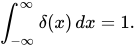
Schematic representation of the Dirac delta function by a line surmounted by an arrow. The height of the arrow is usually meant to specify the value of any multiplicative constant, which will give the area under the function. The other convention is to write the area next to the arrowhead. In mathematical analysis, the Dirac delta function (or distribution), also known as the unit impulse, is a generalized function on the real numbers, whose value is zero everywhere except at zero, where it is infinite, and whose integral over the entire real line is equal to one. Thus it can be represented heuristically assuch that
Since no function has this property, modelling the delta "function" rigorously involves the use of limits or, as is common in mathematics, measure theory and the theory of distributions. (Full article...)
The Castaing machine is a device used to add lettering and decoration to the edge of a coin. Such lettering was necessitated by counterfeiting and edge clipping, which was a common problem resulting from the uneven and irregular hammered coinage. When Aubin Olivier introduced milled coinage to France, he also developed a method of marking the edges with lettering which would make it possible to detect if metal had been shaved from the edge. This method involved using a collar, into which the metal flowed from the pressure of the press. This technique was slower and more costly than later methods. France abandoned milled coinage in favour of hammering in 1585.
England experimented briefly with milled coinage, but it was not until Peter Blondeau brought his method of minting coins there in the mid-seventeenth century that such coinage began in earnest in that country. Blondeau also invented a different method of marking the edge, which was, according to him, faster and less costly than the method pioneered by Olivier. Though Blondeau's exact method was secretive, numismatists have asserted that it likely resembled the later device invented by Jean Castaing. Castaing's machine marked the edges by means of two steel rulers, which, when a coinage blank was forced between them, imprinted legends or designs on its edge. Castaing's device found favour in France, and it was eventually adopted in other nations, including Britain and the United States, but it was eventually phased out by mechanised minting techniques. (Full article...)
Image 12
Three Musketeers - Chrysler Engineers Carl Breer (right), Fred Zeder (center), and Owen Skelton (left) in 1933.
Carl Edgar Myers (March 2, 1842 – 1925) was an American aeronautical engineer. He was born at March 2, 1842 at Herkimer, New York, to Abram H. and Eliza Ann (Cristman) Myers. At various times in his life, he was employed as carpenter, mechanician, plumber, electrician and chemist, banker, and photographer. After 1878, he focused on aeronautical engineering. He became known as the inventor of new or improved systems for generating gases, and as the constructor of hydrogen balloons and airships, including the aerial velocipede, gas kite, sky-cycle and electrical aerial torpedo. He married Mary Breed Hawley on November 8, 1871.
Myers, after spending two years hiring professional balloonists to test his designs, Myers went up in a balloon himself. (Full article...)
The 2009 North Korean nuclear test was the underground detonation of a nuclear device conducted on Monday, 25 May 2009 by North Korea. This was its second nuclear test, the first test having taken place in October 2006. Following the nuclear test, Pyongyang also conducted several missile tests. A scientific paper later estimated the yield as 2.35 kilotons.
William Barton Rogers founded MIT to accelerate American industrialization through scientific knowledge. Initially funded by a federal land grant, the institute adopted a German polytechnic model emphasizing laboratory instruction in applied science and engineering, and moved from Boston's Back Bay to its current campus in Cambridge in 1916. Early growth came through research contracts with private industry, though the institute remained financially constrained and focused primarily on practical engineering education into the 1930s. (Full article...)
The following are images from various Engineering-related articles on Wikipedia.
Image 1The application of the steam engine allowed coke to be substituted for charcoal in iron making, lowering the cost of iron, which provided engineers with a new material for building bridges. This bridge was made of cast iron, which was soon displaced by less brittle wrought iron as a structural material. (from Engineering)
Image 11Archimedes is regarded as one of the leading scientists in classical antiquity whose ideas have underpinned much of the practice of engineering. (from Engineer)
Image 12Hoover Dam is regarded as a major accomplishment in civil engineering (from Engineering)
Image 15A drawing for a steam locomotive. Engineering is applied to design, with emphasis on function and the utilization of mathematics and science. (from Engineering)
Image 19Design of a turbine requires collaboration of engineers from many fields, as the system involves mechanical, electro-magnetic and chemical processes. The blades, rotor and stator as well as the steam cycle all need to be carefully designed and optimized. (from Engineering)
This list was generated from these rules. Questions and feedback are always welcome! The search is being run daily with the most recent ~14 days of results. Note: Some articles may not be relevant to this project.


 Featured articles are displayed here, which represent some of the best content on English Wikipedia.




.jpg)


.jpg)


 Commons
 Wikibooks
 Wikidata
 Wikiquote
 Wikisource
 Wikiversity
 Wiktionary


