


// Workers AI · dad joke modeWhat did the inverse gamma function say? "I'm reciprocal-ly fond of you".


In mathematics, the inverse gamma function is the inverse function of the gamma function. In other words, whenever . For example, .[1] Usually, the inverse gamma function refers to the principal branch with domain on the real interval and image on the real interval , where [2] is the minimum value of the gamma function on the positive real axis and [3] is the location of that minimum.[4]




Definition
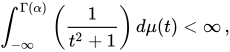
[edit]The inverse gamma function may be defined by the following integral representation[5] where is a Borel measure such that and and are real numbers with .




Series Expansions
[edit]Let be the -th branch of the gamma function, with denoting the principal branch. To obtain a series expansion of the inverse gamma function one can first compute the series expansion of the reciprocal gamma function near the zeros at the negative integers, and then invert the series.


Setting in the expansion then yields, for :[6]where is the polygamma function.


This can be rigorously justified by the Lagrange inversion theorem, which says that if where f is analytic at a point a and , then the inverse is given by a power series[7]


![{\displaystyle g(z)=a+\sum _{n=1}^{\infty }g_{n}{\frac {(z-f(a))^{n}}{n!}},\quad g_{n}=\lim _{w\to a}{\frac {d^{n-1}}{dw^{n-1}}}\left[\left({\frac {w-a}{f(w)-f(a)}}\right)^{n}\right].}](https://wikimedia.org/api/rest_v1/media/math/render/svg/7a7685bf595038560b1c07092c7a45945dc2d0a5)
For example, for the first non principal branch, set and such that . The formula gives


![{\displaystyle g(z)=\sum _{n=1}^{\infty }{\frac {z^{n}}{n!}}\left[\lim _{w\to 0}{\frac {d^{n-1}}{dw^{n-1}}}\Gamma (w+1)^{n}\right].}](https://wikimedia.org/api/rest_v1/media/math/render/svg/7f2e9d3308d6a7126f97661204532b0df408dd60)
Now, assuming is invertible when restricted to an appropriate region, setting gives
![{\displaystyle \Gamma _{1}^{-1}(x)=\sum _{n=1}^{\infty }{\frac {x^{-n}}{n!}}\left[{\frac {d^{n-1}}{dw^{n-1}}}\Gamma (w+1)^{n}\right]_{w=0}.}](https://wikimedia.org/api/rest_v1/media/math/render/svg/feaeca5f715d083288436a7be4f769367c85829c)
Approximation
[edit]To compute the branches of the inverse gamma function one can first compute the Taylor series of near . The series can then be truncated and inverted, which yields successively better approximations to . For instance, we have the quadratic approximation:[8]


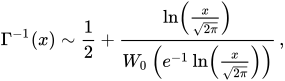
where is the trigamma function. The inverse gamma function also has the following asymptotic formula[9] where is the Lambert W function. The formula is found by inverting the Stirling approximation, and so can also be expanded into an asymptotic series.


References
[edit]- ↑ Borwein, Jonathan M.; Corless, Robert M. (2017). "Gamma and Factorial in the Monthly". The American Mathematical Monthly. 125 (5): 400–424. arXiv:1703.05349. doi:10.1080/00029890.2018.1420983. JSTOR 48663320. S2CID 119324101.
- ↑ (sequence A030171 in the OEIS)
- ↑ (sequence A030169 in the OEIS)
- ↑ Uchiyama, Mitsuru (April 2012). "The principal inverse of the gamma function". Proceedings of the American Mathematical Society. 140 (4): 1347. doi:10.1090/S0002-9939-2011-11023-2. JSTOR 41505586. S2CID 85549521.
- ↑ Pedersen, Henrik (9 September 2013). ""Inverses of gamma functions"". Constructive Approximation. 7 (2): 251–267. arXiv:1309.2167. doi:10.1007/s00365-014-9239-1. S2CID 253898042.
- ↑ Couto, Ana Carolina Camargos; Jeffrey, David; Corless, Robert (November 2020). "The Inverse Gamma Function and its Numerical Evaluation". Maple Conference Proceedings. Section 8.
- ↑ M. Abramowitz; I. A. Stegun, eds. (1972). "3.6.6. Lagrange's Expansion". Handbook of Mathematical Functions with Formulas, Graphs, and Mathematical Tables. New York: Dover. p. 14.
- ↑ Corless, Robert M.; Amenyou, Folitse Komla; Jeffrey, David (2017). "Properties and Computation of the Functional Inverse of Gamma". 2017 19th International Symposium on Symbolic and Numeric Algorithms for Scientific Computing (SYNASC). International Symposium on Symbolic and Numeric Algorithms for Scientific Computing (SYNASC). p. 65. doi:10.1109/SYNASC.2017.00020. ISBN 978-1-5386-2626-9. S2CID 53287687.
- ↑ Amenyou, Folitse Komla; Jeffrey, David (2018). "Properties and Computation of the inverse of the Gamma Function" (MS). p. 28.
 | This mathematical analysis–related article is a stub. You can help Wikipedia by adding missing information. |