


// Workers AI · dad joke modeWhat did the Genocchi number say? It had a lot of sequence issues.
 | This article includes a list of general references but lacks sufficient corresponding inline citations. (April 2025) |
In mathematics, the Genocchi numbers Gn, named after Angelo Genocchi, are a sequence of integers that satisfy the relation
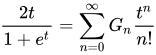
The first few Genocchi numbers are 0, 1, −1, 0, 1, 0, −3, 0, 17 (sequence A226158 in the OEIS), see OEIS: A001469.

where is the Riemann zeta function.

Properties
[edit]- The generating function definition of the Genocchi numbers implies that they are rational numbers. In fact, G2n+1 = 0 for n ≥ 1 and (−1)nG2n is an odd positive integer.
- Genocchi numbers Gn are related to Bernoulli numbers Bn by the formula

Combinatorial interpretations
[edit]The exponential generating function for the signed even Genocchi numbers (−1)nG2n is
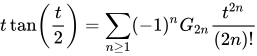
They enumerate the following objects:
- Permutations in S2n−1 with descents after the even numbers and ascents after the odd numbers.
- Permutations π in S2n−2 with 1 ≤ π(2i−1) ≤ 2n−2i and 2n−2i ≤ π(2i) ≤ 2n−2.
- Pairs (a1,...,an−1) and (b1,...,bn−1) such that ai and bi are between 1 and i and every k between 1 and n−1 occurs at least once among the ai's and bi's.
- Reverse alternating permutations a1 < a2 > a3 < a4 >...>a2n−1 of [2n−1] whose inversion table has only even entries.
Primes
[edit]The only known prime numbers which occur in the Genocchi sequence are 17, at n = 8, and −3, at n = 6 (depending on how primes are defined). It has been proven that no other primes occur in the sequence
See also
[edit]References
[edit]- ↑ Luschny, Peter H. N. (2020). "An Introduction to the Bernoulli Function". arXiv preprint.
- Weisstein, Eric W. "Genocchi Number". MathWorld.
- Richard P. Stanley (1999). Enumerative Combinatorics, Volume 2, Exercise 5.8. Cambridge University Press. ISBN 0-521-56069-1
- Gérard Viennot, Interprétations combinatoires des nombres d'Euler et de Genocchi, Seminaire de Théorie des Nombres de Bordeaux, Volume 11 (1981-1982)
- Serkan Araci, Mehmet Acikgoz, Erdoğan Şen, Some New Identities of Genocchi Numbers and Polynomials