


// Workers AI · dad joke modeWhat did the chain sequence say? It was linked to its past.
In the analytic theory of continued fractions, a chain sequence is an infinite sequence {an} of non-negative real numbers chained together with another sequence {gn} of non-negative real numbers by the equations

where either (a) 0 ≤ gn < 1, or (b) 0 < gn ≤ 1. Chain sequences arise in the study of the convergence problem – both in connection with the parabola theorem, and also as part of the theory of positive definite continued fractions.
The infinite continued fraction of Worpitzky's theorem contains a chain sequence. A closely related theorem[1] shows that
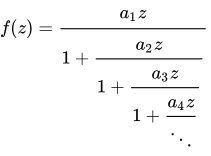
converges uniformly on the closed unit disk |z| ≤ 1 if the coefficients {an} are a chain sequence.
An example
[edit]The sequence {1/4, 1/4, 1/4, ...} appears as a limiting case in the statement of Worpitzky's theorem. Since this sequence is generated by setting g0 = g1 = g2 = ... = 1/2, it is clearly a chain sequence. This sequence has two important properties.
- Since f(x) = x − x2 is a maximum when x = 1/2, this example is the "biggest" chain sequence that can be generated with a single generating element; or, more precisely, if {gn} = {x}, and x < 1/2, the resulting sequence {an} will be an endless repetition of a real number y that is less than 1/4.
- The choice gn = 1/2 is not the only set of generators for this particular chain sequence. Notice that setting generates the same unending sequence {1/4, 1/4, 1/4, ...}.

Notes
[edit]- ↑ Wall traces this result back to Oskar Perron (Wall, 1948, p. 48).
References
[edit]- H. S. Wall, Analytic Theory of Continued Fractions, D. Van Nostrand Company, Inc., 1948; reprinted by Chelsea Publishing Company, (1973), ISBN 0-8284-0207-8