


Talk:Subharmonic function
Add topic | This article is rated C-class on Wikipedia's content assessment scale. It is of interest to the following WikiProjects: | ||||||||||
| |||||||||||

A comment
[edit]The following comment was left in the article proper by Szilard.revesz (talk · contribs):
For definition of subharmonic functions on Riemannian manifolds, the defining inequalities between the subharmonic function $f$ and the harmonic function $f_1$ should be the reverse, in accordance with the definition given above 8and in accordance with the heuristical content of the name SUBharmonic).
I'm not sure what he means precisely, possibly due to notational confusion. RayTalk 19:23, 10 November 2010 (UTC)
Is this true?
[edit]One stated that for a holomorphic function the function is a subharmonic function. I think I have a counterexample, since this is only valid for functions which do not have a local maximum in .



Let and , a closed disk centered at 0 with radius a half, then

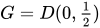
, if


Am I wrong? —Preceding unsigned comment added by 94.212.22.34 (talk) 15:41, 20 January 2011 (UTC)
- I think you confused and in your counterexample. If you interpret , (as one is supposed to do), the inequality really holds. Vigfus (talk) 20:23, 3 August 2012 (UTC)


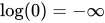
- But in the section Examples it is also stated, that for an analytic function the function is a subharmonic function. This is definitely not true. Consider for example the identity function on . Then , which is negative in general. — Preceding unsigned comment added by 131.152.55.74 (talk) 17:37, 11 December 2020 (UTC)



Maximum Principle(with modulus) for harmonic functions.
[edit]Let's suppose that is a harmonic function non-constant,and is an open simply connected set.I want to prove that there is not with .We observe this equality is equivalent to .Since is subharmonic,we find a contradiction with the maximum principle for subharmonic functions.






¿Is it correct?