


Talk:Project 596
Add topic | A fact from this article was featured on Wikipedia's Main Page in the On this day section on October 16, 2017, October 16, 2019, October 16, 2021, and October 16, 2023. |
 | This article is rated Start-class on Wikipedia's content assessment scale. It is of interest to the following WikiProjects: | ||||||||||||||||||||||||||||||||||||||||||||||
| |||||||||||||||||||||||||||||||||||||||||||||||


Wiki Education Foundation-supported course assignment
[edit] This article is or was the subject of a Wiki Education Foundation-supported course assignment. Further details are available on the course page. Student editor(s): Davidxyz. Peer reviewers: Cmedvid, Emily rodriguez.
Above undated message substituted from Template:Dashboard.wikiedu.org assignment by PrimeBOT (talk) 07:16, 17 January 2022 (UTC)
Co-ordinates
[edit]I've corrected the co-ordinates in the "specifics" section, but don't know how to do it at the top, where the link is. Can anyone help. The true site (round scar) is within a few hundred metres of the co-ordinates I have cited. —Preceding unsigned comment added by Theeurocrat (talk • contribs) 10:21, 6 October 2010 (UTC)
- Unfortunately, that round scar is not the site of 596. Based on the satellite photographs (http://nuclearweaponarchive.org/China/LopNor700c15.jpg) taken just after the blast, the correct coordinates (as far as Google earth can place them) is 40.8121,89.79386, about 2.8 km to the NW of the scar. The cause of the scar is unknown but obviously man-made; there were about 24 drops made in this area (known as the drop area of Lop Nur, separate form the underground test areas of Nanshan, Beishan and Qinggir), 16 of which have no known coordinates, and for which no ground proof seismic disturbances have been noted (including 596 itself). These unplaced drops were up to 3 MT in yield, and might be responsible for the scar. See http://www.rdss.info/cgi-bin/resdb_ent?dbtype_id=GTD SkoreKeep (talk) 06:50, 4 March 2013 (UTC)
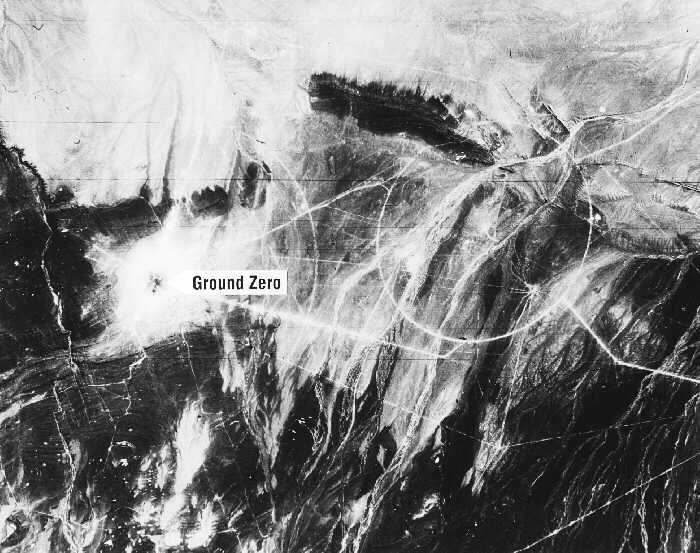
- PS: A close look with the latest data in Google Earth shows a faint circular scar around the new placement as well. I didn't see that until after editing the page. :) SkoreKeep (talk) 07:05, 4 March 2013 (UTC)
- Very good sleuthing, Skorekeep, and that is a great tool. An ex-Air Force friend of mine has already told me that the scar I mentioned is no scar at all, but rather a bombing target. There is another one a few miles west. As to the 596 site, we reckon it is about 500 metres west of the point you calculate, and probably within the margin of error of the tool - if you go into Bing Maps, you can clearly see the base of the tower, the instrumentation bunker, and even the road that the device was rolled down.Theeurocrat (talk) 13:22, 25 April 2013 (UTC)
- I concur with your adjustment. Thanks for the correction. SkoreKeep (talk) 04:16, 22 July 2013 (UTC)
Photo of the mock-up bomb
[edit]I think that this cannot be the right photo. 596 was a tower shot, and there are small pictures of it as a large cylindrical object being pushed down a road to the site. Perhaps the image shows an early weaponised device derived from 596, but it cannot be 596 itself. Skorekeep, any comments? Theeurocrat (talk) 13:22, 25 April 2013 (UTC)
- Sorry, I have no information on that. It seems very unlikely that the Chinese would have made a tower shot item look like a drop bomb; that's too much "gilding the lily". SkoreKeep (talk) 04:01, 22 July 2013 (UTC)
UD3 Thing
[edit]In the 1980's China explored and then abandoned the idea of UD3 fusion via highly symmetrical implosion. They used techniques that weren't available in 1965 to achieve a very small neutron signal. This path was ultimately abandoned because it wasn't reliably reproducible for scientific purposes using 1980's Chinese technology. But then we are supposed to believe the Chinese of 1965 got this working so reliably that they were using it in production nuclear weapons for their military??
We already know what China was using to initiate neutron cascades back then. We know they received it from the Soviet Union who used it in their second generation designs. I'm not certain why the need for the retrocon of UD3?
“Fusion Produced by Implosion of Spherical Explosive” by Q.-D. Dong, J.-C. Zhang, G.Z. Liu, and H.-Z. Jiang, presented at the 1989 Shock Compression of Condensed Matter conference and published in 1990, explores the concept of achieving fusion reactions through the spherical implosion of an explosive material.
Reference no longer has valid URL
[edit]Reference # 3 no longer has a valid URL. It now links to a default landing page at ctbto.org. It'd be interesting to see what should replace it, but I do not know. "16 October 1964 – First Chinese nuclear test: CTBTO Preparatory Commission". www.ctbto.org. Retrieved 2017-06-01. ~2026-34871-90 (talk)eric ferguson ~2026-34871-90 (talk) 12:28, 17 June 2026 (UTC)
Requested move 22 July 2026
[edit]
 | It has been proposed in this section that multiple pages be renamed and moved. A bot will list this discussion on the requested moves current discussions subpage within an hour of this tag being placed. The discussion may be closed 7 days after being opened, if consensus has been reached (see the closing instructions). Please base arguments on article title policy, and keep discussion succinct and civil. Please use {{subst:requested move}}. Do not use {{requested move/dated}} directly. |
- Project 596 → 596 (nuclear test)
- Project 596L → 596L (nuclear test)
- Project 639 → 639 (nuclear test)
– Scholars do not use this wording, and any online mention along the lines of WP:COMMONNAME of "Project 596" is likely to stem from this page seemingly inventing it. Each article should also make it clearer that these are the codenames of the devices and designs, the test events themselves were codenamed (Operation) 21-41, 21-72, and 21-73 respectively. See Zhang:
China conducted twenty-three atmospheric nuclear tests, including seventeen airburst tests—sixteen air-dropped (codenamed 21-7x) by aircrafts over an airburst center, and one by DF-2A missile (21-2) over twenty kilometers away from the airburst center. It also conducted six surface nuclear tests (codenames 21-4x), twenty-three underground nuclear tests including eight tunnel tests (codenamed 21-9 x), and fifteen vertical shaft tests (codenamed 21-8x).
See Reed, 2008, The Chinese nuclear tests, 1964–1996 and Zhang, 2025, The Untold Story of China's Nuclear Weapon Development and Testing. Doeze (talk) 13:02, 22 July 2026 (UTC)
- @Amigao @JArthur1984 @NPguy what are we thinkin here folks Doeze (talk) 14:48, 24 July 2026 (UTC)
- I agree with the general rationale here (i.e., WP:CITOGENESIS), but for the purposes of adequate article title WP:PRECISION, the moves should follow the framework of 596 (nuclear weapons test) and so forth. - Amigao (talk) 15:31, 24 July 2026 (UTC)
- Good thinking. Either of the suggested alternatives is an improvement. My thinking is "(nuclear test)" is the better of the two alternatives, as don't these tests necessarily occur before weaponization? It is possible I am wrong and may need to be corrected on this more technical matter. JArthur1984 (talk) 15:56, 24 July 2026 (UTC)
- I would favor this logic, in spite of the page being called Nuclear weapons testing, and these tests being in pursuit of deliverable weapons, they are not always weaponized. See also Sedan (nuclear test), Chagan (nuclear test), Raduga (nuclear test), Project Gnome (nuclear test). Doeze (talk) 16:08, 24 July 2026 (UTC)
- I have a hard time caring about this. The current names seem more natural than the proposed ones. Having a number and a parenthetical is bizarre, and if the number is made up, why keep it at all? NPguy (talk) 20:24, 24 July 2026 (UTC)
- the numbers are the part that’s “real”. JArthur1984 (talk) 00:59, 25 July 2026 (UTC)
- The quote above is supposed to explain why "Project 596" is not the term scholars use. I'm not sure how it does that, but it doesn't use anything like "596." So where does that number come from? I haven't dug into the citations. NPguy (talk) 19:56, 25 July 2026 (UTC)
- the numbers are the part that’s “real”. JArthur1984 (talk) 00:59, 25 July 2026 (UTC)
- I have a hard time caring about this. The current names seem more natural than the proposed ones. Having a number and a parenthetical is bizarre, and if the number is made up, why keep it at all? NPguy (talk) 20:24, 24 July 2026 (UTC)
- I would favor this logic, in spite of the page being called Nuclear weapons testing, and these tests being in pursuit of deliverable weapons, they are not always weaponized. See also Sedan (nuclear test), Chagan (nuclear test), Raduga (nuclear test), Project Gnome (nuclear test). Doeze (talk) 16:08, 24 July 2026 (UTC)
- Selected anniversaries (October 2017)
- Selected anniversaries (October 2019)
- Selected anniversaries (October 2021)
- Selected anniversaries (October 2023)
- Start-Class China-related articles
- Low-importance China-related articles
- Start-Class China-related articles of Low-importance
- WikiProject China articles
- Start-Class military history articles
- Start-Class military science, technology, and theory articles
- Military science, technology, and theory task force articles
- Start-Class weaponry articles
- Weaponry task force articles
- Start-Class Asian military history articles
- Asian military history task force articles
- Start-Class Chinese military history articles
- Chinese military history task force articles
- Requested moves