


Talk:History of trigonometry
Add topic | This  level-5 vital article is rated B-class on Wikipedia's content assessment scale. level-5 vital article is rated B-class on Wikipedia's content assessment scale.It is of interest to the following WikiProjects: | ||||||||||
| |||||||||||

Disputed
[edit]This article makes the claim that Indian mathematicians were in the 5th century BC, before Hipparchus. In actuality, they seem to have been in the 5th century AD (and were influenced by the work of Ptolemy if I remember the book by Boyer correctly)!
Overall, I'm concerned that the article goes beyond acknowledging the Indian and Arabic contributions to trigonometry, to actually minimizing the Greek and European contributions. In this it seems to follow the "Crest of the Peacock" book cited as a reference, and which seems to have come under heavy criticism in academic circles. Indeed, its author admitted that he intentionally left out the Greek contributions from his book, preferring to focus on the non-European roots. More serious is the criticism made in the Pingree review linked above that the Peacock author "has no particular expertise" in the field (and in particular relies on secondary sources because he does not know the languages) and his accounting of Indian and Arab contributions especially "abound[s] in inaccuracies of dating, of names, and of historical facts" and that the "misleading and just plain wrong statements in the book seriously affect the persuasiveness of the author's arguments."
I'm not a professional historian myself, although I've read a couple of books (by Boyer and Maor) on the history of mathematics and trigonometry which give a quite different picture from the one in this article. It doesn't seem in keeping with WP:NPOV to (apparently) base this article so strongly on a single iconoclastic source. Not to mention mixing up BC with AD!
UNDISPUTABLE
[edit]Steven this article was indeed incorrect but the page is been restructured & now it seems to be correct.Just i want to say to u that what ever u have said regarding only this article is correct.But i want to say u tht your view regarding the Indian mathematics is incorrect.It is true that Hipparchus & ptolemy were the first to bring about developement in Trigonometry After that Indian came to bring developement in trigonometry which was significant & mainly was not influenced by ptolemy's work.Just to make your info more correct that Ptolemy's & greek mathematicians works were on chord functions & Indian mathematician's works were based on sine functions.So it cannot be said that Indian mathematicians were influenced by ptolemy.Indian mathematicians prepared their own sine table & world knows that very well.Because sine is the oldest trigonometric functions & were originated by Indian mathematicians.Just make more research on this Origin of sine functions u will know the truth.One more time truely speaking "Hipparchus" is the creator of Trigonometry Because the earliest one is the father.Hipparchus is truely said as the father of Trigonometry.I THINK NOW WE SHOULD REMOVE THIS FROM DISPUTATIONS.
202.179.64.9 16:27, 4 November 2006 (UTC)Aaditya D.Singh
Retrieved from "http://en.wikipedia.org/wiki/Talk:History_of_trigonometric_functions"
- Thanks for fixing the BC/AD mistake. I changed the disputed tag to a POV tag, since I don't see any obvious factual errors (although I'm skeptical of any claims sourced to the Peacock book because of the criticisms cited above), but the article still seems woefully unbalanced.
- I didn't say that Indian and Arab mathematicians didn't make significant contributions (e.g. it's clear that our modern definition of sine as the half-chord instead of the chord, and even the name "sine", comes from India...and in fact I was the first person to add this information to Wikipedia a year or two ago), just that the contributions of Greek and (later) European mathematicians are currently grossly understated in the article.
- You appear to have no evidence to support your assertion that there were no significant Hellenistic influences on the Indian work 600 years later; as far as I can tell, professional historians of mathematics seem to disagree. (Note the article still makes the biased, and arguably incorrect claim that "the first significant developments of trigonometry were in India".)
- By the way, if "u" take a little more time to write like a literate adult, it will be easier to take you seriously. —Steven G. Johnson 19:21, 4 November 2006 (UTC)
- PS. What is the evidence that Bhaskara II treated trigonometry as a subject in its own right, not as an adjunct to astronomy etc.? According to the Boyer reference, the first person to do so was Regiomontanus and that's what the Wikipedia article originally said, and a user later moved this statement to apply to Bhaskara without citing any source. Euler's contributions are also understated by the deprecating words "in Europe" added to his contributions, as he seems to be the first person anywhere to define trig functions by their infinite series and to analytically continue them to the complex plane (this is what is meant by "analytic" treatment of a function, in case you don't know math). The way that this article has evolved, with sourced statements about one person moved to unsourced statements about other people, does not inspire trust. —Steven G. Johnson 19:31, 4 November 2006 (UTC)
OK NOW
[edit]Steven,I dont know who had edited this article.But its correct now.Yes sentence "the first significant developement of trigonometry was in India" has biased view.But its correct now.Rest i do not see any disputable sentences in article.If there is any, then comment on it,We will make this page as a #REDIRECTWP:NPOV.Regarding ptolemys influence on Indian mathematicians i think this link will answer your question better then me-http://www.trigonometry-help.net/history-of-trigonometry.php. This site is authorised & clearly used related for info regarding trigonometry.It mentions clearly that Indian mathematicians worked on sine functions & not on half-chord functions as greeks & europeans did. 202.179.64.9 13:01, 5 November 2006 (UTC)Aaditya D.Singh
Undisputable
[edit]Step on Steven & continue this talk.Remember u had declared this page under dispute so u r the only one to remove this page from disputes.I dont really know wht is seems to be wrong in this page u r still not mentioning whts incorect.This page should be soon declared as "normal point of view" as it deserves.Simply keeping quiet will not work.I am not ordering but this is too much.Reply this soon. —The preceding unsigned comment was added by 202.179.64.9 (talk • contribs) 15:25, 3 December 2006 (UTC). 202.179.64.9 15:30, 3 December 2006 (UTC)Aaditya D.Singh
There is proof that there have been a significant Greek influence in India during Gupta and before Gupta period on maths, science and artichecture Obiwana (talk) 12:17, 4 January 2023 (UTC)
The Sulba Sutras
[edit]I am removing an unsourced claim in the history section about the Sulba Sutras containing trigonometric functions. There is no evidence of this. Since the claim was made in other WP pages as well, I decided to probe it more and realized that the source provided was G. G. Joseph's book The Crest of the Peacock: The Non-European Roots of Mathematics (p. 232). However what is provided in Joseph's book is a modern-day proof of some results stated in the Sulba sutras, and that proof uses , (and that too a little redundantly since the angle is 45 degrees and he is really talking about the diagonal of a square). There is no indication in Joseph's book anywhere that sine, cosine, or anything resembling trigonometric functions are mentioned in the Sulbasutras. What is mentioned is the following line in Sankrit verse: "Divide the diameter of a circle into 15 equal part and take 13 of them to be the side of the square," (for "squaring the circle"). The Sulbasutras say that and nothing else (and no indication is given of how the result was discovered.) That is not evidence for knowledge of trigonometric functions. Fowler&fowler«Talk» 14:20, 22 February 2007 (UTC)

However what is provided in Joseph's book is a modern-day proof of some results stated in the Sulba sutras, and that proof uses , (and that too a little redundantly since the angle is 45 degrees and he is really talking about the diagonal of a square).
I was about to suggest OR violation as are apparent by constant vandalism you have caused in Indian mathematics related articles but then "The whole of Indian geometry and trignometry is dominated by the theorum of the suqare and the diagonal." (Geometry in Ancient and Mediaeval India By T.A. Sarasvati Amma page 58). Freedom skies| talk 21:10, 22 February 2007 (UTC)
- Yes? But what does your quote have to do with the Sulba Sutras? There was a lot of great trigonometry in India in the first millennium CE. However, in the Sulba Sutras, no trigonometry is present. There was knowledge of Pythagoras's Theorem, but no trigonometry. Computing the ratio of the side of a square to its diagonal doesn't mean that you have also computed and therefore you know about trigonometric functions! Fowler&fowler«Talk» 09:52, 24 February 2007 (UTC)

- @Freedom skies: I doubt that Sarasvati Amma misspelled "theorem" that way. Michael Hardy (talk) 17:54, 9 March 2026 (UTC)
- Why are you replying to a post from 20 years ago? Anyway, here's the quotation:
–jacobolus (t) 19:44, 9 March 2026 (UTC)2.17. The Sulbasutras and later ages
There is a charge against Indian mathematics that the earlier phase has no connection with its later phases, especially that the Sulbasutra mathematics has nothing to do with later mathematics. The charge was perhaps first framed by G. R. Kaye, in whose eyes any stick is good enough to beat the Indians with. One could have ignored this charge if it had not been repeated by such a responsible and unprejudiced critic of Indian achievements as A. B. Keith.
A close study of the Sulbasutras in relation to the rest of Indian mathematics will reveal the following facts, out of which a single one only can be adduced as evidence that Sulbasutra mathematics stands apart from the rest of Indian mathematics.
(1) The two most important achievements of Sulbasutra geometry are the enunciation of the theorem of the square on the diagonal and the recognition of the properties of similar figures.
The whole of Indian geometry and trigonometry is dominated by the theorem of the square on the diagonal. The study of rational figures which fills pages in later mathematical texts, the sine-table and even much of algebra is based on this theorem. The field of influence of the principle of proportionality is even wider, holding sway as it does, over the whole of Indian mathematics.
(2) As far as the constructions in the Sulbasutras are concerned their rightful legatee is the science of architecture. [...]
(3) The remarkably close approximation for the value of given in the Sulbasutras is apparently lost sight of in later works. But this is nothing strange. The Sulbasutra value is a very good approximation, no doubt, but too cumbersoe for manipulation [...]
(4) [...] (5) [...]
Thus there is no sufficient ground for thinking that the Sulbasutra mathematics was forgotten by later ages.
- Why are you replying to a post from 20 years ago? Anyway, here's the quotation:

Rename article "History of trigonometry"
[edit]Hello,
The current name of this article is "History of trigonometric functions", but this name does not correctly reflect the contents of this article. This article does not simply limit itself to the history of trigonometric functions but rather is covers the entire history of trigonometry. Also, there is currently no "History of trigonometry" article on Wikipedia. That is why I propose renaming this article "History of trigonometry". What are your opinions on this matter? selfwormTalk) 22:16, 28 July 2007 (UTC)
- Considering how it has been around two weeks since I've posted this topic, I will now proceed to change the title of this article from "History of trigonometric functions" to "History of trigonometry". selfwormTalk) 02:22, 12 August 2007 (UTC)
Early Trigonometry
[edit]Need fix on text. Broken - can't read right. —Preceding unsigned comment added by 121.1.55.86 (talk) 13:10, 18 June 2010 (UTC)
This page has more context into Arabic reasoning why developments were made than other regions of the world.. effectively minimizing achievement.2601:646:9480:4C0A:48F1:7179:BD4B:2267 (talk) 07:09, 9 May 2018 (UTC)unsigned
جب
[edit]I doubt that Arabic jiba and jaib are written the same way. جب would be either jib or jab, but hardly jaib, and jiba only if the final a is desinential. This needs verification. --dab (𒁳) 12:18, 1 July 2010 (UTC)
I have just consulted Lane, and I find no evidence that جب means either "bay" or "chord". Something is wrong here. --dab (𒁳) 12:33, 1 July 2010 (UTC)
As so often, it turns out that these claims are based on nothing at all. Our source here is this, a 1996 online article which does not cite its own sources, but which more significantly doesn't match our claims here.
Connor and Robertson say that Arabic jiba and jaib are words for "chord" and "fold" respectively. That's it. No word on homography, and no claim that either word is spelled jb جب .
I just wasted ten minutes because people will insist on making stuff up based on no evidence. --dab (𒁳) 12:39, 1 July 2010 (UTC)
I am dismayed to see that this piece of misinformation has travelled through time from 2004. Worse, the 2004 version still offers as speculation that jiba may have been abbreviated (not "spelled") as jb. This was then "fixed" to the irritating "Arabic writes no vowels" by some well-meaning but clueless editor in 2005. For the next five years, this artefact of one Wikipedian with a clue writing speculation being "improved" by another Wikipedian without a clue, was carried along without being touched or questioned. Seriously, I prefer people inserting "penis" in random places in articles, as that's at least easy to catch and doesn't give anybody a false impression. --dab (𒁳) 13:00, 1 July 2010 (UTC)
- Here is another source: Boyer, History of Mathematics, page 252:
- It was Robert of Chester's translation from the Arabic that resulted in our word "sine." The Hindus had given the name jiva to the half-chord in trigonometry, and the Arabs had taken this over as jiba. In the Arabic language there is also the word jaib meaning "bay" or "inlet." When Robert of Chester came to translate the technical word jiba, he seems to have confused this with the word jaib (perhaps because vowels were omitted); hence, he used the word sinus, the Latin word for "bay" or "inlet." Sometimes the more specific phrase sinus rectus, or "vertical sine," was used; hence, the phrase sinus versus, or our "versed sine," was applied to the "sagitta," or the "sine turned on its side."
- And here is another source: Mao, Trigonometric Delights, chapter 3:
- Now begins an interesting etymological evolution that would finally lead to our modern word “sine.” When the Arabs translated the Aryabhatiya into their own language, they retained the word jiva without translating its meaning. In Arabic—as also in Hebrew—words consist mostly of consonants, the pronunciation of the missing vowels being understood through common usage. Thus jiva could also be pronounced as jiba or jaib, and jaib in Arabic means bosom, fold, or bay. When the Arabic version was translated into Latin, jaib was translated into sinus, which means bosom, bay, or curve (on lunar maps regions resembling bays are still described as sinus). We find the word sinus in the writings of Gherardo of Cremona (ca. 1114–1187), who translated many of the old Greek works, including the Almagest, from Arabic into Latin. Other writers followed, and soon the word sinus—or sine in its English version—became common in mathematical texts throughout Europe.
- (Note that the above two sources were provided back in 2004, both in the article and in the discussion in the Talk page when someone asked about this specific topic. In 2004, unfortunately, MediaWiki did not support the
reftag, so associating information in the text with the corresponding sources was difficult. You are correct that additional unsourced discussion of the Arabic language was later added, so I've just trimmed these additions in the current article.) — Steven G. Johnson (talk) 15:34, 1 July 2010 (UTC)
You note, of course, that the two sources you cite are contradictory? The first one says that jiba was misidentified as jayb ("jaib")yby the translator into Latin (Robert of Chester), while the second claims that the move from jiba to jayb happened in Arabic tradition itself. The second version is what I also found in O'Connor (1996). But your second source (Mao) is clearly unaware of Arabic spelling. By consulting any Arabic dictionary, you will find that jayb is spelled with yod. There is little point in trying to uphold an apparent mistake in a treatise on Trigonometric Delights on an incontrovertible point of Arabic orthography ((Lane: jayb (p. 492): "opening at the neck and bosom [of a garment]", "the heart or bosom", "the place of entrance of the land")). I also presume that jiba is spelled with ta marbouta, but I couldn't find the word. It would be ever so helpful if the authors who have already researched this stuff could bring themselves to provide the actual Arabic spelling.
The mistake that happens here is that some authors correctly state that jb may have been the abbreviation for jiba , much like sin is the abbreviation for sinus (but they fail to make clear whether this is ad hoc speculation, or whether we have positive evidence that this abbreviation was in use in medieval Arabic mathematical literature), and then other authors assume that this is due to the "fact" that "Arabic doesn't write vowels", unaware that there is no other way of spelling "jaib" than jyb.
What we still don't know is whether jayb is an artefact of the Latin translators, or whether jayb became the pronunciation of the abbreviation jb even in Arabic. I suggest that we treat Boyer's account as more authoritative, although we should phrase it carefully, since we have two other accounts of lesser reliability that say otherwise. --dab (𒁳) 08:58, 2 July 2010 (UTC)
Further light is shed on this by ar:دوال مثلثية. It turns out that جيب is the name of "sine" in Modern Arabic. I can only assume it is pronounced jayb, not jīb, although this needs verification. In the light of this, and seeing that none of your references supports a spelling jb جب , I strongly recommend that we do not restore this spelling unless we can clearly explain what we are claiming was spelled this way, based on what evidence. --dab (𒁳) 09:25, 2 July 2010 (UTC)
- The Maor reference seems ambiguous to me regarding whether the change happened in Arabic or not; it only says that it could be pronounced jaib in Arabic, not that it was. Since the Maor is ambiguous, and Boyer is not, I don't think that you should delete Boyer's argument, nor should you delete the references.
- In any case, I agree that the Arabic spelling itself, which was a later unsourced addition to the article, should be removed. (It's not like جب is comprehensible to an English reader anyway.) — Steven G. Johnson (talk) 15:33, 2 July 2010 (UTC)
For what it's worth, here's another source (Kim Plofker's Mathematics in India, and Plofker is a careful scholar). This is what it says, p. 257:
The standard Arabic word for Sine, jayb (literally "cavity", "pocket"), is apparently a misinterpretation of an earlier word jība using the same consonants j-y-b. This term jība, being meaningless in Arabic, was read as the more familiar word jayb. (It is the literal sense of jayb as "pocket" or "fold" that was later translated into Latin as "sinus", whence our "sine.")
She goes on to point out that jība comes from Sanskrit jīvā a synonym of the standard jyā, and quotes al-Biruni:
[…] call the half-Chords juyūb [plural of jayb], for the name of the Chord in the Indian [language] was jībā, and [the name] of its half jībārd. But since the Indians use only the half-Chords, they applied the name of the full [Chord] to the half, for ease of expression
She also has a footnote on "This well-known story", so presumably she has checked multiple sources. And the transition happened in the Arabic tradition itself, because the former word was meaningless. Shreevatsa (talk) 21:32, 2 July 2010 (UTC)
- So, it sounds like we have different reputable sources that disagree on this point, so we clearly should report both. — Steven G. Johnson (talk) 22:30, 2 July 2010 (UTC)
System of notation
[edit]I find it astonishing that we gloss over the system of numeric notation in use in the various cultures at various times, as these various systems, by themselves, determine the overall development of mathematics. Greek numerical notation was little more than hash marks (Attic, Ionian, etc.). Roman numerals were better. The Greeks developed algebra and other symbolic notations because their actual numbers were so unwieldy. Which is why they used chords - and other clever dodges - to begin with.
Note the Indian contribution comes immediately after their development of what we now call "Arabic" numbers around the 4th century, but also note the strange "accurate to four decimal places" attributed to Indian mathematicians c.450 AD. I am informed Islamic mathematicians developed decimals several centuries later. Islam got "Arabic" numbers from India (date uncertain), which Fibonacci introduced to Europe in 1202. Which is a date that ought to be engraved in every 6 year old's head, as it is one of the most significant dates in all history.
Lack of an effective number system also explains the slowness of the Chinese to take up trig, as their number systems (various) were perhaps the most unwieldy of all, and which were in common use into the 20th century. This is not to say that one positively, absolutely could not perform trig in Attic or Chinese numbers, but that the process was so difficult as to be impractical.
The abacus was not a Chinese invention. It had been in widespread use in Europe, before the advent of Arabic numbers. Dave of Maryland (talk) 22:25, 31 August 2012 (UTC)
Cotes is right, but Rickey is wrong.
[edit]The short discussion of Cotes is marred by an unreliable source. Rickey's article was not published in a reputable history of math or history of science journal, it was never peer-reviewed by historians. It cites only one other article, perhaps we should look at the source Rickey cites.
Worse, Rickey makes an obvious math error: the two triangles he says are similar are not similar. Cotes does not make this mistake, Rickey has made it while trying to simplify Cotes's longer explanation. 98.109.232.157 (talk) 06:37, 1 September 2014 (UTC)
External links modified
[edit]Hello fellow Wikipedians,
I have just modified one external link on History of trigonometry. Please take a moment to review my edit. If you have any questions, or need the bot to ignore the links, or the page altogether, please visit this simple FaQ for additional information. I made the following changes:
- Added archive https://web.archive.org/web/20110101211150/http://faculty.kfupm.edu.sa/PHYS/alshukri/PHYS215/Islamic_astronomy.htm to http://faculty.kfupm.edu.sa/PHYS/alshukri/PHYS215/Islamic_astronomy.htm
When you have finished reviewing my changes, you may follow the instructions on the template below to fix any issues with the URLs.
This message was posted before February 2018. After February 2018, "External links modified" talk page sections are no longer generated or monitored by InternetArchiveBot. No special action is required regarding these talk page notices, other than regular verification using the archive tool instructions below. Editors have permission to delete these "External links modified" talk page sections if they want to de-clutter talk pages, but see the RfC before doing mass systematic removals. This message is updated dynamically through the template {{source check}} (last update: 5 June 2024).
- If you have discovered URLs which were erroneously considered dead by the bot, you can report them with this tool.
- If you found an error with any archives or the URLs themselves, you can fix them with this tool.
Cheers.—InternetArchiveBot (Report bug) 17:55, 3 April 2017 (UTC)
External links modified
[edit]Hello fellow Wikipedians,
I have just modified one external link on History of trigonometry. Please take a moment to review my edit. If you have any questions, or need the bot to ignore the links, or the page altogether, please visit this simple FaQ for additional information. I made the following changes:
- Added archive https://www.webcitation.org/6Auwxe6v3?url=http://www-gap.dcs.st-and.ac.uk/~history/HistTopics/Trigonometric_functions.html to http://www-gap.dcs.st-and.ac.uk/~history/HistTopics/Trigonometric_functions.html
When you have finished reviewing my changes, you may follow the instructions on the template below to fix any issues with the URLs.
This message was posted before February 2018. After February 2018, "External links modified" talk page sections are no longer generated or monitored by InternetArchiveBot. No special action is required regarding these talk page notices, other than regular verification using the archive tool instructions below. Editors have permission to delete these "External links modified" talk page sections if they want to de-clutter talk pages, but see the RfC before doing mass systematic removals. This message is updated dynamically through the template {{source check}} (last update: 5 June 2024).
- If you have discovered URLs which were erroneously considered dead by the bot, you can report them with this tool.
- If you found an error with any archives or the URLs themselves, you can fix them with this tool.
Cheers.—InternetArchiveBot (Report bug) 12:35, 5 November 2017 (UTC)
Ptolemy's Tables
[edit]I don't understand the claim that 'Neither the tables of Hipparchus nor those of Ptolemy have survived to the present day, although descriptions by other ancient authors leave little doubt that they once existed'. This may be true of Hipparchus, but not of Ptolemy. Ptolemy's Table of Chords is included at pp.57-60 of G Toomer's 1984 English translation of the Almagest (Syntaxis). The claim that Ptolemy's tables have not survived is attributed to Boyer's History of Mathematics, but in fact Boyer says explicitly 'Fortunately, Ptolemy's Almagest has survived the ravages of time; hence we have not only his trigonometric tables but also an account of the methods used in their construction' (Boyer, page 183 in the 1968 edition. The edition cited in the present article has different pagination.) I have not amended the article, as I am not an expert and may have misunderstood something, but anyone can check the citations I have given.109.149.2.108 (talk) 20:57, 4 October 2018 (UTC) [Added by the same commenter: Incidentally, I also think the present article makes too much of the distinction between chords and sines. I was trying to work out how one would convert Ptolemy's table of chords to a table of sines, when I realised it is mathematically trivial. To get the sine of angle A one simply looks up the chord of angle 2A. There is admittedly a technical complication in that Ptolemy expresses his chords in units of 120, which he says is convenient for computational purposes, so to get the 'standard' value for the sine of A one has to divide Ptolemy's figure for the chord of 2A by 120, but again, this is mathematically trivial. For example, to get the sine of 20 degrees, one looks up the chord for 40 degrees, for which the table gives a value of just over 41, and dividing this by 120 gives just under .342, which is correct. And of course from a table of sines one can easily derive the other trig functions; e.g. cos a is sin (90 - a). So Ptolemy's table of chords (which is far more precise than the example I have given) contains virtually the whole of practical trigonometry.]31.48.173.19 (talk) 19:01, 5 October 2018 (UTC)
Redundant verbiage?
[edit]The fourth paragraph of the section “Classical Antiquity” begins with this passage that I find very oddly phrased:
“Although it is not known when the systematic use of the 360° circle came into mathematics, it is known that the systematic introduction of the 360° circle came a little after Aristarchus of Samos composed On the Sizes and Distances of the Sun and Moon (ca. 260 BC), since he measured an angle in terms of a fraction of a quadrant.”
Shouldn’t that be more like “Although it is not known when the systematic use of the 360° circle came into mathematics, it is known that it came a little after Aristarchus of Samos composed On the Sizes and Distances of the Sun and Moon (ca. 260 BC), since he measured an angle in terms of a fraction of a quadrant.” ?
Likewise, the next sentence is: “It seems that the systematic use of the 360° circle is largely due to Hipparchus and his table of chords.” which I think could be abridged to “It seems that it is largely due to Hipparchus and his table of chords.”
Am I right, or is there something I don’t understand properly?
CielProfond (talk) 04:22, 23 August 2022 (UTC)
- Please go ahead and rewrite for clarity. If you want to make sure you get the story right, you could refer to a reliable book, e.g. Van Brummelen’s The Mathematics of the Heavens and the Earth: The Early History of Trigonometry or works by Neugebauer on the history of mathematical astronomy. –jacobolus (t) 19:18, 23 August 2022 (UTC)
Some identities used by Ptolemy
[edit]I reverted @Myuoh kaka roi's addition of:
Ptolemy used a form of the relation and gave formulas for although they did not actually use sines and cosines but chords.[1]
References
- ↑ "Trigonometric functions". Maths History. Retrieved 2026-07-26.


This modern formulation is anachronistic and I think misleading. It's not entirely clear what the first formula is referring to, but in Ptolemy's work the chords involved are still treated as line segments, so this is probably nothing more or less than the Pythagorean theorem, which was obvious to geometers of the time and was not any kind of novelty. Finding the chord corresponding to a sum of two arcs was not done using sines and cosines, and just saying that "they used chords" doesn't explain how. If you want to add material about this, I think it should be described in closer to the style of the time, with more detail about what was actually done, and more detail about why it mattered.
Finally, you should give full bibliographic information when citing the MacTutor History of Mathematics Archive. –jacobolus (t) 22:41, 26 July 2026 (UTC)
- @Jacobolus I completely agree with your revert but since mactutor is a reliable source,I think we need a more neutral and accurate view on what ptolemy is describing these identities and yes they didn't used modern day trigonometry functions like sine and cosine as they used chords to measure it.My suggestion is that we can mention the that they derived these identities using chords not by modern trigonometry identities. Myuoh kaka roi (talk) 16:14, 27 July 2026 (UTC)
- Any discussion of angle sums in Ptolemy's work needs to describe how he used Ptolemy's theorem for it, and give a bit of explanation about how that works. If you want to add something about this you should find a source discussing it in detail, rather than 1 off-hand sentence in a very high level summary. MacTutor is generally a good source but this particular page is frankly not great, especially not as a source for a generic "History of trigonometry" article. –jacobolus (t) 17:02, 27 July 2026 (UTC)
- I agree with your statement. For Ptolemy's trigonometric identities, I need to find a detailed reliable source that discusses them, and I'll look for one.
- Do you find any issue about the trigonometric functions and identities I added for Varāhamihira? I have cited MacTutor as the source. Myuoh kaka roi (talk) 18:07, 27 July 2026 (UTC)
- I didn't actually look at that part, and I don't know much about Varāhamihira. (Reverting it was accidental and I put it back.) In general though, instead of starting from sources about individual authors, I'd recommend starting from a well regarded source about the history of trigonometry in India or the history of trigonometry in the ancient world and letting that source guide the choice of which people/topics to mention. For example, Glen Van Brummelen's book The Mathematics of the Heavens and the Earth: The Early History of Trigonometry is excellent. The relevant chapter is pp. 94–134. –jacobolus (t) 18:19, 27 July 2026 (UTC)
- thanks for recommendation,i will surely check it Myuoh kaka roi (talk) 18:45, 27 July 2026 (UTC)
- I didn't actually look at that part, and I don't know much about Varāhamihira. (Reverting it was accidental and I put it back.) In general though, instead of starting from sources about individual authors, I'd recommend starting from a well regarded source about the history of trigonometry in India or the history of trigonometry in the ancient world and letting that source guide the choice of which people/topics to mention. For example, Glen Van Brummelen's book The Mathematics of the Heavens and the Earth: The Early History of Trigonometry is excellent. The relevant chapter is pp. 94–134. –jacobolus (t) 18:19, 27 July 2026 (UTC)
- Any discussion of angle sums in Ptolemy's work needs to describe how he used Ptolemy's theorem for it, and give a bit of explanation about how that works. If you want to add something about this you should find a source discussing it in detail, rather than 1 off-hand sentence in a very high level summary. MacTutor is generally a good source but this particular page is frankly not great, especially not as a source for a generic "History of trigonometry" article. –jacobolus (t) 17:02, 27 July 2026 (UTC)
Addressing my Recent Edits and need help
[edit]@Jacobolus, Can you help me?
I addressed my edits and trimmed the section these edits are here
For this, which trigerred interceptor IG, this was newly added to Indian section when it doesn't needed to be here!
Thanks! ~2026-50448-70 (talk) 17:44, 19 September 2026 (UTC)
- I think you may be slightly misinterpreting. My impression is that there is decent consensus that Indian trigonometric concepts were influenced by Greek ones, and the dispute is about whether:
- Hipparchus might have constructed a chord table based on a circle of radius (sinus totus) 3438, with Indian tables copying that and filling in additional values (and at some point switching from chords to sines), or
- Hipparchus might have used a chord table with a different circle radius (e.g. 3600), with Indian mathematicians, still probably basing the general concept on knowledge of Greek trigonometry, generating the specific 3438 radius circle locally.
- I don't think "However, this hypothesis has been heavily refuted due to significant mathematical discrepancies and inadequacies" is a supportable phrasing. There is not enough extant information to be sure about the details, so most of what we can say about transmission between places is substantially speculative. It would be better to say something along the lines of: Toomer hypothesized Hipparchus made a chord table based on circle of radius 3438 but other scholars find his argument unconvincing. If we want to go into further detail about this point, I think it would be better to put it at some other article, since it's getting a bit into the weeds here. –jacobolus (t) 18:18, 19 September 2026 (UTC)
- Hi, Thanks for the reply! Just to clarify, I don't mean of Trignometric concept but about Aryabhata's Sine table specifically; and the outdated claim that he simply adapted or copied a pre-existing Greek table rather than computing the values himself. The sources I provided directly refute the idea that the table itself was a copy, based on mathematical proof. How about we combine it with the Hayashi citation for example like: Toomer hypothesized that Hipparchus constructed a chord table based on a circle of radius 3438, which was later adapted in India. However, scholars such as Takao Hayashi have demonstrated the originality of Aryabhata's sine table; mathematical analysis shows Aryabhata computed the values himself using traditional Indian rules (ardhādhikena) rather than copying an earlier table.
- This is the kind of example where we should not present any scholar's interpretation as factual ("demonstrated", "showed", "proved", etc.), but instead try to represent what the dispute is. –jacobolus (t) 20:20, 19 September 2026 (UTC)
- "Yes, I completely understand your point. Just to clarify, I originally used the word 'demonstrated' because I was directly reflecting the corresponding source's own wording. In his paper, Achar states [discussing Hayashi https://web.archive.org/web/20160924072759/https://www.insa.nic.in/writereaddata/UpLoadedFiles/IJHS/Vol37_2_1_BNNAchar.pdf]:
- 'Thus, there is no valid basis for the assertion that Aryabhața derived his Table of RSines from a Table of Chords of Hipparchus. On the other hand, Hayashi has clearly demonstrated recently the originality of Äryabhața's Rsine table... These differences arise because of rounding off ('ardhādhikena', rounded to the next integer because of its being greater than half) and could not have occurred if Äryabhața had simply copied a table. On the other hand, Hayashil has clearly demonstrated recently the originality of Äryabhața's Rsine table. Hayashi has reexamined, on the basis of grammatically and mathematically precise interpretation of Nilakantha, another verse in the second chapter of Aryabhatya, verse 2.12, which gives second order differences in Rsines. While doing so, Hayashi has observed that six of the entries in the table of Rsines of Aryabhața in verse 1.12 quoted earlier differ from the correct values by one unit. These differences arise because of rounding off ('ardhädhikena', rounded to the next integer because of its being greater than half) and could not have occurred if Äryabhața had simply copied a table.' ~2026-50448-70 (talk) 20:38, 19 September 2026 (UTC)
- Hi, Thanks for the reply! Just to clarify, I don't mean of Trignometric concept but about Aryabhata's Sine table specifically; and the outdated claim that he simply adapted or copied a pre-existing Greek table rather than computing the values himself. The sources I provided directly refute the idea that the table itself was a copy, based on mathematical proof. How about we combine it with the Hayashi citation for example like: Toomer hypothesized that Hipparchus constructed a chord table based on a circle of radius 3438, which was later adapted in India. However, scholars such as Takao Hayashi have demonstrated the originality of Aryabhata's sine table; mathematical analysis shows Aryabhata computed the values himself using traditional Indian rules (ardhādhikena) rather than copying an earlier table.
- Here's what Glen Van Brummelen says in a footnote:
Early researchers had assumed that Hipparchus’s chord table looked much like Ptolemy’s. [Biot 1859, 408–410], for instance, had already raised the possibility that Hipparchus’s chord table was similar enough to Ptolemy’s that it might be the source of the Indian sine tables; and [Tannery 1893, 63–68] speculated that Indian tables derived from a Greek table even earlier than Hipparchus. (See [Szabó 1985b] for a claim that Hipparchus must have had the Almagest chord table itself, based on results of certain gnomon shadow length calculations.) The reconstruction of a chord table with from the lunar parameters was first explored in [Toomer 1973a] and asserted too strongly as “conclusively established.” However, an incorrect dating for one of the eclipse observations flawed the analysis, and it was abandoned when the correct date failed to confirm that ([Swerdlow 1979b], Toomer in [Ptolemy (Toomer) 1984, 215 n. 75]). Further, an analysis of Toomer’s success in matching the Almagest parameters [Klintberg 2005] recently concluded that Toomer’s evidence for as opposed to, say, is not as strong as it seems. However, [Duke 2005a] revisited the issue. A new path through the computations results in an extremely good match with Hipparchus. Finally, [van der Waerden 1986] speculates that Indian chord tables are based not on Hipparchus (who was “not a great geometer”), but on a table that van der Waerden believed to have been composed by Apollonius. He reconstructed this hypothetical table based on the Almagest declination table in [van der Waerden 1988], but this analysis was undermined in [Van Brummelen 1993, 90–101].
- The cited paper is Duke, Dennis (2005). "Hipparchus' eclipse trios and early trigonometry" (PDF). Centaurus. 47: 163–177. doi:10.1111/j.1600-0498.2005.470204.x.
- –jacobolus (t) 20:17, 19 September 2026 (UTC)
- Yes! Thank you for sharing excerpt! The footnote highlights just how speculative and heavily contested the particular 'Greek transmission' theory is, bouncing from Toomer's flawed 3438 hypothesis, to Klintberg's 3600 counter-hypothesis, to Duke's alternate mathematical path, to van der Waerden's speculations about Apollonius.
- Infact, reviewing sources like Van Brummelen, Klintberg, Thompson and other is what led me to draft my original wording!Brummelen , also, although he tend to favor Duke, but he presents the other side of issues as well:
Of course when the word transmission appears it is implicit that the only transmission that is entertained is the one from Greece to India. So, we examined Dennis Duke's paper to see whether it deserves the right to be called the defender of the transmission thesis. Needless to say I found his logic faulty, although it is novel in its approach. He is obviously not familiar with the bulk of the Indian literature when he makes the assertion that "The fact that no Indian text gives the slightest hint regarding the origins of their models or the empirical basis of their model parameters is not helpful," but then he goes on to soften the blow by adding 'but except for the Almagest, the same is largely true of ancient western astronomical texts'. To which we may add that the vaunted adherence to uncorrupted data in the Almagest for which the Occidental takes great pride has been seriously called into question by RR Newton. In fact there are plenty of commentaries (the AryabhaTya alone has over 14 commentaries spread out over a thousand years) it is the commentaries that one should go to for pedagogical treatment of the subject.
In the next section on Proof we list a lot of the original sources that contain Upapatti's or Rationalizations of the original works.[...]o bolster such an idea they would name the 3 or 4 top mathematicians in the early centuries, and neglect to mention that there were at least 200 mathematicians of world class caliber that studded the Indian scene over the 2000 years since the first Siddhantas appeared. So the statement that Duke makes is most likely a result of ignorance of where to look. But this would not be the first time in History that an otherwise rational scholar would insist that if he was not aware of a certain piece of work, it did not exist.
In most instances when the Occidental seeks to devalue the contributions of the 'other' he will invoke the opinion (rather than the unattested 'fact') that the accuracy of the Indie results suffer from inferiority when compare to the Greek data. But Duke takes the view that the agreement between the Indie results of the mean and the anomaly and the corresponding results from the Almagest is proof that the Indians plagiarized from the Greeks. I remain deeply in admiration of the creativity and the extraordinary arguments that the Occidental will marshal to support his thesis that the Greeks should be granted priority in every topic, even when there is not a single document attesting to such a priority.


- Thompson,
(relevant page 194-197)there is no explicit evidence about the nature of Hipparchus’ chord table,” and no real proof that such a table ever existed. [...] The idea that Greeks may have been influenced by Indian developments is never even suggested by modern Western historians of science. But in this case, of course, we have no evidence for influence either way, since the connection between Hipparchus’ two numbers and the Indian sine table is purely speculative.
- Klintberg:
"Many famous western historians of astronomy and mathematics have actively been promoting the idea that the 3438'-based Indian sine tables... were derived from ancient Greek chord tables. Most of these historians, however, have not supported their claims with any real evidence." (Pages 169-170)
"...since Toomer not only does not succeed in generating, in any of his reconstructions, the exact same 'strange numbers' as those that Ptolemy reports that Hipparchus had but also does not have any real evidence that Hipparchus ever even used a chord table, it is rather safe to conclude that Toomer never was in a position to conclusively prove anything about the existence of an alleged Hipparchan chord table with base radius 3438'."
"But it is also equally true that no one has conclusively proven that the Indians did copy the values from some other Greek chord table. For example, the values in Ptolemy's chord table (which is a good example of a chord table that does not use a base radius of 3438') do not produce the exact same values as those in the Indian sine tables." (Page 178)
~2026-50448-70 (talk) 21:15, 19 September 2026 (UTC)"The fact that Toomer has failed to conclusively establish that Hipparchus had a 3438'-based chord table also means that it was never actually proven that the Indians must have derived their sine table values from an Hipparchan chord table with a base radius of 3438'... Therefore, it is still perfectly possible that the Indians not at all copied Hipparchus's values, but instead relied on their own, ancient mathematical tradition to independently produce their sine tables." (Page 191)
- Reading them, most of the hypothesis looked like built on circular mathematical assumption rather than historical proof!
~2026-50448-70 (talk) 21:27, 19 September 2026 (UTC)See, for example, van der Waerden 1988, who confirms (p. 27, footnote 4) that he has read Toomer's 1984 footnote, but still says (p. 27) that "G.I. Toomer has shown in his paper that the errors which Ptolemy ascribes to Hipparchos can be understood by assuming that Hipparchos used a table of chords in a circle of radius 3438' "(page 195)
- @Jacobolus so what is the solution?My suggestion is that Greek astronomy and Mathematics had influence in indian trigonometry especially angle measurement and chord should be mentioned but indian mathematican transformer the full chord into half chord as Greek chord values are based on full chord and aryabhatta sine table is derived from the half chord techniques of previous indian Mathematics work which is independent that of Greek chord tables. Myuoh kaka roi (talk) 12:17, 21 September 2026 (UTC)
- I think we should follow the lead of secondary sources like Van Brummelen or Plofker and say that the nature and extent of transmission of ideas from Greek to Indian mathematics is not known for sure, and various modern authors have different hypotheses about it, but the (speculative) consensus is that Indian trigonometric tables were a conceptual extension of Greek ones.
- Here's Plofker for example:
If this material on Sines in the Pañca-siddhāntikā is indeed reproduced as it appeared in a text of the early first millennium, then table 3.1 represents the first surviving exemplar of an Indian Sine table. It also bears a strong resemblance to some aspects of Greek trigonometry of Chords; in fact, its Sine values for arcs at intervals of 3°45′ could equally well be entries in a Chord table for arcs up to 180◦ at intervals of 7°30′ with R = 60. The value R = 60 is attested in Hellenistic trigonometry, and so is the division of the quadrant into sixths, that is, arcs of 15° = 2 · 7°30′.
Given these similarities and the other Greek traces in the Pañca-siddhāntikā, it seems reasonable to hypothesize (although it remains unproven) that the Indian invention of trigonometry of Sines was partly inspired by Hellenistic Chords. Indian astronomers appear to have been the first to think of replacing the rather clumsy Chord geometry of right triangles inscribed in a semicircle with the simpler Sine geometry of right triangles in a quadrant.
- –jacobolus (t) 14:51, 21 September 2026 (UTC)
- Also, at the same time we must note that the earliest-known sanskrit text on sine function is the Āryabhaṭīya of Āryabhaṭa (b. 476 CE). And also that, Greek's work (like Ptolemy and Hipparchus) dealt only with chords and not the half-chords as done by Indians. ~2026-50448-70 (talk) 10:57, 22 September 2026 (UTC)
- I already mentioned in my comment above that althrough they were Greek influence in indian trigonometry india transformer the chord from full chord to half chord which itself is an independent invention Myuoh kaka roi (talk) 12:20, 22 September 2026 (UTC)
- Also, at the same time we must note that the earliest-known sanskrit text on sine function is the Āryabhaṭīya of Āryabhaṭa (b. 476 CE). And also that, Greek's work (like Ptolemy and Hipparchus) dealt only with chords and not the half-chords as done by Indians. ~2026-50448-70 (talk) 10:57, 22 September 2026 (UTC)
- @Jacobolus so what is the solution?My suggestion is that Greek astronomy and Mathematics had influence in indian trigonometry especially angle measurement and chord should be mentioned but indian mathematican transformer the full chord into half chord as Greek chord values are based on full chord and aryabhatta sine table is derived from the half chord techniques of previous indian Mathematics work which is independent that of Greek chord tables. Myuoh kaka roi (talk) 12:17, 21 September 2026 (UTC)
- Reading them, most of the hypothesis looked like built on circular mathematical assumption rather than historical proof!
- Shouldn't this specific para be actually removed as it's not relevant to the Indian Mathematics section and also, it has been already mentioned in the Greek section specifically! ~2026-50448-70 (talk) 21:56, 19 September 2026 (UTC)
- I have removed it as I felt this sentence has nothing to do with the modern version of law of Sine as the modern version of it was developed later by Nasir al-Din al-Tusi using trigonometry functions Myuoh kaka roi (talk) 22:33, 19 September 2026 (UTC)
- Oops! I mistakenly overlooked! I didn't have intention of removing all of that but seeing greek thing in Indian section, I quite caught more of it unfortuntely! Definitely there are sources stating, Equivalent of law of sines known already to Ptolemy(although used less frequently) and also implied in Brahmagupta's work.bSince, Ptolemy work is stated in Greek section, it was not needed to be still there and was irrelevant to mention in Indian section; I have restored Brahmgupta's relevant para to it. ~2026-50448-70 (talk) 00:54, 21 September 2026 (UTC)
- @Myuoh kaka roi, I don't think that justifies to put that part in Indian section unless you specifies what advances they made compared to this; else it's not relevant at all! ~2026-50448-70 (talk) 10:55, 21 September 2026 (UTC)
- I mean there is no need to remove that statement .The only advancements that he did was giving a formula for the circumradius of a triangle which is kinda similar to what Euclid did except he didn't gave formula unlike brahmagupta but brahmagupta didn't used sine function for this as it was used later by islamic mathematicans Myuoh kaka roi (talk) 12:08, 21 September 2026 (UTC)
- well i think you are kinda Right as even brahmagupta didn't developed the modern formula of Sine as it has been developed by islamic mathematicans centuries after Myuoh kaka roi (talk) 12:12, 21 September 2026 (UTC)
- I mean there is no need to remove that statement .The only advancements that he did was giving a formula for the circumradius of a triangle which is kinda similar to what Euclid did except he didn't gave formula unlike brahmagupta but brahmagupta didn't used sine function for this as it was used later by islamic mathematicans Myuoh kaka roi (talk) 12:08, 21 September 2026 (UTC)
- @Myuoh kaka roi, I don't think that justifies to put that part in Indian section unless you specifies what advances they made compared to this; else it's not relevant at all! ~2026-50448-70 (talk) 10:55, 21 September 2026 (UTC)
- This is not necessarily accurate though or can be misleading ! For ex. as stated in article, or the Brummelen :
- " Whether or not this apparent use of the Law of Sines allows us to claim
- independent knowledge of it for Brahmagupta is a delicate matter.....Brahmagupta’s accomplishments did not end with the Law of Sines. One of his more remarkable mathematical achievements was a method that began with a sine table with a mere six entries, and computed the sine of any given arc in a single calculation, with surprising accuracy." He offcourse used sine function for it:
- "Multiply the 'sine' of the anomaly by the 'sine' of the maximum equation and divide by the 'sine' of the corresponding equation."
- Also, I am still confused about Euclids as you've been saying because I didn't find his mentions! ~2026-50448-70 (talk) 13:29, 22 September 2026 (UTC)
- Euclid described the law of sines in geometric chord manner as he didn't used the sine function to describe the value but as far as I know the modern formula for the law of sine was eventually development by islamic mathematicans as even brahmagupta actually work doesn't describe the equation in the modern form Myuoh kaka roi (talk) 13:34, 22 September 2026 (UTC)
- This is the statement of the description
In his Brāhmasphuṭasiddhānta, Brahmagupta expresses the circumradius of a triangle as the product of two sides divided by twice the altitude; the law of sines can be derived by alternately expressing the altitude as the sine of one or the other base angle times its opposite side, then equating the two resulting variants
- It says expressing the altitude of the formula as sine in the given value so he didn't used sine do derive the law of sine but it is better if We have the original translation of brahmagupta of how he derived it here it says that he expressed the circumradius by dividing the product twice by altitude where he used jya(sine) in the equation is not known or he used altitude instead of jya Myuoh kaka roi (talk) 13:40, 22 September 2026 (UTC)
- "it is better if We have the original translation of brahmagupta.."Unfortunately! The translation isn't available...
- Brummulen disccus with respect to Original sanskrit work only!
- In his planetary epicycle model (śīghra), Brahmagupta explicitly incorporates sines. The primary text which he states:
"Multiply the ‘sine’ of the [Sighra] anomaly by the ‘sine’ of the maximum Sighra equation and divide by the ‘sine’ of the corresponding Sighra equation; the result is the ‘Sighra hypotenuse’. When the [Sighra] anomaly is half a circle ..this Śīghra hypotenuse is equal to the radius diminished by the 'sine' of the maximum equations; when the anomaly is equal to the whole circle, the same is equal to the radius increased by the same 'sine' of the maximum equation."
- Based on this model, he calculates distance () using sine functions:
- it explicitly uses jyā (sine) for both terms.
- and, Rearranging this equation for triangle :
- Since , and this is an explicit functional application of the Law of Sines using sine ratios directly:
- ~2026-50448-70 (talk) 14:37, 22 September 2026 (UTC)
- So he did used sine based on what brummulen describe as it is said that he didn't provided the general formula for law of sine as he didn't systematically used for solving triangle.The general formula for law of sine and cosine came from islamic mathematicans or it is said that islamic mathematicans may have gave law of sines for spherical geometry. Myuoh kaka roi (talk) 14:49, 22 September 2026 (UTC)
- That's Progression indeed: The basic nature was know since Ptolemy and then Development of the Sine Function took place and Indian mathematicians known, beginning with Āryabhaṭa (c. 476 CE) and continued by Brahmagupta (c. 628 CE), with the sine function (jyā)
- Brahmagupta used the sine ratios to solve side-angle relationships in astronomical triangles (such as calculating the śīghra planetary hypotenuse. As Glen Van Brummelen notes, formulas such as arefunctionally equivalent to the Law of Sines and their applicatio.
- Brahmagupta applied these sine relationships as procedural tools for astronomical models rather than stating a general, standalone theorem of plane geometry (like e.g., ). Offcourse upcoming mathematicial would try to systemize the much of the existing concepts and ideas. Infact, it was written in Algebraic expression much later(perhaps later than even Islamic Mathematican); it was treated in words itself! ~2026-50448-70 (talk) 15:15, 22 September 2026 (UTC)
- yep that what it's stating he applied it for astronomical models rather than not giving a general formula or standalone theorem Myuoh kaka roi (talk) 15:27, 22 September 2026 (UTC)
- I think the stable version of the Law of sines § History does a fine job at briefly describing the early history of the law of sines. (I reverted a couple recent changes that seems substantially misleading and unsupported by the sources.) –jacobolus (t) 18:48, 22 September 2026 (UTC)
- isn't this stated in source "Theorems on the lengths of chords are essentially applications of the modern law of sines." page 145 ~2026-50448-70 (talk) 19:04, 22 September 2026 (UTC)
- So he did used sine based on what brummulen describe as it is said that he didn't provided the general formula for law of sine as he didn't systematically used for solving triangle.The general formula for law of sine and cosine came from islamic mathematicans or it is said that islamic mathematicans may have gave law of sines for spherical geometry. Myuoh kaka roi (talk) 14:49, 22 September 2026 (UTC)
- Or less authorative than above but still reliable perhaps
- Also, I am unaware of, What proof he is discussing though!
- "...proof of the Law of Sines that Brahmagupta might have produced over 1300 years ago". Generally they started with PtolemY although in terms of chords though Euclid remains absent here! ~2026-50448-70 (talk) 13:44, 22 September 2026 (UTC)
- This is mac tutor article but Euclid elements do talk about the theorem which is equivalent to law of sines and cosine(in chord form )as boyer mentioned in his quote
Propositions II.12 and 13 of the Elements, for example, are the laws of cosines for obtuse and acute angles respectively, stated in geometric rather than trigonometric language and proved by a method similar to that used by Euclid in connection with the Pythagorean theorem. Theorems on the lengths of chords are essentially applications of the modern law of sines.
Machine tutor article that you mentioned generally don't have information of Euclid and they didn't mentioned him but boyer did mention it Myuoh kaka roi (talk) 14:06, 22 September 2026 (UTC)- I mean, is there good modern source that connects Euclids to "law of sines"? "Machine tutor article that you mentioned generally don't have information of Euclid and they didn't mentioned him but boyer did mention it " didn't make the sense well! For ex. Multiple sources indeed, does associate his work with the equivalent of Law of Cosines! ~2026-50448-70 (talk) 14:18, 22 September 2026 (UTC)
- Boyer source is highly reliable peer reviewed source as mac tutor source through reliable but it's not a peer reviewed journal as boyer source is .Machine tutor source act as an encyclopedia and biography related to mathematicans and maths but it lacks certain information as compared to high peer reviewed source like Boyer.(Even encyclopedia like brittancia omit a lot of description in the source)So it is better to stuck in peer reviewed journals Myuoh kaka roi (talk) 14:22, 22 September 2026 (UTC)
- That's alright! I am just asking if there's more source in peer-reviewed source and especially Modern source (because of certain problem Old source may have and also modern source may be more aware too) that discuss those -just for Clarification!! I guess Brummulen too associate Euclid's elements with Law of cosines! ~2026-50448-70 (talk) 14:55, 22 September 2026 (UTC)
- Boyer source is highly reliable peer reviewed source as mac tutor source through reliable but it's not a peer reviewed journal as boyer source is .Machine tutor source act as an encyclopedia and biography related to mathematicans and maths but it lacks certain information as compared to high peer reviewed source like Boyer.(Even encyclopedia like brittancia omit a lot of description in the source)So it is better to stuck in peer reviewed journals Myuoh kaka roi (talk) 14:22, 22 September 2026 (UTC)
- I mean, is there good modern source that connects Euclids to "law of sines"? "Machine tutor article that you mentioned generally don't have information of Euclid and they didn't mentioned him but boyer did mention it " didn't make the sense well! For ex. Multiple sources indeed, does associate his work with the equivalent of Law of Cosines! ~2026-50448-70 (talk) 14:18, 22 September 2026 (UTC)
- This is mac tutor article but Euclid elements do talk about the theorem which is equivalent to law of sines and cosine(in chord form )as boyer mentioned in his quote
- We need to find this anyway if you need further clarification about this try inviting other editors who are expert in maths Myuoh kaka roi (talk) 14:57, 22 September 2026 (UTC)
- I just wanted to clarified since you added those stuffs! ~2026-50448-70 (talk) 15:19, 22 September 2026 (UTC)
- i didn't added Euclid stuff in this article it was there so long ,I only added brahmagupta law of sines.I just imported the content from this article to Law of Sine Myuoh kaka roi (talk) 15:25, 22 September 2026 (UTC)
- Ahh! I meant this though the wording is different than that of here; By the way, I dont agree with this edit well. Due to the reason stated far above, it was better previously offcourse with the source supporting it :The first known table of chords was produced by the Greek mathematician in about 140 BC ~2026-50448-70 (talk) 15:59, 22 September 2026 (UTC)
- @~2026-50448-70 See history section of Trigonometry article it ;is mentioned that
In 140 BC, Hipparchus (from Nicaea, Asia Minor) gave the first tables of chords, analogous to modern tables of sine values, and used them to solve problems in trigonometry and spherical trigonometry.
- That doesn't mean that he derived the first sine table; his table is related to chords, which has similar purpose like with the modern sine table that aryabhatta has developed Myuoh kaka roi (talk) 16:50, 22 September 2026 (UTC)
- Yes I see import from Trignometry article but, the point is "Hypothetical Table" which nature isn't known, "there are no real proof that such a table ever existed, even in fragment". The same is highlighted by many scholars;. I am fine with chord table though! ~2026-50448-70 (talk) 17:23, 22 September 2026 (UTC)
- Ahh! I meant this though the wording is different than that of here; By the way, I dont agree with this edit well. Due to the reason stated far above, it was better previously offcourse with the source supporting it :The first known table of chords was produced by the Greek mathematician in about 140 BC ~2026-50448-70 (talk) 15:59, 22 September 2026 (UTC)
- i didn't added Euclid stuff in this article it was there so long ,I only added brahmagupta law of sines.I just imported the content from this article to Law of Sine Myuoh kaka roi (talk) 15:25, 22 September 2026 (UTC)
- I just wanted to clarified since you added those stuffs! ~2026-50448-70 (talk) 15:19, 22 September 2026 (UTC)
- I think you didnt understand what the sentence means it says that hipparchus table works similar to the table of sine constructed by aryabhatta that doesnt mean that hipparchus invented sine table.His table of chord work similar to modern sine table. Myuoh kaka roi (talk) 17:33, 22 September 2026 (UTC)
- "His Table of Chord Works Similar to Modern Sine Table"-I simply don't understand this.
- My question indeed shall be, has this been mentioned by other sources such as Boyer or other modern sources with the phrase as such, Thurston’s Appendix 1 is a hypothetical mathematical reconstruction based on Toomer's 1973 paper, which tried to deduce Hipparchus's table from two ratios in lunar theory reported centuries later in the Almagest.
- Issue definitely is presenting Hipparchus's table as an undisputed verified fact here to the something not well attested at all. Hipparchus’s writings are lost and our knowledge of his table relies entirely on modern mathematical reconstructions which offcourse have been pointed out are speculative and contested.. ~2026-50448-70 (talk) 18:41, 22 September 2026 (UTC)
- His ideas were lost but are preserved by Ptolemy, and It say that most historians consider his table of chords work as similar to the modern sine table, as I mention again that doesn't mean that he constructed the table of sine which is done by aryabhatta.Its like saying papyrus is the precursor of paper but that doesn't mean that ancient Egyptians invented paper, although both are used as the same technique for writing similarly hipparchus tables are similar in terms of using as modern sine table Myuoh kaka roi (talk) 19:04, 22 September 2026 (UTC)
- Ptolemy reported certain lunar parameters and eclipse calculations, but Hipparchus's actual table and writings did not survive. The 3438'-based table cited appendix is not a preserved ancient document; it is a modern mathematical reconstruction. Comparing Hipparchus's lost table to a papyrus vs. paper literally assumes that we possess Hipparchus's artifact and know its exact structure. ~2026-50448-70 (talk) 19:13, 22 September 2026 (UTC)
- There is no remaining fragment of Hipparchus' chord table, or any of his works except the Commentary on the Phaenomena of Eudoxus and Aratus, which was only preserved bundled among a variety of other commentaries on Aratus' extremely popular poem Phaenomena.
- But we know that Hipparchus wrote a 12-book treatise on the chords of a circle, and the scholarly consensus is that Ptolemy copied some version of Hipparchus' star chart (how much it was extended or modified, and when is not precisely known), and also many of his mathematical methods. My impression is that scholars broadly agree that Hipparchus made some kind of chord table, but there are conflicting speculations about the details. –jacobolus (t) 19:07, 22 September 2026 (UTC)
- First of all sorry for my edit that troubled you(as you have mentioned above); I don't have any problem with mentioning Chord thing, infact, I have definitely retained it on the contrary. Only problem is the rest of sentence which is a bit confusing. ~2026-50448-70 (talk) 19:18, 22 September 2026 (UTC)
- We also don't really know for sure what Hipparchus might have done "first". It would probably be better to say something along the lines of: Hipparchus is usually credited with having constructed the first trigonometric table, describing the chord lengths corresponding to arcs of various lengths, and with combining Mesopotamian numerical methods with Greek geometrical ones. We can mention that the chord table can be used in broadly the same way as a modern sine table. –jacobolus (t) 19:24, 22 September 2026 (UTC)
- I agree with @Jacobolus description about the Hipparchus table and that the chord table can be used as same as modern sine table Myuoh kaka roi (talk) 19:31, 22 September 2026 (UTC)
- How Chord table can be used same as modern sine table-This is both Mathematically and historically loose! ~2026-50448-70 (talk) 19:42, 22 September 2026 (UTC)
- Chords and sines are essentially the same idea (a straight segment corresponding to a circular arc), and the information encoded in a chord table vs. a sine table is basically identical. If you put everything in a circle of diameter , then the chord corresponding to an arc with inscribed angle has length . Even if you use central angles, it's not hard to change from one type of table to the other:
- Imagine you start with a chord table with entries for central angles from to , representing chords in a circle of diameter . Now divide all of the input angles by and double the size of your reference circle. Now you have a sine table for central angles from to representing sines in a circle of radius , without needing to change any of the entries.
- This is why scholars have long thought that Indian sine tables were likely copied from, or at least inspired by, Greek ones: all you need to change is a couple of surrounding definitions, without recomputing anything.
- Why could a chord table be used like a modern sine table? Because there was presumably a highly developed theoretical trigonometry apparatus which accompanied the table and described how to use it for solving various kinds of metrical geometry problems. We can speculate that Hipparchus' 12-book treatise on chords in a circle, and Menelaus' (2.5 centuries later) 6-book treatise on the same subject, likely covered many similar topics to a modern trigonometry textbook. Or we can directly see the various ways that Ptolemy uses his chord table. –jacobolus (t) 20:19, 22 September 2026 (UTC)
- The only differnce between greek and indian work is that Indians used half chord instead of full chord althrough they were influence from greeks maths indians just transform it into half chord instaed of using full chord and are made a more efficent table and aryabhatta treated the half chord function as sine Myuoh kaka roi (talk) 20:32, 22 September 2026 (UTC)
- "The ONLY difference between greek and indian work is that Indians used half chord instead of full chord":
- This is completely false. The mathematical methods used to construct and interpolate tables in India were fundamentally different from Greek geometric methods.
- Also Aryabhata used an original second-order sine difference method, which has no known counterpart in Greek geometry. Later Indian mathematicians developed completely original non-geometric approaches, such as Bhaskara I’s rational approximation formula and Madhava’s power series (Taylor series) expansions
- "Indians just transform it into half chord... and are made a more efficent table":
- I have no more words here ;Literally reducing centuries of Indian trigonometric developments to "just transforming Greek chords into half-chords" definitely ignores the substantial historiographical evidence for independent Indian rounding tradition as well as computational traditions..IG! ~2026-50448-70 (talk) 20:46, 22 September 2026 (UTC)
- Even despite independent indian computation it is highly certain that they did got influence from Greek mathematicans idea ,see I think you stil won't understand what we are saying,Indian trigonometry advancements were independent like sine table and second order sine difference but the ideas of angle measurement and chord have certain Greek influence which indian mathematicans learned from Helenistic astronomy it's not saying that indians borrowed from Greeks it's saying that certain Greek ideas were known to indians but they made their own half chord tables and aryabhatta formula of second order sine difference is independent. Myuoh kaka roi (talk) 21:04, 22 September 2026 (UTC)
- I haven't even discussed of absoroption of concept of Chord..from beginning the debate was regarding Sine table itself! The debate was strictly about the sine table itself, and whether we should assert modern mathematical reconstructions of Hipparchus's lost chord table as an unqualified, definitive historical fact while dropping the cautious qualifiers .. ~2026-50448-70 (talk) 21:19, 22 September 2026 (UTC)
- The sine table is an independent invention from india and Greek used full chord not half chord and as @Jacobolus mentioned that both Chords and sines are essentially the same idea see his above reply Myuoh kaka roi (talk) 21:26, 22 September 2026 (UTC)
- I accept the things that truly acknowledges the functional equivalence without blurring the historical distinction as well. ~2026-50448-70 (talk) 21:37, 22 September 2026 (UTC)
- The sine table is an independent invention from india and Greek used full chord not half chord and as @Jacobolus mentioned that both Chords and sines are essentially the same idea see his above reply Myuoh kaka roi (talk) 21:26, 22 September 2026 (UTC)
- I haven't even discussed of absoroption of concept of Chord..from beginning the debate was regarding Sine table itself! The debate was strictly about the sine table itself, and whether we should assert modern mathematical reconstructions of Hipparchus's lost chord table as an unqualified, definitive historical fact while dropping the cautious qualifiers .. ~2026-50448-70 (talk) 21:19, 22 September 2026 (UTC)
- Even despite independent indian computation it is highly certain that they did got influence from Greek mathematicans idea ,see I think you stil won't understand what we are saying,Indian trigonometry advancements were independent like sine table and second order sine difference but the ideas of angle measurement and chord have certain Greek influence which indian mathematicans learned from Helenistic astronomy it's not saying that indians borrowed from Greeks it's saying that certain Greek ideas were known to indians but they made their own half chord tables and aryabhatta formula of second order sine difference is independent. Myuoh kaka roi (talk) 21:04, 22 September 2026 (UTC)
- The only differnce between greek and indian work is that Indians used half chord instead of full chord althrough they were influence from greeks maths indians just transform it into half chord instaed of using full chord and are made a more efficent table and aryabhatta treated the half chord function as sine Myuoh kaka roi (talk) 20:32, 22 September 2026 (UTC)
- How Chord table can be used same as modern sine table-This is both Mathematically and historically loose! ~2026-50448-70 (talk) 19:42, 22 September 2026 (UTC)
- That is what I am saying, for example we don't know some particular work as attested fact though, Yes, There are broader sources that accepts"..... first known table of chords was produced by the Greek mathematician Hipparchus in about 140 BC. Although these tables have not survived, it is claimed that twelve books of tables of chords were written by Hipparchus. This makes Hipparchus the founder of trigonometry." ~2026-50448-70 (talk) 19:33, 22 September 2026 (UTC)
- I agree with @Jacobolus description about the Hipparchus table and that the chord table can be used as same as modern sine table Myuoh kaka roi (talk) 19:31, 22 September 2026 (UTC)
- We also don't really know for sure what Hipparchus might have done "first". It would probably be better to say something along the lines of: Hipparchus is usually credited with having constructed the first trigonometric table, describing the chord lengths corresponding to arcs of various lengths, and with combining Mesopotamian numerical methods with Greek geometrical ones. We can mention that the chord table can be used in broadly the same way as a modern sine table. –jacobolus (t) 19:24, 22 September 2026 (UTC)
- Another source that folks may find valuable is Pingree (1976) "The Recovery of Early Greek Astronomy from India". –jacobolus (t) 19:33, 22 September 2026 (UTC)
- I have read this article by Pingree a long ago; but certain part of the things still hasn't been subscribed by many authors! ~2026-50448-70 (talk) 19:37, 22 September 2026 (UTC)
- Thanks @Jacobolus your wording provides a balanced way forward. I'm also interested at what Van Brummelen says regarding this. I do support mentioning Hipparchus's table of chords, and I think drawing on Van Brummelen alongside other reliable sources will help us write a substantially more robust and accurate statement... ~2026-50448-70 (talk) 19:53, 22 September 2026 (UTC)
- Here's Sidoli's (2004) PhD thesis:
It is clear that trigonometry by tables had not yet been introduced in the time of Archimedes but that by the time of Hipparchus it was in full use. While nothing rules out the possibility that these methods were introduced in the period between these two authors, nothing compels us to this conclusion. Moreover, ancient testimony agrees with the general impression created by the technical literature. It seems most likely that trigonometry by tables was devised in the time of Hipparchus, if indeed it was not his own contrivance.
- This is called "clear" because "it is difficult to conceive of the work attributed to Hipparchus, Diodorus and Menelaus without the use of such tables." That is, the types of astronomy problems which were being solved at that time required a quantity of detailed trigonometrical calculations which would have been implausibly cumbersome without some kind of trigonometric table. –jacobolus (t) 19:57, 22 September 2026 (UTC)
- Yes, what is your proposed wording corresponding to the source, I think I am closer to your wording and Your proposed wording:
~2026-50448-70 (talk) 20:31, 22 September 2026 (UTC)"Hipparchus is usually credited with having constructed the first trigonometric table, describing the chord lengths corresponding to arcs of various lengths, and with combining Mesopotamian numerical methods with Greek geometrical ones."
- more appropriate would be
Myuoh kaka roi (talk) 20:36, 22 September 2026 (UTC)"Hipparchus is usually credited with having constructed the first trigonometric table, describing the chord lengths corresponding to arcs of various lengths, and with combining Mesopotamian numerical methods with Greek geometrical ones. His chord table can be used in broadly the same way as a modern sine table."
- I don't agree with last sentence however, because it speaks of an artifact we do not possess and though it is partially acceptable in general pedagogy, but encyclopedically weak and historically imprecise still!.
- I also tend to agree with this particular's statement by Sidoli's in my intial reading :
~2026-50448-70 (talk) 21:07, 22 September 2026 (UTC)"While balanced reconstruction may help us develop a better sense for the mathematical conditions, almost our only access to the factis through the ancient and medieval texts. In order to be convincing, a reconstruction must present itself as possessing the characteristic of plausibility. Our knowledge of history and our experience of life, however, assures us that those events which actually transpire are not at all inhibited by this constraint.
Reconstructions will come and go.If we are to have any knowledge of ancient mathematics, it must be based securely on a close reading of the ancient texts. How we read these texts will, of course, change over time. This study is primarily an exposition of the way I read the mathematics of Ptolemy and his predecessors at the present time. "- let see what @Jacobolus version of the sentence should be.He told it's okay to consider chord table as sine table but I need the full version from him. Myuoh kaka roi (talk) 21:16, 22 September 2026 (UTC)
- I am in agreement of his proposed wording * "First trigonometric table" (perhaps an accurate umbrella category) and ,
- "Describing the chord lengths corresponding to arcs of various lengths" (specifying the exact geometric quantity tabulated, without anachronistically labeling it a sine table).
- If so, I fully support adopting this exact phrasing. ~2026-50448-70 (talk) 21:31, 22 September 2026 (UTC)
- Let see what his opinions are Myuoh kaka roi (talk) 21:35, 22 September 2026 (UTC)
- let see what @Jacobolus version of the sentence should be.He told it's okay to consider chord table as sine table but I need the full version from him. Myuoh kaka roi (talk) 21:16, 22 September 2026 (UTC)
- Yes, what is your proposed wording corresponding to the source, I think I am closer to your wording and Your proposed wording:
- First of all sorry for my edit that troubled you(as you have mentioned above); I don't have any problem with mentioning Chord thing, infact, I have definitely retained it on the contrary. Only problem is the rest of sentence which is a bit confusing. ~2026-50448-70 (talk) 19:18, 22 September 2026 (UTC)
- His ideas were lost but are preserved by Ptolemy, and It say that most historians consider his table of chords work as similar to the modern sine table, as I mention again that doesn't mean that he constructed the table of sine which is done by aryabhatta.Its like saying papyrus is the precursor of paper but that doesn't mean that ancient Egyptians invented paper, although both are used as the same technique for writing similarly hipparchus tables are similar in terms of using as modern sine table Myuoh kaka roi (talk) 19:04, 22 September 2026 (UTC)


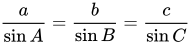


I have been asked on my talk page to give my opinion here. However, my competence on the history of mathematics is very low. Nevertheless, here are some remarks.
- I have had many interactions with Jacobolus on Wikipedia talk pages, and I have been always astonished by his knowledge of the history of mathematics and his balanced opinions. This is also the case here where he gave many relevant quotations. So, here, I am inclined to fully support his opinion.
- It seems that a part of the debate is whether Indians created their tables indepedently of the Greeks or if they copied them from Greek tables. This is a wrong question. Indeed, at that time, mathematicians travelled much, at least for having access to the manuscripts where they were accessible. Also, trigonometry is useful for sailors, and I guess that trigonometric tables were useful for sailors. So, it is highly probable that Indian mathematicians knew Greek tables, or, at least, knew their existence. So, the probable scheme is that Indians used their knowledge of Greek tables for designing new tables. As do all mathematicians, they used their own knowledge for improving the tables. So, Indian computed their tables, but were certainly inspired by Greek tables. The question is the inspiration degree.
- Jacobolus quoted that the main change between Greek tables and Indian tables is the replacement of chords with half chords. This may seem a minor technical change, but this is fundamental, as this reflects that the geometry of right triangles is much easier than the geometry of isosceles triangles.
- So, my opinion is that the end of the second paragraph of § Indian mathematics, starting from "Some historians of mathematics have argued ..." must be either removed or (much more difficult) completely rewritten.
A final remark: it seems that many "historian of mathematics" are neither historians nor mathematicians. I consider their conclusions as non-reliable. An example that history of mathematics requires good mathematical knowledge: I doubt that any "historian of mathematics" remarqued that the definition by Eudoxus of Cnidus of the equality of irrational proportions is essentially the same as the definition of real numbers with Dedekind cuts. D.Lazard (talk) 10:35, 25 September 2026 (UTC)
- You're too kind. I only know a small amount compared to the mathematical historians who have read all of the relevant primary documents across multiple languages and are deeply familiar with the secondary literature (I only vaguely know the content of high-level surveys). Any apparent knowledge is often the result of just directly looking up secondary sources before I say something I'm not sure about; I'd say my main skill is some patience and effective literature searching and skimming. In Wikipedia, I think we should nearly always defer to reliable sources, and try to summarize them, attributing any controversial claims and labeling them as controversial.
- For example, I think Pingree's inference that the Indian astronomers/geometers of the first few centuries AD had access to several pre-Ptolemy Greek astronomy/geometry texts seems plausible, based on his argument, but I don't know nearly enough about the detailed astronomical calculations he describes to give any personal insight. However, it seems like at least some of his claims are disputed by other scholars, so we shouldn't just present Pingree's hypothesis as historical fact, but should try to separate known details from hypothetical/speculative interpretations. –jacobolus (t) 19:21, 25 September 2026 (UTC)
- As for the aside about Eudoxus and Dedekind: Dedekind was clearly familiar with Eudoxus's theory as expressed in the Elements, as were all mathematicians at the time, and there has been quite a lot written about the relation by mathematical historians. For example, Nikolić (1974) mentions:
Besides Struik [(1967)], many other historians [of] matematics and commentators on Eudoxus' works, such as Arnold (1939), Bourbaki (1960), Becker (1954), Bilimovic (1949-1956), Enriques (1930), Haase, and Scholz (l928), Morduhaj (1958), Markovic (1946), Natucci (1951), Ribnikov (1960), Steckin (1956), Van der Waerden (1950), and others, point to the similarities of the ideas in both Eudoxus' theory of ratios and Dedekind's theory of cuts;
- (and I'm sure there have been many further commentaries in the half century since). Later in this article:
Dedekind was, at any rate, well acquainted with Eudoxus' theory of ratio and found inspiration for the solution of the problem he was interested in, when in his lectures he wanted precisely to expound the foundations of the infinitesimal analysis, which led him at last to the idea of cut in a system of points of a straight line, i.e. in a system of numbers, and also to a precise formulation of the axiom of continuity. A letter shows that Dedekind was inspired by Eudoxus' notion of ratio and by the whole theory of ratio.
- Cheers, –jacobolus (t) 19:41, 25 September 2026 (UTC)
- So what we can do either remove the paragraph of Indian mathematics, starting from "Some historians of mathematics have argued ..." or just completly rewrite the sentence to keep it in a neutralized way Myuoh kaka roi (talk) 16:34, 26 September 2026 (UTC)
Bhaskara 2
[edit]Is there any source that discuss him in more detail other than, "and detailed method for constructing a table of sines for any angle were give by Bhaskara in 1150. ~2026-50448-70 (talk) 03:50, 21 September 2026 (UTC)
- https://linux.ime.usp.br/~bedulli/Datta-Singh_hindu-trigonometry-1983.pdf has some detail, though it's hard to tell (I'm not sure if scholars entirely know) which developments were Bhaskara II's and which things he was merely repeating from other sources. –jacobolus (t) 05:27, 21 September 2026 (UTC)
- Van Brummelen's The Mathematics of the Heavens and the Earth also discusses Bhaskara II's construction of trigonometric tables, including the accurate (but unexplained/unproven) closed expression , a good approximation for (namely, , which is accurate to about 1 part in 50 thousand), and formulas for the sine of a sum or difference of angles. –jacobolus (t) 05:41, 21 September 2026 (UTC)
- The approximation if is not really a conceptual novelty. Earlier creators of Indian sine tables which used could plainly see that to the nearest integer but , and that's a pretty plausible reason for the earliest sine tables to step in increments of : a side of a regular 96-gon has the same length, rounded to the nearest arcminute, as the arc it subtends. –jacobolus (t) 17:02, 21 September 2026 (UTC)


