


Talk:Gaussian filter
Add topic | This article is rated Start-class on Wikipedia's content assessment scale. It is of interest to the following WikiProjects: | ||||||||||
| |||||||||||

Gaussian blur
[edit]Can the introductory sentences be simplified? It looks like it's written for people who already understand specialized terminology. Chris (talk) 15:56, 9 August 2013 (UTC)
- The following discussion is closed. Please do not modify it. Subsequent comments should be made in a new section. A summary of the conclusions reached follows.
- The result of this discussion was not merged D O N D E groovily Talk to me 04:03, 21 March 2012 (UTC)
Is this the same as the Gaussian blur interpolation? - Fredrik Johansson 18:58, 8 September 2006 (UTC)
- No, but they are related. A simple Gaussian filter filters a signal (1D), Gaussian blur is 2D. --84.150.198.254 22:12, 21 October 2006 (UTC)
- It looks like we should not merge Gaussian blur with this one then. Graeme Bartlett (talk) 21:05, 31 March 2009 (UTC)
- No, that's an old discussion. A lot of the material in the filter article applies to the blurring article, plus there's duplicated stuff. Both articles really refer to Gaussian filters (except one current covers the 1D and the other the 2D), so I see no reason why they can't be merged. -Roger (talk) 21:20, 31 March 2009 (UTC)
- I think Gaussian blur should absolutely not be merged with Gaussian filter, even if they use the same theory. They are about totally different contexts. Please keep them separate. A photographer might be interested in gaussian blur, and a radio communications designer in gaussian filters. A "see also" link would be sufficient to link the two articles. --HelgeStenstrom (talk) 13:13, 9 November 2009 (UTC)
- I agree with Helga (above). I was specifically looking for the Gaussian filter as it applied to graphic arts, so I searched for "Gaussian blur", its name in PhotoShop. I wanted to learn about 2D without having to weed my way through the 1D references. Lisa Pickens. —Preceding unsigned comment added by 76.26.110.157 (talk) 09:20, 6 December 2009 (UTC)
- The difference between "filter"and "blur' is the difference between a tool and the application of the tool. In the blur article one could focus on the application in graphics. In the filter article one could describe the filter implementation. --84.150.100.221 (talk) 10:31, 29 December 2009 (UTC)
- A Gaussian blur is an image processing effect accomplished by the application of a Gaussian filter to images. Gaussian filter can be applied to may other types of data and signals. This article should stick to math and information related to filter theory and could generalize to N-dimensions. Hgkamath (talk) 04:28, 8 February 2011 (UTC)
non-causal?
[edit]It looks to me like the gaussian filter, as defined here, is non-causal. Is this correct? If so, how does one approximate a gaussian filter in the "real" world? Thanks, Mherndon 16:23, 2 July 2007 (UTC) The usual dimensions in images are spatial and the whole image is available before application. If an image was transmitted then causality would matter as one would have to wait for relevant pixels to arrive before computing the filter. Hgkamath (talk) 04:28, 8 February 2011 (UTC)
- A binomial filter (a FIR filter with binomial coefficients) is an approximation to a gaussian filter. --89.59.137.109 00:16, 3 July 2007 (UTC)
Digital implementation section
[edit]I edited the digital implementation section, but left the tag on because I'm not sure whether the math is correct or not. The first few paragraphs seem OK as far as I know (not sure) but the units seem wrong for the cut-off frequency f/sigma. f is already in samples per second, and sigma would be in seconds, I think. ☺Coppertwig (talk) 22:54, 17 April 2010 (UTC)
- The article may be measuring sd in samples rather than time units, but I agree, the cleanup template should stay: the article is far from clear to technically minded readers, let alone a general reader. It also fails to give its source. SpinningSpark 10:23, 18 April 2010 (UTC)
Sudden jump to digital image processing
[edit]The last paragraph under the Definition subheading suddenly starts talking about image and pixel from the second line. I think this is out of context there. The 2-D Gaussian filter should be described in a generic mathematical context rather than particular application (to graphics/image processing). — Preceding unsigned comment added by Srays (talk • contribs) 09:27, 11 January 2011 (UTC)
Minimizing the rise and fall time?
[edit]The article says "Gaussian filters have the properties of having no overshoot to a step function input while minimizing the rise and fall time.". All filters with non-negative (or non-positvie) impulses have no overshoot. The fastest filter without overshoot is the dirac delta (it is instantaneous). It should probably be the fastest filter subjected to some constraint.LarsPM (talk) 16:13, 16 October 2013 (UTC)
Kernel size
[edit]"A gaussian kernel requires 6{\sigma}-1 values, e.g. for a {\sigma} of 3 it needs a kernel of length 17"
Can you please clarify this? I understand it is somehow derived from the 3-sigma rule to cover approximately 99.7 of the the total area of the Gaussian distribution but this is not stated anywhere. Furthermore it is not stated if this refers to an odd or even kernel and what the purpose of -1 is. If I take an odd kernel of 17 pixels that gives an effective radius for the sampling points (at the pixel centres) of (17 - 1) / 2 = 8 pixels. That is a sigma of 8 / 3 = 2.667 approx. I don't see how from a sigma of 3 one can derive a kernel of 17 pixels. My calculation gives me 18 pixels and if I wanted to make this odd I would go up to 19 pixel giving me a sigma of 3.167 approx which is closer to 3. Maybe I have missed something.
Second frequency response function description is badly worded
[edit]A function is given in terms of the standard deviation in time-domain, and then a frequency response function is given. At first, because of poor wording, the frequency response function appears to be the frequency response of the same preceding time-domain function, but upon looking closer I see that the standard deviation for the frequency-domain function is in terms of the standard deviation in frequency units. Either "standard deviation" should mean the same in both functions, or language should be introduced that clarifies that the two functions use a different meaning for standard deviation (sigma and sigma-f are the inverse of each other -- sigma-f = 1/sigma). — Preceding unsigned comment added by 2601:643:201:6351:E1CA:D283:CDEB:13A7 (talk) 19:32, 27 November 2015 (UTC)
What is ?
[edit]
The Definition section mentions but does not explain what it is. It is not obvious to a non-mathematician. — Preceding unsigned comment added by 184.70.193.174 (talk) 18:54, 26 February 2019 (UTC)
Incorrect formula for frequency cutoff with arbitrary attenuation
[edit]The formula : appears to be incorrect. My derivation, supported by numerical calculations indicates that the proper formula is : Also I found a reference that suggests the proper (rearranged) formula, but regrettably with an improper derivation. I would appreciate help finding other references.
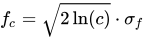
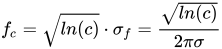
https://www.gaussianwaves.com/2012/05/derivation-of-expression-for-a-gaussian-filter-with-3-db-bandwidth/ --Gnobe (talk) 20:32, 2 September 2019 (UTC)
Infinite support
[edit]@Fgnievinski: re this edit, what do you mean by "infinite support"? Is that a typo? SpinningSpark 15:20, 19 August 2021 (UTC)
- @Spinningspark: I've tried to clarify it now: . fgnievinski (talk) 16:09, 19 August 2021 (UTC)
Rephrase purpose in introduction?
[edit]The introduction says, "It is considered the ideal time domain filter, just as the sinc is the ideal frequency domain filter.[1]" I'm having trouble understanding this: the equivalent of a sinc() in frequency would be a rect() in time domain. A Gaussian in time is a Gaussian in frequency. Sinc() is useful if you care about having absolute cutoff in frequency and are willing to have big tails in the time domain. Gaussian gives the tightest combination of tails in time and frequency domain, e.g., uncertainty principle. I'd like to modify this section to reflect that. David (talk) 00:14, 17 June 2022 (UTC)
- The following discussion is closed. Please do not modify it. Subsequent comments should be made in a new section. A summary of the conclusions reached follows.
- I retract my superficial judgment regarding the "The Necessity of the 'Definition' Section." For specific reasons, please refer to the discussion thread titled "The Theory of Gaussian Filters Based on Digital Signal Processing (DSP)." Additionally, the section on "The Necessity of the Symbol ϵ" has also been thoroughly discussed (see "Why use ϵ?"). For the reasons stated above, I have closed this Talk. Thanks to everyone for the advice. P. W. Kime (talk) 18:24, 31 July 2026 (UTC)
The Necessity of the "Definition" Section and the Symbol ϵ
[edit]Currently, the discussion in the "Definition" section is nearly identical to that covered in 【Gaussian function】 and 【Fourier transform】. In my view, there does not seem to be a close connection between the "Definition" section and the subsequent content in this topic.
Furthermore, the mathematical expressions presented in the "Definition" section contain errors. Based on my verification, the Fourier transform of the impulse response is correct, so I will not elaborate on it here. However, the subsequent Fourier transform expressed in terms of standard deviation is incorrect.
---
For further details, see "Wrong part in the 'Definition'" and "Why use ϵ?".
P. W. Kime (talk) 03:25, 29 July 2026 (UTC)
Wrong part in the "Definition"
[edit]For the impulse response form, we know

And its Fourier Transform is

I am using here to denote ordinary frequency, because the symbol is typically used to denote functions, such as , and we may be dealing with polynomials in this topic. To avoid symbol conflicts, I will use to denote frequency in this talk and in any subsequent replies.


For the standard deviation form, have

Compared to the impulse response form, you might realize that

Because is a constant, or something not relate to , the correct frequency response should be


Why use ϵ?
[edit]According to the definition in the context, it says

(Note: the here is not frequency,) which is the Taylor series expansion of the exponential function .

From "Calculation of Taylor series" under 【Taylor series】 topic:
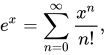
Let and rewrite the equation, obtain


So, my question is: Why not just use symbol but use a Greek letter - Epsilon () here?


When I first encountered in this topic, I mistakenly assumed it referred to the error term. I believe this symbol can lead to some misunderstanding and constitutes a misuse; furthermore, the "Symbol" section of the 【Epsilon】 topic also details the common uses of across various fields, including engineering, math, physics, none of which include referring to the exponential function. P. W. Kime (talk) 10:42, 28 July 2026 (UTC)
- My input is that the risk of confusing any specific symbol with other outside definitions is reader specific and and will always exist to some degree. I have no objections to changing the symbol. Netshine2 (talk) 15:49, 28 July 2026 (UTC)
- I would replace with too. I can only speculate, but maybe the cited source used ? But I can only access a preview of that source, so I can't check to see how they write it and why. Or maybe some editor didn't know how to write ? Regardless, I say please change it to . Em3rgent0rdr (talk) 16:29, 28 July 2026 (UTC)
- @Netshine2, @Em3rgent0rdr Thank you for your replies. I’ve also posted two discussion topics: "The Necessity of the 'Definition' Section and the Symbol ϵ" and "Wrong part in the 'Definition'". Actually, I had originally intended to post them together with this discussion in a single thread, but I used the title tag (i.e.,
== Some Title ==) when posting, which caused the system to recognize them as separate talks, so the signature wasn’t automatically added. I’ve updated the signature, so you can reply now. - Feel free to share your thoughts anytime.
- P.S. Since this error has occurred, let’s treat it as a separate discussion—please post your reply in the appropriate Talks section. Thanks! P. W. Kime (talk) 03:54, 29 July 2026 (UTC)
Wrong part in the "Synthesizing Gaussian filter polynomials"
[edit]---
Before beginning this talk, I had already changed the symbol to , in line with "Why use ϵ?". You can see the changes HERE.
---
According to the definition in the context, it says

But the correct form should be
![{\displaystyle e^{-a\omega ^{2}}{\sqrt {(e^{-a\omega ^{2}})^{2}}}=e^{-a\omega ^{2}}\cdot {\sqrt[{\cancel {2}}]{(e^{-a\omega ^{2}})^{\cancel {2}}}}=e^{-2a\omega ^{2}}={\frac {1}{e^{2a\omega ^{2}}}}}](https://wikimedia.org/api/rest_v1/media/math/render/svg/6c5310339f56b1c69d7a5c3000f47078c5d7e17a)
P. W. Kime (talk) 02:38, 30 July 2026 (UTC)
- yikes. I wish that cited source "Handbook of filter synthesis" wasn't hidden under a limited-preview, preventing me from checking it. Is there another publicly-viewable source that gives the correct result? Em3rgent0rdr (talk) 05:46, 30 July 2026 (UTC)
- @Em3rgent0rdr I’m not sure if this is what you need. The link will take you to djvu.online, where the resources are also in
*.djvuformat. - Alternatively, you can access the PDF version via this link. This link will take you to limewire.com; please note that it will expire in 7 days (i.e., available before 2026/8/7).
- ======
- Disclaimer
- ----
- I make no guarantees regarding the links provided above; please use your own judgement as to whether you wish to accept any security risks associated with them. If you have any concerns, I recommend searching for relevant information yourself, or enquiring at a library near your current location to see if they hold a copy of "Zverev, Anatol I. (1967). Handbook of Filter Synthesis. New York, Chichester, Brisbane, Toronto, Singapore: John Wiley & Sons, Inc. ISBN 0-471-98680-1.”
- P. W. Kime (talk) 07:50, 30 July 2026 (UTC)
- That Zverev 1967 source isn't helping me. Maybe because it is using a different notation, or maybe some other editors changed things around from when it was first cited. Sorry I can't be of more help. Em3rgent0rdr (talk) 15:52, 30 July 2026 (UTC)
- @Em3rgent0rdr I’m not sure if this is what you need. The link will take you to djvu.online, where the resources are also in
The Theory of Gaussian Filters Based on Digital Signal Processing (DSP)
[edit]Basic of Gaussian function
The basic Gaussian form is

Its integral would be

Let , and since ,
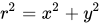


Let , ,


![{\displaystyle {\begin{aligned}\int _{-\infty }^{\infty }g(x)\,dx&={\sqrt {\int _{0}^{2\pi }\left[-{\frac {1}{2}}e^{u}\right]_{0}^{-\infty }\,d\theta }}\\&={\sqrt {\int _{0}^{2\pi }{\frac {1}{2}}\,d\theta }}={\sqrt {\pi }}\,.\end{aligned}}}](https://wikimedia.org/api/rest_v1/media/math/render/svg/1562bd88c67a9703bece3753f1e070c7802c80fe)
Imply that

It is clear that for all the Gaussian form we discussed above has the expected value
![{\displaystyle E[X]={\frac {\displaystyle \int _{-\infty }^{\infty }x\ g(x)\,dx}{\displaystyle \int _{-\infty }^{\infty }\ g(x)\,dx}}=0\,.}](https://wikimedia.org/api/rest_v1/media/math/render/svg/6660ca9413a8964337dfe4ea4153f4213d62e677)
For the variance,

which is hard to calculate.
To calculate the variance, let's introduce a parameter into Gaussian kernel:

Let ,


Differentiating both sides of the equation with respect to :

yields

Hence, let , obtain


From the results of subsection Expected value and subsection Variance, you might notice that some special properties would appear when

such that
![{\displaystyle \mathbb {E} [X]=0\quad {\text{and}}\quad Var(X)=1\,.}](https://wikimedia.org/api/rest_v1/media/math/render/svg/bf7fe288f1ca66cb4e16c4e39722144d5b0f942b)
If we normalize the form of its integral, we obtain

and its expected value and variance are also and , respectively.


Use the same method, we can easily obtain the Gaussian distribution:

The most efficient method for computing the Fourier transform (FT) of the Gaussian function and its variants may be to start with the normalized form, given that

Rewriting this in parametric form, we have

It is also an impulse response.
And its Fourier Transform is

Define

We can evaluate it by deriving a differential equation for :


Since

Therefore,

Apply integration by parts, let

Have
![{\displaystyle {\begin{aligned}F'(k)&={\frac {i\pi }{a}}\left(\left[{\vphantom {a^{b^{c}}}}uv\right]_{-\infty }^{\infty }-\int _{-\infty }^{\infty }v\,du\right)\\&={\frac {i\pi }{a}}\left[e^{-ax^{2}}e^{-i2\pi kx}\right]_{-\infty }^{\infty }-{\frac {i\pi }{a}}\int _{-\infty }^{\infty }e^{-ax^{2}}\left(-i2\pi k\right)e^{-i2\pi kx}\,dx\end{aligned}}}](https://wikimedia.org/api/rest_v1/media/math/render/svg/482463251727098c100cbee62a795855fb71cd48)
Because as ,


The solution of differential equation would be

When , the Fourier transform of the Gaussian function is identical to the Gaussian function itself, that is


And hence

So,

And this result implies that the Fourier Transform of Gaussian distribution would be

The Gaussian filter
Following the discussion above, we now have a thorough understanding of the Gaussian function itself and its spectral form. According to digital signal processing theory, the parameters of a low-pass filter designed using the Gaussian function can be calculated using the following equation:

Here, is the normalized cutoff frequency; is the decibel value of the half-power point.


After performing operations such as elimination, taking the natural logarithm, and rearranging terms, we obtain

Or form in angular frequency

The normalized cutoff frequency can be obtained from Nyquist rate:

where is the cutoff frequency and is the sampling frequency.


The above are my recent study notes, which should be helpful in refining this topic. Feel free to leave comments and join the discussion, or you can directly using the text above to edit the topic content—I've authorized you to do so. Due to personal reasons, I’ll be stepping away for a while.