


Talk:Function of several complex variables
Add topic | This article is rated B-class on Wikipedia's content assessment scale. It is of interest to the following WikiProjects: | ||||||||||
| |||||||||||

 | The content of Reinhardt domain was merged into Function of several complex variables on 2020-11-20. The former page's history now serves to provide attribution for that content in the latter page, and it must not be deleted as long as the latter page exists. For the discussion at that location, see its talk page. |
| The content of Holomorphically convex hull was merged into Function of several complex variables on 2020-11-25. The former page's history now serves to provide attribution for that content in the latter page, and it must not be deleted as long as the latter page exists. For the discussion at that location, see its talk page. |

I'm considering merge the domain of holomorphy into Several complex variables, but the domain of holomorphy (theory) may be the title of this page
[edit]The reason for branching into several complex variables from the trunk of complex analysis is that, unlike the case of one variable, the boundaries of all domains do not always become natural boundaries. I think the purpose of this page is to explain the mathematical elements that have become the elements that branch off from the trunk of complex analysis into several complex variables. This mathematical element seems to be called the domain of holomorphy, and since holomorphically convex and local Levi property etc. are conditions that make it a domain of holomorphy (And the theory of sheaf seems to be used to elucidate this condition. ), it seemed like we could read the domain of holomorphy as the theory that led to the branching of several complex variables from the trunk complex analysis. However, on the contrary, it seems good to rename the title of this page to the domain of holomorphy (theory). The lack of a page called several complex variables in EOM makes me think about this. The title of the textbook uses several complex variables, so my idea may be off the mark. thanks!--SilverMatsu (talk) 05:33, 21 December 2020 (UTC)
I forgot to say it. Redirecting to the title of this page instead of section redirecting to the domain of holomorphy is also a suggestion choice.--SilverMatsu (talk) 05:39, 21 December 2020 (UTC)
- I don't think I agree with the assertion that several complex variables is distinct from complex analysis in one variable only in the sense that it is the study of domains of holomorphy/Stein manifolds. The interesting phenomena that occur in several complex variables are fundamentally important to the study of compact complex manifolds and projective complex varieties for example, and has a different flavour to complex analytic geometry in or on Stein manifolds, which is what the current lead gives most of its weight to.

- I don't think it is standard anywhere to refer to the theory of complex functions of several variables as "domains of holomorphy theory" so Wikipedia should definitely avoid presenting that as the main name of the subject. As you point out however, people do refer to "several complex variables" and that is the title of the main book on the subject, so that is surely the better name for the article. I think we probably agree that the area is different enough in flavour to complex analysis of a single variable that it deserves its own article. I wouldn't be opposed to merging with complex analysis, which is quite a thin article, but I don't think there is any particular need to. In particular I think complex analysis of a single variable gets a very different (and much broader) treatment pedagogically, and that is an article looked at frequently by people who are not pure mathematicians interested in several complex variables (engineers, physicists) and presenting all the definitions on that page in their largest generality would serve more to obfuscate the point rather than elucidate it for most visitors. Just my two cents. Thank you for improving the articles in complex analysis! Tazerenix (talk) 05:53, 23 December 2020 (UTC)
- Thank you very much for teaching me. Thanks for giving me many interesting examples of other manifolds. Sure, it seems too narrow, so I turn the suggestion into a section redirect to the domain of holomorphism. Then, I will modify the lead sentence and correct it to say, "One of the reasons why this field has come to be studied is that the boundary does not become a natural boundary." thanks!--SilverMatsu (talk) 08:01, 23 December 2020 (UTC)
- Withdraw from merge the domain of holomorphy. I might suggest merging conditions that are equivalent to the domain of holomorphy, but I thought that should be considered on the domain of holomorphy. Writing the domain of holomorphy on this page has no effect on withdrawal. thanks!--SilverMatsu (talk) 13:53, 26 December 2020 (UTC)
A memo about the structure of the section
[edit]The course catalog. --SilverMatsu (talk) 03:19, 21 January 2022 (UTC)
Is this right?
[edit]The section Stein manifold begins as follows:
"Since a non-compact (open) Riemann surface always has a non-constant single-valued holomorphic function, and satisfies the second axiom of countability, the open Riemann surface can be thought of 1-dimensional complex manifold to have a holomorphic embedding into a complex plane ."

But wait. A holomorphic embedding is certainly also a topological embedding. But most non-compact surfaces do not have any topological embeddings into the complex plane.
For instance, the torus with one point removed (the "punctured torus") has no topological embedding into the plane.
Question: Is it possible that the phrase "holomorphic embedding" should be replaced with holomorphic immersion? Or just holomorphic mapping? 2601:200:C000:1A0:9AE:98DB:C7E0:3910 (talk) 17:57, 28 December 2022 (UTC)
- Apparently Gunning and Narasimhan proved that every non-compact Riemann surface does in fact immerse in the complex plane.
- (R. C. Gunning and Raghavan Narasimhan, Immersion of open Riemann surfaces, Math. Annalen 174 (1967), 103–108.)
- Therefore I will correct the text to reflect this fact. 2601:200:C000:1A0:9AE:98DB:C7E0:3910 (talk) 18:58, 28 December 2022 (UTC)
Please say what you mean by superscript n
[edit]The definition of a coherent sheaf is given as follows:
"A coherent sheaf on a ringed space is a sheaf satisfying the following two properties:


- is of finite type over , that is, every point in has an open neighborhood in such that there is a surjective morphism for some natural number ;
- for arbitrary open set , arbitrary natural number , and arbitrary morphism of -modules, the kernel of is of finite type."


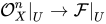




But what does the superscript n mean in the symbol ""?

The article does not say, and nothing in the linked article ringed space uses this notation.
I can guess two distinct possibilities for what "" means.
I hope someone knowledgeable about this subject can explain the notation and avoid having thousands of future readers of Wikipedia also have to guess what it means. 2601:200:C082:2EA0:E1A8:CCAE:61A1:827C (talk) 02:25, 9 February 2023 (UTC)
Bad English and grammar
[edit]Someone please proofread this article. 2A02:6B6F:E98D:400:9BF:E37:5EAC:CB2C (talk) 22:16, 6 February 2025 (UTC)
Complex analysis sidebar
[edit]I am proposing to add the template:Complex analysis sidebar to the article.
Strangely enough, I am getting pushback for that change, hence the discussion. Nolord (talk) 23:08, 30 September 2026 (UTC)
- Sidebars should not be added to the lead, but there is also a general consensus that sidebars should only be used sparingly. They are useful only for closely connected articles (e.g., like books in a series), not for whole areas. Sławomir Biały (talk) 06:28, 1 October 2026 (UTC)
- I understand the general guidance that sidebars should be used sparingly. I'm asking for an article-specific reason against this one. SCV is directly an extension of complex analysis, so there is at least a concrete navigational case for it. What is the article-specific reason against using it here, compared to other related articles? Nolord (talk) 06:40, 1 October 2026 (UTC)
- Complex analysis is a wide field that has many subtopics. The interaction between these subtopics is complex (complicated), and many subtopics are shared with other areas of mathematics. Sidebars are not adapted to this complexity, at least because they are presented as a linear list of items, possibly grouped is sections. So, they are not useful to a reader who want a synthetic view of the subject. They are not useful also to a reader searching information on a narrow subtopic. For this, the tool "search Wikipedia" and Wikipedia categories are much more useful. A synthetic view should be given by the article Complex analysis. The fact that it is not the case of the current state of the article is another problem that cannot be solved by a sidebar. D.Lazard (talk) 08:04, 1 October 2026 (UTC)
- I understand the general guidance that sidebars should be used sparingly. I'm asking for an article-specific reason against this one. SCV is directly an extension of complex analysis, so there is at least a concrete navigational case for it. What is the article-specific reason against using it here, compared to other related articles? Nolord (talk) 06:40, 1 October 2026 (UTC)