


Pseudoanalytic function
In mathematics, pseudoanalytic functions are functions introduced by Lipman Bers (1950, 1951, 1953, 1956) that generalize analytic functions and satisfy a weakened form of the Cauchy–Riemann equations.
Definitions
[edit]Let and let be a real-valued function defined in a bounded domain . If and and are Hölder continuous, then is admissible in . Further, given a Riemann surface , if is admissible for some neighborhood at each point of , is admissible on .

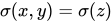


The complex-valued function is pseudoanalytic with respect to an admissible at the point if all partial derivatives of and exist and satisfy the following conditions:




If is pseudoanalytic at every point in some domain, then it is pseudoanalytic in that domain.[1]

Similarities to analytic functions
[edit]- If is not the constant , then the zeroes of are all isolated.
- Therefore, any analytic continuation of is unique.[2]


Examples
[edit]- Complex constants are pseudoanalytic.
- Any linear combination with real coefficients of pseudoanalytic functions is pseudoanalytic.[1]
See also
[edit]References
[edit]- 1 2 Bers, Lipman (1950), "Partial differential equations and generalized analytic functions" (PDF), Proceedings of the National Academy of Sciences of the United States of America, 36 (2): 130–136, Bibcode:1950PNAS...36..130B, doi:10.1073/pnas.36.2.130, ISSN 0027-8424, JSTOR 88348, MR 0036852, PMC 1063147, PMID 16588958
- ↑ Bers, Lipman (1956), "An outline of the theory of pseudoanalytic functions" (PDF), Bulletin of the American Mathematical Society, 62 (4): 291–331, doi:10.1090/s0002-9904-1956-10037-2, ISSN 0002-9904, MR 0081936
Further reading
[edit]- Kravchenko, Vladislav V. (2009). Applied pseudoanalytic function theory. Birkhauser. ISBN 978-3-0346-0004-0.
- Bers, Lipman (1951), "Partial differential equations and generalized analytic functions. Second Note" (PDF), Proceedings of the National Academy of Sciences of the United States of America, 37 (1): 42–47, Bibcode:1951PNAS...37...42B, doi:10.1073/pnas.37.1.42, ISSN 0027-8424, JSTOR 88213, MR 0044006, PMC 1063297, PMID 16588987
- Bers, Lipman (1953), Theory of pseudo-analytic functions, Institute for Mathematics and Mechanics, New York University, New York, MR 0057347