


Normalized difference red edge index
The normalized difference red edge index (NDRE) is a metric that can be used to analyse whether images obtained from multi-spectral image sensors contain healthy vegetation or not.[1] It does this by measuring the amount of chlorophyll in a plant.[2]
It is similar to Normalized Difference Vegetation Index (NDVI) but uses the ratio of Near-Infrared and the edge of Red as follows:[3]
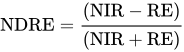
The red edge is the part of the spectrum centered around 715 nm.
The Index will give a value between -1.0 to +1.0, with a higher value showing a healthy plant environment.[3]
See also
[edit]References
[edit]- ↑ Barnes, E. M., Clarke, T. R., Richards, S. E., Colaizzi, P. D., Haberland, J., Kostrzewski, M., ... & Lascano, R. J. (2000, July). Coincident detection of crop water stress, nitrogen status and canopy density using ground based multispectral data. In Proceedings of the Fifth International Conference on Precision Agriculture, Bloomington, MN, USA (Vol. 1619).
- ↑ "NDRE: Normalized Difference Red Edge Index". EOS Data Analytics. Retrieved April 7, 2025.
- 1 2 "NDRE Formula Explained". Farmonaut. September 23, 2024. Retrieved April 7, 2025.
External links
[edit]- IEE Explore website, Normalized Difference Red-Edge Estimation With Modified DiscoGAN Model, article by Hyeon-Beom Choi, Kwon-Hee Han and Jeongwook Seo (2006)
- Spectral Reflectance Changes Associated with Autumn Senescence of Aesculus hippocastanum L. and Acer platanoides L. Leaves. Spectral Features and Relation to Chlorophyll Estimation
- Chlorophyll Absorption
- Barnes, T.R., Clarke, S.E. Richards et al. 2000. Coincident Detection of Crop Water Stress, Nitrogen Status and Canopy Density using Ground-Based Multispectral Data. Proceedings of the Fifth International Conference on Precision Agriculture
 | This biology article is a stub. You can help Wikipedia by adding missing information. |
 | This remote sensing-related article is a stub. You can help Wikipedia by adding missing information. |