


McMullen problem
The McMullen problem is an open problem in discrete geometry named after Peter McMullen.
Statement
[edit]In 1972, David G. Larman wrote about the following problem:[1]


Larman credited the problem to a private communication by Peter McMullen.
Equivalent formulations
[edit]Gale transform
[edit]Using the Gale transform, this problem can be reformulated as:







The numbers of the original formulation of the McMullen problem and of the Gale transform formulation are connected by the relationships



Partition into nearly-disjoint hulls
[edit]Also, by simple geometric observation, it can be reformulated as:



The relation between and is


Projective duality
[edit]
The equivalent projective dual statement to the McMullen problem is to determine the largest number such that every set of hyperplanes in general position in d-dimensional real projective space form an arrangement of hyperplanes in which one of the cells is bounded by all of the hyperplanes.
Results
[edit]This problem is still open. However, the bounds of are in the following results:
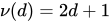
- David Larman proved in 1972 that[1]
- Michel Las Vergnas proved in 1986 that[2]
- Jorge Luis Ramírez Alfonsín proved in 2001 that[3]

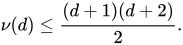
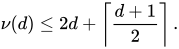
The conjecture of this problem is that . This has been proven for .[1][4]

References
[edit]- 1 2 3 Larman, D. G. (1972), "On sets projectively equivalent to the vertices of a convex polytope", The Bulletin of the London Mathematical Society, 4: 6–12, doi:10.1112/blms/4.1.6, MR 0307040
- ↑ Las Vergnas, Michel (1986), "Hamilton paths in tournaments and a problem of McMullen on projective transformations in ", The Bulletin of the London Mathematical Society, 18 (6): 571–572, doi:10.1112/blms/18.6.571, MR 0859948
- ↑ Ramírez Alfonsín, J. L. (2001), "Lawrence oriented matroids and a problem of McMullen on projective equivalences of polytopes", European Journal of Combinatorics, 22 (5): 723–731, doi:10.1006/eujc.2000.0492, MR 1845496
- ↑ Forge, David; Las Vergnas, Michel; Schuchert, Peter (2001), "10 points in dimension 4 not projectively equivalent to the vertices of a convex polytope", Combinatorial geometries (Luminy, 1999), European Journal of Combinatorics, 22 (5): 705–708, doi:10.1006/eujc.2000.0490, MR 1845494