


Hadamard gap theorem
In mathematics, the Hadamard gap theorem is a result about the analytic continuation of lacunary power series. Such a power series is "badly behaved" in the sense that it cannot be extended to be an analytic function anywhere on the boundary of its disk of convergence. The result was proved by Jacques Hadamard in his influencial 1892 thesis.[1]
Statement of the theorem
[edit]Let be a sequence of integers such that the for , or equivalentlyLet be a sequence of complex numbers such that the power series


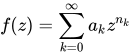
has radius of convergence . Then the unit circle is a natural boundary for the series .[2][3]


This theorem is a special case of both the Fabry gap theorem and Ostrowski's overconvergence theorem.
See also
[edit]References
[edit]- ↑ Hadamard, J. (1892). "Essai sur l'étude des fonctions données par leur développement de Taylor". Journal de Mathématiques Pures et Appliquées (in French). 8: 101–186. ISSN 1776-3371.
- ↑ Titchmarsh, E. C. (1939). The Theory of Functions. Oxford University Press. p. 223.
- ↑ Dienes, Paul (1957). The Taylor Series: An Introduction to the Theory of Functions of a Complex Variable. Dover Publications. p. 231.
 | This mathematical analysis–related article is a stub. You can help Wikipedia by adding missing information. |