


Gompertz constant
In mathematics, the Gompertz constant or Euler–Gompertz constant,[1][2] denoted by , appears in integral evaluations and as a value of special functions. It is named after Benjamin Gompertz.

It can be defined via the exponential integral as:[3]

The numerical value of is about
History
[edit]When Euler studied divergent infinite series, he encountered via, for example, the above integral representation. Le Lionnais called the Gompertz constant because of its role in survival analysis.[1]
In 1962, Shidlovski proved that at least one of the Euler–Mascheroni constant and the Euler–Gompertz constant is irrational.[4] This result was improved in 2012 by Tanguy Rivoal, who proved that at least one of them is transcendental.[2][4][5][6]
Identities involving the Gompertz constant
[edit]The most frequent appearance of is in the following integrals:

which follow from the definition of δ by integration of parts and a variable substitution respectively.
Applying the Taylor expansion of we have the series representation

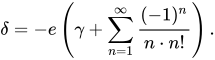
Gompertz's constant is connected to the Gregory coefficients via the following formula:[7]

The Gompertz constant also happens to be the regularized value of the summation of alternating factorials of all natural numbers (1 − 1 + 2 − 6 + 24 − 120 + ⋯), which is defined by Borel summation:[2]

It is also related to several polynomial continued fractions:[1][2]


Notes
[edit]- 1 2 3 Finch, Steven R. (2003). Mathematical Constants. Encyclopedia of Mathematics and Its Applications. Vol. 94. Cambridge University Press. pp. 425–426. ISBN 978-0-521-81805-6.
- 1 2 3 4 Lagarias, Jeffrey C. (2013). "Euler's constant: Euler's work and modern developments". Bulletin of the American Mathematical Society. 50 (4): 527–628. arXiv:1303.1856. doi:10.1090/S0273-0979-2013-01423-X.
- ↑ Weisstein, Eric W. "Gompertz Constant". MathWorld. Retrieved 1 August 2026.
- 1 2 Aptekarev, A. I. (2009). "On linear forms containing the Euler constant". arXiv:0902.1768 [math.NT].
- ↑ Rivoal, Tanguy (2012). "On the arithmetic nature of the values of the gamma function, Euler's constant, and Gompertz's constant". Michigan Mathematical Journal. 61 (2): 239–254. doi:10.1307/mmj/1339011525.
- ↑ Waldschmidt, Michel (2023). "On Euler's Constant" (PDF). Sorbonne Université, Institut de Mathématiques de Jussieu, Paris.
- ↑ Mező, István (2014). "Gompertz constant, Gregory coefficients and a series of the logarithm function" (PDF). Journal of Analysis and Number Theory. 2 (2): 33–36.