


Draft:Aboudi Setty
 | Review waiting, please be patient.
This may take 5 weeks or more, since drafts are reviewed in no specific order. There are 2,571 pending submissions waiting for review.
Where to get help
How to improve a draft
You can also browse Wikipedia:Featured articles and Wikipedia:Good articles to find examples of Wikipedia's best writing on topics similar to your proposed article. Improving your odds of a speedy review To improve your odds of a faster review, tag your draft with relevant WikiProject tags using the button below. This will let reviewers know a new draft has been submitted in their area of interest. For instance, if you wrote about a female astronomer, you would want to add the Biography, Astronomy, and Women scientists tags. Editor resources
Reviewer tools
|
Submission declined on 15 September 2026 by ClaudineChionh (talk).
Where to get help
How to improve a draft
You can also browse Wikipedia:Featured articles and Wikipedia:Good articles to find examples of Wikipedia's best writing on topics similar to your proposed article. Improving your odds of a speedy review To improve your odds of a faster review, tag your draft with relevant WikiProject tags using the button below. This will let reviewers know a new draft has been submitted in their area of interest. For instance, if you wrote about a female astronomer, you would want to add the Biography, Astronomy, and Women scientists tags. Editor resources
This draft has been resubmitted and is currently awaiting re-review. |  |
 Comment: Please do not remove past AfC decline templates. These are left for future reviewers so that they can review your draft and check that any prior concerns have been addressed. Removing these templates can make it more difficult for your draft to be accepted. Thank you. —ClaudineChionh (she/her · talk · email) 12:54, 15 September 2026 (UTC)
- Comment: Both Setty's story and the story of the archives look genuinely interesting, however the draft currently relies too heavily on primary sources. As an encyclopaedia, Wikipedia summarises what independent secondary sources say about a subject. Are there newspaper or magazine articles, or scholarly journals, that discuss Setty in depth? Sources do not need to be online or in English. —ClaudineChionh (she/her · talk · email) 00:14, 15 September 2026 (UTC)
 | This is a draft article. It is a work in progress open to editing by anyone. Please ensure core content policies are met before publishing it as a live Wikipedia article. Find sources: Google (books · news · scholar · free images · WP refs) · FENS · JSTOR · TWL Last edited by 1onym ball (talk | contribs) 17 days ago. (Update)
This draft has been submitted and is currently awaiting review. |
Aboudi Setty | |
|---|---|
| עבודי סטי | |
 Portrait of Aboudi Setty, Baghdad, circa 1940. | |
| Born | 1883 |
| Died | 1970 (aged 86–87) |
| Occupations | Lawyer, community leader, public figure |
| Known for | Leadership in the Baghdad Jewish community, founding the "Tomkhe Tora" society |
Aboudi Setty[1] (also spelled Abboudi Setti or Siti; 1883 – 1970) was a prominent Iraqi-Jewish lawyer, public figure, and a central community leader in the Baghdad Jewish community during the first half of the 20th century.[2][3][4] His public activity was characterized by a youthful and reformist leadership that challenged the traditional, conservative oligarchy of the community's wealthy elite.[2][4]
Biography
[edit]Setty was born in Baghdad in 1883. In his youth, he studied in a traditional "Heder" with a private tutor until the age of 12, where he mastered writing in Arabic and Hebrew using Rashi script. He later studied for eight years at the government secondary school "Idadiyya," where the language of instruction was Turkish.
In 1908, he worked as a Turkish language teacher at the Alliance Israélite Universelle school in Baghdad. Toward the outbreak of World War I, he graduated with honors from law school in Baghdad.[3] In 1916, during World War I, Setty was conscripted into the Ottoman Army and sent to an officer training course in Constantinople (Istanbul). He deserted due to the authorities' discriminatory treatment of Arab and Jewish soldiers.[3][1] Consequently, he was sentenced to death in absentia by a Turkish military court.[3][1] Following his escape, he was captured by British forces, sent to a prisoner-of-war camp in India, and remained there for about a year and a half until the end of the war.[5][6]
Legal and Public Career
[edit]Setty began his public and administrative career as an official in the Ministry of Finance, a position that helped him master government systems, establish close ties with the administration, and develop precise financial management skills.[2][5] After obtaining his license to practice law, he expanded his professional focus to defending public interests and engaging deeply with the pressing issues of the Jewish community in Baghdad.[2] His exceptional public standing was demonstrated when he served between 1933 and 1945 as the secretary and treasurer of the Baghdad Bar Association, being elected by his Muslim colleagues as the sole Jewish attorney to hold this position.
Community Leadership and "Tomkhe Tora"
[edit]From 1920 to 1950, Setty served continuously as a member of the General Committee ("Majlis 'Umumi" or "Al-Majlis Al-Umumi Al-Israili") of the Baghdad Jewish community.[5][4] Official rosters from 1940 list him explicitly as "The Lawyer Aboudi Setty" (المحامي عبودي ستي).[4] From 1927 to 1929, he served as secretary of the Community's Material Committee, where he successfully implemented substantial budget savings by eliminating fictitious expenses.[5]
In 1926, Setty founded the "Tomkhe Tora" society in Baghdad, an association designed to provide financial support to students and young men from impoverished families to prevent them from needing public charity.[5][7]
Rescue of Archives and Later Years
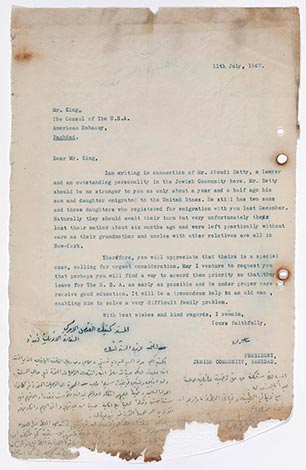
[edit]Following the 2003 US-led invasion of Iraq, thousands of documents pertaining to the Jewish community—including records of the "Tomkhe Tora" society and a personal letter written by Setty in July 1947 to the U.S. Consul in Baghdad regarding his family's immigration—were discovered in a flooded basement of the Mukhabarat headquarters and subsequently rescued and preserved through the Iraqi Jewish Archive project.[8][9]
Setty made aliyah to Israel in 1956. He passed away in 1970. In 1963, he provided a comprehensive historical testimony regarding the Jewish community of Baghdad as part of the Oral Documentation Project at the Hebrew University of Jerusalem.[2][3]
See also
[edit]References
[edit]- 1 2 3 Prominent Jews in Modern Iraq, Al-Gardenia. (Based on the book by Meir Basri).
- 1 2 3 4 5 Kazzaz, Nissim. (1991). *היהודים בעיראק במאה העשרים* (The Jews in Iraq in the Twentieth Century). Ben-Zvi Institute for the Study of Jewish Communities in the East. p. 67, 85.
- 1 2 3 4 5 Ben-Yaakov, Avraham. (1979). *יהודי בבל: מסוף תקופת הגאונים עד ימינו* (Jews of Babylon: From the End of the Geonic Period to Our Time). Kiryat Sefer. p. 23.
- 1 2 3 4 Membership roster of the Israelite General Council of Baghdad, 1940. Iraqi Jewish Archive (IJA).
- 1 2 3 4 5 Historical interview transcript with Aboudi Setty, The Oral Documentation Project, The Hebrew University of Jerusalem.
- ↑ Video recording of the interview with Aboudi Setty, Documentation Archive YouTube channel.
- ↑ Budgetary documentation of Tomkhe Tora for 1933–1934, Iraqi Jewish Archive (IJA).
- ↑ Discovery and Recovery: Preserving Iraqi Jewish Heritage, U.S. National Archives.
- ↑ Original letter written by Aboudi Setty to the U.S. Consul (1947), Iraqi Jewish Archive Digital Exhibition.
- provide significant coverage: discuss the person in detail, not brief mentions or interviews lacking independent analysis;
- are reliable: from reputable outlets with editorial oversight;
- are independent: not connected to the person, such as interviews, press releases, the subject's own website, or sponsored content.
Please add references that meet all three of these criteria. If none exist, the subject is not yet suitable for Wikipedia.