


Cluster prime
In number theory, a cluster prime is a prime number p such that every even positive integer k ≤ p − 3 can be written as the difference between two prime numbers not exceeding p.[1][2] For example, the number 23 is a cluster prime because 23 − 3 = 20, and every even integer from 2 to 20, inclusive, is the difference of at least one pair of prime numbers not exceeding 23:
p ≤ 23 5 − 3 = 2 7 − 3 = 4 11 − 5 = 6 11 − 3 = 8 13 − 3 = 10 17 − 5 = 12 17 − 3 = 14 19 − 3 = 16 23 − 5 = 18 23 − 3 = 20
On the other hand, 149 is not a cluster prime because 140 < 146, and there is no way to write 140 as the difference of two primes that are less than or equal to 149.
By convention, 2 is not considered to be a cluster prime. The first 23 odd primes (up to 89) are all cluster primes.[2][3] The first few odd primes that are not cluster primes are
Paul Erdős asked if there are infinitely many cluster primes.[2][3][4] It is not known if there are infinitely many cluster primes.
Properties
[edit]- The prime gap preceding a cluster prime is always six or less. For any given prime number n, let denote the n-th prime number. If ≥ 8, then − 9 cannot be expressed as the difference of two primes not exceeding ; thus, is not a cluster prime.
- The converse is not true: the smallest non-cluster prime that is the greater of a pair of gap length six or less is 227, a gap of only four between 223 and 227. 229 is the first non-cluster prime that is the greater of a twin prime pair.
- The set of cluster primes is a small set. In 1999, Richard Blecksmith proved that the sum of the reciprocals of the cluster primes is finite.[3]
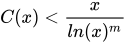
- Blecksmith also proved an explicit upper bound on C(x), the number of cluster primes less than or equal to x. Specifically, for any positive integer m: for all sufficiently large x.
- It follows from this that almost all prime numbers are absent from the set of cluster primes.


References
[edit]- ↑ Weisstein, Eric W. "Cluster Prime". mathworld.wolfram.com. Wolfram Research, Inc. Retrieved 2026-10-01.
- 1 2 3 Sloane, N. J. A. (ed.). "Sequence A038134 (Cluster primes)". The On-Line Encyclopedia of Integer Sequences. OEIS Foundation.
- 1 2 3 Blecksmith, Richard; Erdős, Paul; Selfridge, J. L. (1999). "Cluster Primes". The American Mathematical Monthly. 106 (1). [Taylor & Francis, Ltd., Mathematical Association of America]: 43–48. doi:10.2307/2589585. ISSN 0002-9890.
- ↑ Guy, Richard K. (2004). Unsolved Problems in Number Theory. Problem Books in Mathematics. Vol. 1. New York, NY: Springer New York. doi:10.1007/978-0-387-26677-0. ISBN 978-1-4419-1928-1.