


Bjerrum length
The Bjerrum length (after Danish chemist Niels Bjerrum 1879–1958 [1]) is the separation at which the electrostatic interaction between two elementary charges is comparable in magnitude to the thermal energy scale, , where is the Boltzmann constant and is the absolute temperature in kelvins. This length scale arises naturally in discussions of electrostatic, electrodynamic and electrokinetic phenomena in electrolytes, polyelectrolytes and colloidal dispersions. [2]


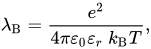
In standard units, the Bjerrum length is given by where is the elementary charge, is the relative dielectric constant of the medium and is the vacuum permittivity. For water at room temperature (), , so that .




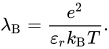
In Gaussian units, and the Bjerrum length has the simpler form

The relative permittivity εr of water decreases so strongly with temperature that the product (εr·T) decreases. Therefore, in spite of the (1/T) relation, the Bjerrum length λB increases with temperature, as shown in the graph above.
See also
[edit]References
[edit]- ↑ "Obituary: Professor Niels J. Bjerrum". Transactions of the Faraday Society. 55: X001. 1959. doi:10.1039/TF959550X001.
- ↑ Russel, William B.; Saville, D. A.; Schowalter, William R. (1989). Colloidal Dispersions. New York: Cambridge University Press.