


253 Mathilde

 Mathilde photographed by the NEAR Shoemaker spacecraft on 27 June 1997 | |
| Discovery[1][2] | |
|---|---|
| Discovered by | Johann Palisa |
| Discovery site | Vienna Obs. |
| Discovery date | 12 November 1885 |
| Designations | |
| Pronunciation | /məˈtɪldə/[citation needed] |
Named after | Mathilde Loewy |
| |
| main-belt (middle) | |
| Orbital characteristics[3] | |
| Epoch 9 June 2026 (JD 2461200.5) | |
| Uncertainty parameter 0 | |
| Aphelion | 3.347 AU |
| Perihelion | 1.947 AU |
| 2.647 AU | |
| Eccentricity | 0.2643 |
| 4.31 yr (1,573 d) | |
| 273.534° | |
| 0° 13m 43.948s / day | |
| Inclination | 6.740° |
| 179.494° | |
| 157.564° | |
| Known satellites | 0 |
| Proper orbital elements[4] | |
Proper semi-major axis | 2.648 AU |
Proper eccentricity | 0.219 |
Proper inclination | 6.54° |
Proper mean motion | 83.5361 deg / yr |
Proper orbital period | 4.30951 yr (1574.05 d) |
Precession of perihelion long. | 52.8 arcsec / yr |
Precession of asc. node | −63.3 arcsec / yr |
| Physical characteristics | |
| Dimensions | 66 km × 48 km × 46 km[5] |
| 52.8±2.6 km[5] | |
| Volume | 78000+12000 −11000 km3[5] |
| Mass | (1.033±0.044)×1017 kg[6][5] |
Mean density | 1.3±0.2 g/cm3[3][6] |
Equatorial surface gravity | 0.00989 m/s2 |
| 17.406 ± 0.010 d (417.74 ± 0.24 h)[3] | |
| 0.047±0.005[5] | |
| Temperature | ≈ 174[7] K |
| Cb[3] | |
| 10.35[3] | |
253 Mathilde is an asteroid in the intermediate asteroid belt, approximately 50 kilometers in diameter, that was discovered by Austrian astronomer Johann Palisa at Vienna Observatory on 12 November 1885. It has a relatively elliptical orbit that requires more than four years to circle the Sun. This tumbling asteroid has an unusually slow rate of rotation, requiring 17.4 days to complete a 360° revolution about its axis.[8] It is a primitive C-type asteroid, which means the surface has a high proportion of carbon; giving it a dark surface that reflects only 4% of the light that falls on it.[9]
Mathilde was visited by the NEAR Shoemaker spacecraft during June 1997, on its way to asteroid 433 Eros. During the short flyby, the spacecraft imaged a hemisphere of the asteroid, revealing many large craters that had gouged out depressions in the surface. It was the first carbonaceous asteroid to be explored and, until 21 Lutetia was visited in 2010, it was the largest asteroid to be visited by a spacecraft.
Observation history
[edit]In 1880, Johann Palisa, the director of the Austrian Naval Observatory (538), was offered a position as an assistant at the newly completed Vienna Observatory. Although the job represented a demotion for Johann, it gave him access to the new 27-inch (690 mm) refractor, the largest telescope in the world at that time. By this point Johann had already discovered 27 asteroids, and he would employ the Vienna 27-inch (690 mm) and 12-inch (300 mm) instruments to find an additional 94 asteroids before he retired.[10]
Among his discoveries was the asteroid 253 Mathilde, found on 12 November 1885. The initial orbital elements of the asteroid were then computed by V. A. Lebeuf, another Austrian astronomer working at the Paris Observatory.[11] The name of the asteroid was suggested by Lebeuf, after Mathilde, the wife of Moritz Loewy—who was the vice director of the observatory in Paris.[2][11]
In 1995, ground-based observations determined that Mathilde is a C-type asteroid. It was also found to have an unusually long period of rotation of 418 hours.[11]
Characteristics
[edit]
Mathilde is very dark, with an albedo comparable to fresh asphalt,[12] and is thought to share the same composition as CI1 or CM2 carbonaceous chondrite meteorites, with a surface dominated by phyllosilicate minerals.[13] The asteroid has a number of extremely large craters, with the individual craters being named for coal fields and basins around the world.[14] The two largest craters, Ishikari (29.3 km) and Karoo (33.4 km), are as wide as the asteroid's average radius.[5] The impacts appear to have spalled large volumes off the asteroid, as suggested by the angular edges of the craters.[9] Uniformity in brightness and colour were visible in the craters and there was no appearance of layering, so the asteroid's interior must be very homogeneous. There are indications of material movement along the downslope direction.[5] It has a very slow rotation, at 17.4 days, possibly due to the impacts which created the craters.[8]

The density measured by NEAR Shoemaker, 1,300 kg/m3, is less than half that of a typical carbonaceous chondrite; this may indicate that the asteroid is very loosely packed rubble pile.[6] The same is true of several C-type asteroids studied by ground-based telescopes equipped with adaptive optics systems (45 Eugenia, 90 Antiope, 87 Sylvia and 121 Hermione). Up to 50% of the interior volume of Mathilde consists of open space. However, the existence of a 20-km-long scarp may indicate that the asteroid does have some structural strength, so it could contain some large internal components.[15] The low interior density is an inefficient transmitter of impact shock through the asteroid, which also helps to preserve the surface features to a high degree.[5]
Mathilde's orbit is eccentric, taking it to the outer reaches of the belt. Nonetheless, the orbit lies entirely between the orbits of Mars and Jupiter; it does not cross the planetary orbits. It also has one of the slowest rotation periods of the known asteroids—most asteroids have a rotation period in the range of 2–24 hours.[16] Because of the slow rotation rate, NEAR Shoemaker was only able to photograph 60% of the asteroid's surface. The slow rate of rotation may be accounted for by a satellite orbiting the asteroid, but a search of the NEAR images revealed none larger than 10 km in diameter out to 20 times the radius of Mathilde.[17]

Exploration
[edit]On 27 June 1997, the NEAR Shoemaker spacecraft passed within 1,212 km of Mathilde while moving at a velocity of 9.93 km/s. This close approach allowed the spacecraft to capture over 500 images of the surface,[9] and provided data for more accurate determinations of the asteroid's dimensions and mass (based on gravitational perturbation of the spacecraft).[6] However, only one hemisphere of Mathilde was imaged during the fly-by.[15]
See also
[edit]References
[edit]- ↑ "(253) Mathilde = 1885 VA = 1915 TN = 1949 OL1". Minor Planet Center. Retrieved 23 July 2026.
- 1 2 Moore, Sir Patrick (1999). The Wandering Astronomer. CRC Press. pp. 59-61. ISBN 0-7503-0693-9. OL 6899638M.
- 1 2 3 4 5 "JPL Small-Body Database Lookup: 253 Mathilde (A885 VA)" (2026-04-14 last obs.). Jet Propulsion Laboratory. Retrieved 23 July 2026.
- ↑ "(253) Mathilde – Proper Elements". Asteroids Dynamic Site. Retrieved 23 July 2026. For more information about proper orbital elements, go to the "Proper Elements" tab and then click "[Help]" at the upper right corner.
- 1 2 3 4 5 6 7 8 J. Veverka; et al. (1999). "NEAR Encounter with Asteroid 253 Mathilde: Overview". Icarus. 140 (1): 3–16. Bibcode:1999Icar..140....3V. doi:10.1006/icar.1999.6120.
- 1 2 3 4 D. K. Yeomans; et al. (1997). "Estimating the mass of asteroid 253 Mathilde from tracking data during the NEAR flyby". Science. 278 (5346): 2106–9. Bibcode:1997Sci...278.2106Y. doi:10.1126/science.278.5346.2106. PMID 9405343.
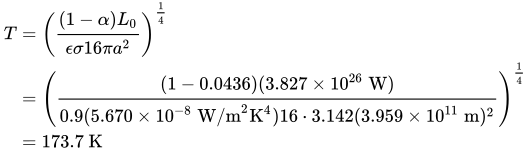
- ↑ For asteroid albedo α, semimajor axis a, solar luminosity , Stefan–Boltzmann constant σ and the asteroid's infrared emissivity ε (≈ 0.9), the approximate mean temperature T is given by: : See: Torrence V. Johnson; Paul R. Weissman; Lucy-Ann A. McFadden (2007). Encyclopedia of the Solar System. Elsevier. pp. 294. ISBN 978-0-12-088589-3.
- 1 2 "253 Mathilde". sprite.phys.ncku.edu.tw. Retrieved 8 August 2026.
- 1 2 3 Williams, David R. (18 December 2001). "NEAR Flyby of Asteroid 253 Mathilde". NASA. Archived from the original on 18 August 2006. Retrieved 10 August 2006.
- ↑ Raab, Herbert (2002). "Johann Palisa, the most successful visual discoverer of" (PDF). Astronomical Society of Linz. Archived from the original (PDF) on 28 September 2007. Retrieved 27 August 2007.
- 1 2 3 Savage, D.; Young, L.; Diller, G.; Toulouse, A. (February 1996). "Near Earth Asteroid Rendezvous (NEAR) Press Kit". NASA. Archived from the original on 19 March 2012. Retrieved 29 August 2007.
- ↑ Pon, Brian (30 June 1999). "Pavement Albedo". Heat Island Group. Archived from the original on 29 August 2007. Retrieved 27 August 2007.
- ↑ Kelley, M. S.; Gaffey, M. J.; Reddy, V. (12–16 March 2007). "Near-IR Spectroscopy and Possible Meteorite Analogs for Asteroid (253)". 38th Lunar and Planetary Science Conference. League City, Texas: Lunar & Planetary Institute. p. 2366. Bibcode:2007LPI....38.2366K.
- ↑ Blue, Jennifer (29 August 2007). "Categories for Naming Features on Planets and Satellites". USGS. Archived from the original on 24 August 2007. Retrieved 29 August 2007.
- 1 2 Cheng, Andrew F. (2004). "Implications of the NEAR mission for internal structure of Mathilde and Eros". Advances in Space Research. 33 (9): 1558–1563. Bibcode:2004AdSpR..33.1558C. doi:10.1016/S0273-1177(03)00452-6.
- ↑ Lang, Kenneth R. (2003). "2. Asteroids and meteorites, Size, color and spin". NASA's Cosmos. NASA. Retrieved 29 August 2007.
{{cite web}}: CS1 maint: deprecated archival service (link) - ↑ W. J. Merline; et al. (1998). "Search for Satellites of 253 Mathilde from Near-Earth Asteroid Rendezvous Flyby Data". Meteoritics & Planetary Science. 33 (S4): A105. Bibcode:1998M&PSA..33..105M. doi:10.1111/j.1945-5100.1998.tb01327.x.

External links
[edit]
- Hall, Alan (30 June 1997). "NEAR-ing Mathilde". Scientific American. Archived from the original on 26 September 2007. Retrieved 29 August 2007.
- Flyby gif parent page
- "NEAR Multispectral Imager (MSI) Data Archive (with Mathilde Images)". Asteroid/Dust Subnode Home. NASA Plantary Data System.
- "Derived 253 Mathilde Data". Asteroid/Dust Subnode Home. NASA Plantary Data System.
- "253 Mathilde". NASA. 3 November 2024.
- 253 Mathilde at AstDyS-2, Asteroids—Dynamic Site
- 253 Mathilde at the JPL Small-Body Database

