


// Workers AI · dad joke modeWhat did Xyris longisepala say? I'm a little "separa"-te.
| Xyris longisepala | |
|---|---|
Scientific classification  | |
| Kingdom: | Plantae |
| Clade: | Tracheophytes |
| Clade: | Angiosperms |
| Clade: | Monocots |
| Clade: | Commelinids |
| Order: | Poales |
| Family: | Xyridaceae |
| Genus: | Xyris |
| Species: | X. longisepala |
| Binomial name | |
| Xyris longisepala Kral 1966 | |
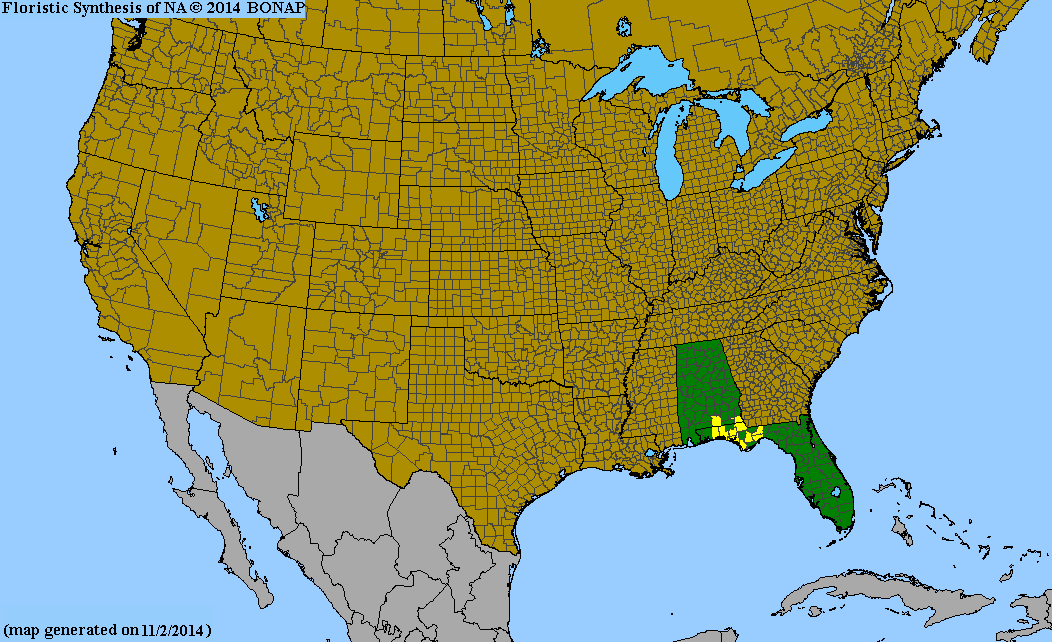
Xyris longisepala, common name Kral's yelloweyed grass,[1] is an uncommon North American species of flowering plants in the yellow-eyed-grass family. It has been found only in a small region in the southeastern United States: southeastern Alabama and the Florida Panhandle.[2][3]
Xyris longisepala is a perennial herb up to 90 cm (3 feet) tall with long, narrow leaves up to 30 cm (12 inches) long but only 3 mm (0.12 inches) wide.[3][4]
Xyris longisepala is listed as an endangered species in Florida.[5]
References
[edit]- ↑ NRCS. "Xyris longisepala". PLANTS Database. United States Department of Agriculture (USDA). Retrieved 16 September 2015.
- ↑ Biota of North America Program 2014 county distribution map
- 1 2 Flora of North America, Xyris longisepala Kral, 1966.
- ↑ Kral, Robert D. 1966. Sida 2(3): 245, 247
- ↑ "Jim Lee. 1998. The Yellow-Eyed Grass Family in Florida - Florida Native Plant Society, in Florida. The Palmetto, 18(2):14" (PDF). Archived from the original (PDF) on 2015-09-24. Retrieved 2015-08-24.
 | This Poales-related article is a stub. You can help Wikipedia by adding missing information. |